
Mobility enables participation in society. Yet not everyone can move through cities with the same freedom and ease. Doctoral researcher María José Zúñiga investigates how mobility systems and public spaces can be planned to be fairer, more inclusive, and more sustainable - and how people's diverse identities and life experiences shape their access to mobility.
In brief
- Doctoral candidate María José Zúñiga explores how mobility can become more equitable and inclusive.
- Her projects focus on intersectionality.
- She uses interviews, workshops, and surveys to support more citizen-centered urban development.
Display external content
At this point content of an external provider (source: www.xyz.de) is integrated. When displaying, data may be transferred to third parties or cookies may be stored, therefore your consent is required.
You can find more information and the possibility to revoke your consent at www.tum.de/datenschutz .
I agree
{ "@context": "https://schema.org", "@type": [ "VideoObject" ], "name": "Science Stories: Rethinking mobility through the lens of justice with Maru00eda Josu00e9 Zu00fau00f1iga", "url": "https://www.youtube.com/watch?v=G6-c7rGQoAE", "uploadDate": "2026-08-05T14:44:25+00:00", "dateCreated": "2026-08-05T14:44:25+00:00", "dateModified": "2026-08-05T14:44:25+00:00", "encodingFormat": "video/youtube", "thumbnailUrl": "https://img.youtube.com/vi/G6-c7rGQoAE/maxresdefault.jpg" }
María José Zúñiga is originally from Ecuador. She studied Architecture at the Universidad del Azuay in Cuenca, Ecuador's third-largest city. After gaining experience in the UN-Habitat in Africa, the United Nations program for human settlements and sustainable urban development, and completing a master's degree in the Netherlands, she moved to Munich in 2022. Since then, she has been working at the Chair of Urban Structure and Transport Planning , led by Prof. Gerhard Wulfhorst at the TUM School of Engineering and Design. In 2026, she began her doctoral studies as part of the TUM Mobility Justice Research Group .
Creating fairer cities through research
María José's interest in social justice grew out of her academic background and her experience in the municipal government of her hometown, Cuenca. "I want to understand how people move through cities and which spaces are accessible to them, depending on their diverse identities and experiences," she says. "For me, mobility is not just a technical issue. It connects social, economic, cultural, political, and environmental questions."
A key focus of her work is the concept of intersectionality. Different social categories-such as gender, ethnicity, age, socioeconomic status, migration experience, or disability-intersect with systems of power to shape the extent to which people experience disadvantage or privilege. During her literature review, María José found that intersectionality has received little attention in mobility research and practice. In her doctoral project, she applies this concept to mobility systems to uncover hidden inequities.
Her research explores questions such as: Who feels and is excluded from using mobility and public spaces freely? And which social groups are often overlooked in urban and mobility planning processes?
 María José Zúñiga
 Focusing on those most affected by exclusion
María José's research focuses on social groups vulnerable to exclusion, including intersectional identities of women, migrants, people with disabilities, and children. Her goal is to make structural inequities visible and to develop concepts for more just mobility systems.
"If we understand the mobility needs of the people who face the greatest disadvantages in their everyday lives, we can create solutions that benefit many others as well," says María José. "For me, mobility justice means making power structures visible and aligning planning processes more closely with the realities of people's everyday lives."
Working together with citizens
As part of her research, María José conducts interviews with people affected by mobility barriers. She is also involved in the Inclusive Spaces Project, which focuses on inclusive design for people with disabilities as well as the monitoring and evaluation of urban spaces. Her work examines how disability interacts with other social factors and why these intersections can intensify inequity. Additional research activities include analysis of surveys and implementing awareness workshops with citizens and members of marginalized communities.
These projects are carried out in living labs in German cities, as well as in locations across Europe. One important insight has already emerged: while many municipalities share similar goals, they operate under very different conditions. Mobility cultures, resources, transport systems, political processes, and public priorities can vary considerably.
"At TUM, I can combine my passion for justice with academic research," says María José. "That was not part of my original plan, but today I see it as a great opportunity to contribute to more inclusive and sustainable cities. Urban and mobility spaces should be accessible, safe, free, and enjoyable places for everyone."
For María José, sustainable mobility means more than climate-friendly modes of transport. It is also about how cities are planned, whose knowledge counts, who gets a say in decision-making, and what forms of participation are possible in everyday life.
Mobility
Mobility is key to combating climate change. Find out how we are developing new interdisciplinary models for digitally connected, sustainable mobility.
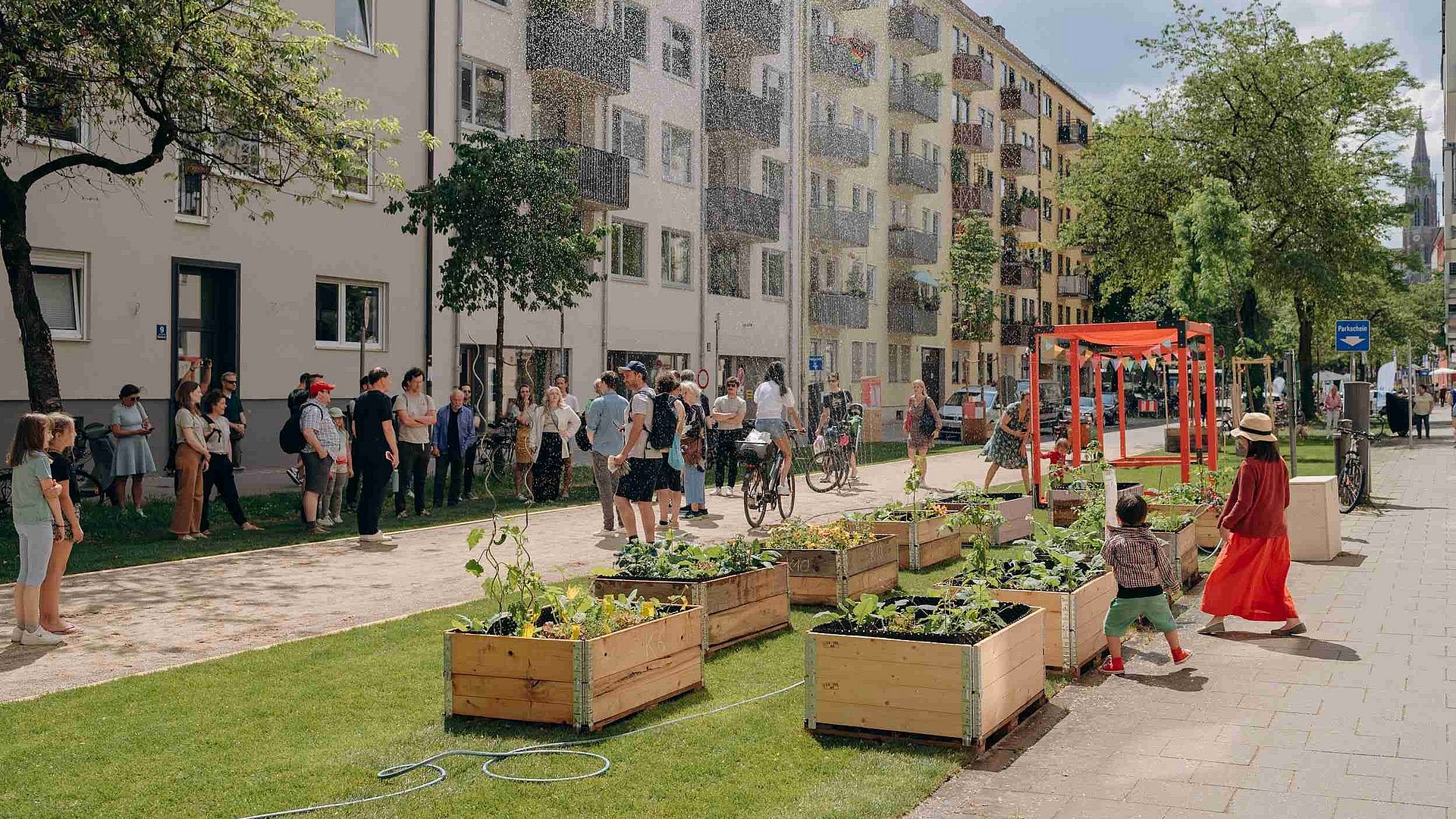 MCube / Viktoriya Zayika
  Astrid Eckert / TUM
  Astrid Eckert / TUM
  Astrid Eckert / TUM
  Astrid Eckert / TUM
  Astrid Eckert / TUM Astrid Eckert / TUM


