
Final-year students in RMIT's Digital Media Major Project course are collaborating with RMIT's Centre of Digital Ecosystems (CODE) to develop large-scale interactive works using CODE's spatial interaction framework.
The brief to students was to create an experimental interactive installation using a system developed by CODE: a combination of projection and projection mapping, the ZED camera vision system as body tracking, and game engines as processing, world building, and interaction mechanics.
Crucially, the brief required interactive installations that could transition 'awkward encounters into beautiful moments', where strangers could negotiate space, proximity, timing, and intention together.
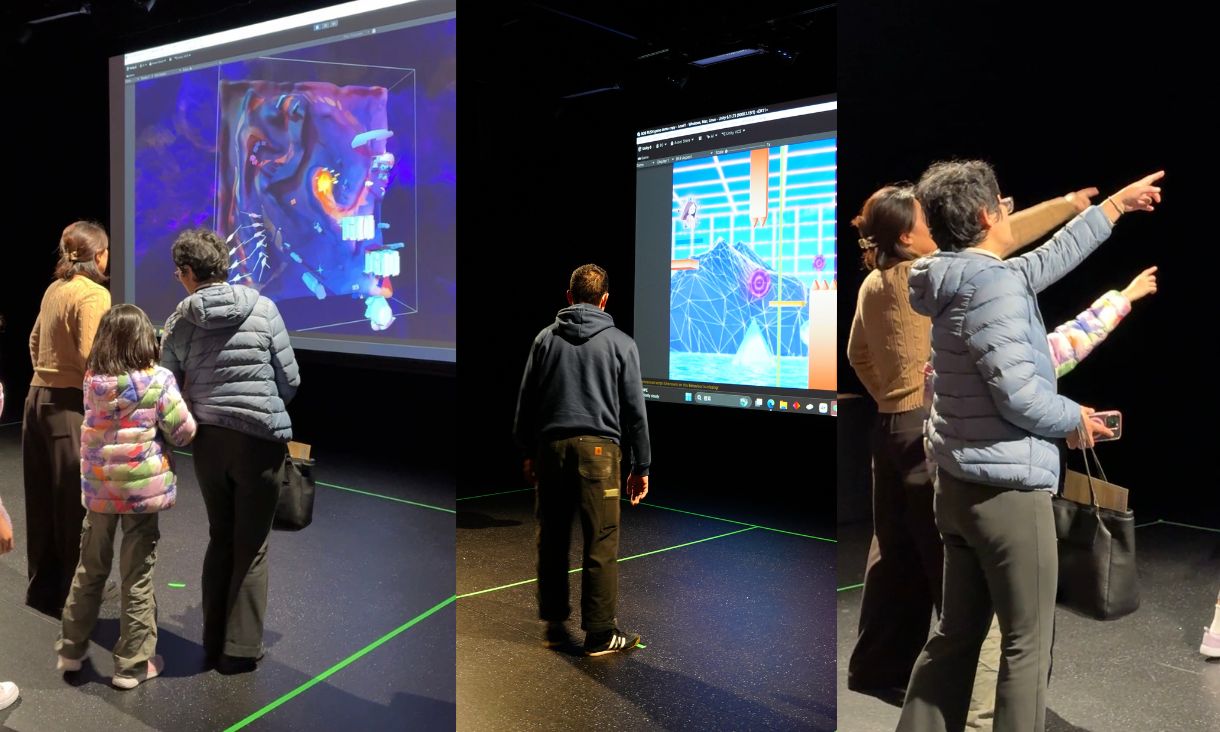
Brandon Sun was part of the team that created Bob Rush, a cooperative platformer where the players must escort a princess through five levels to find her beloved cat, Bob. He said the process of creating Bob Rush involved continuous iteration, feedback and testing.
"This process gave us valuable feedback and guided the direction of the game to respond to the brief," he said. "More importantly, it made the game more collaborative and fun that challenged us to think both conceptually and technically."
"This pushed us internally to collaborate as well in bringing our specialisation and creative approaches together."
The projects were developed through a large-scale interactive installation format designed to support collective audience participation, challenging them to consider not only screen-based interaction, but also embodied participation, spatial choreography, audience behaviour, and the logistics of presenting digital media work in public settings.
Mai Anh Vo was part of the team that created Sunbound, an interactive puzzle installation that balances its miniature world under the weight of players. She said the project as inspired by 1940s marble labyrinths, while adding a real-world weighting factor that makes every physical movement of each player matter in the interactive world.
"With a motion-capture camera, movement of visitors becomes movement of carved stone statues sliding atop the encased world, their weights physically tipping it," she said.
"The installation can be seamlessly played in public spaces without a set team or wait time, and intuitive physics design is to be accessible for most demographics."
The students faced many challenges through the design and implementation process, including negotiating new technology, collaborating with their groups, interacting with different audiences and problem-solving on the run.
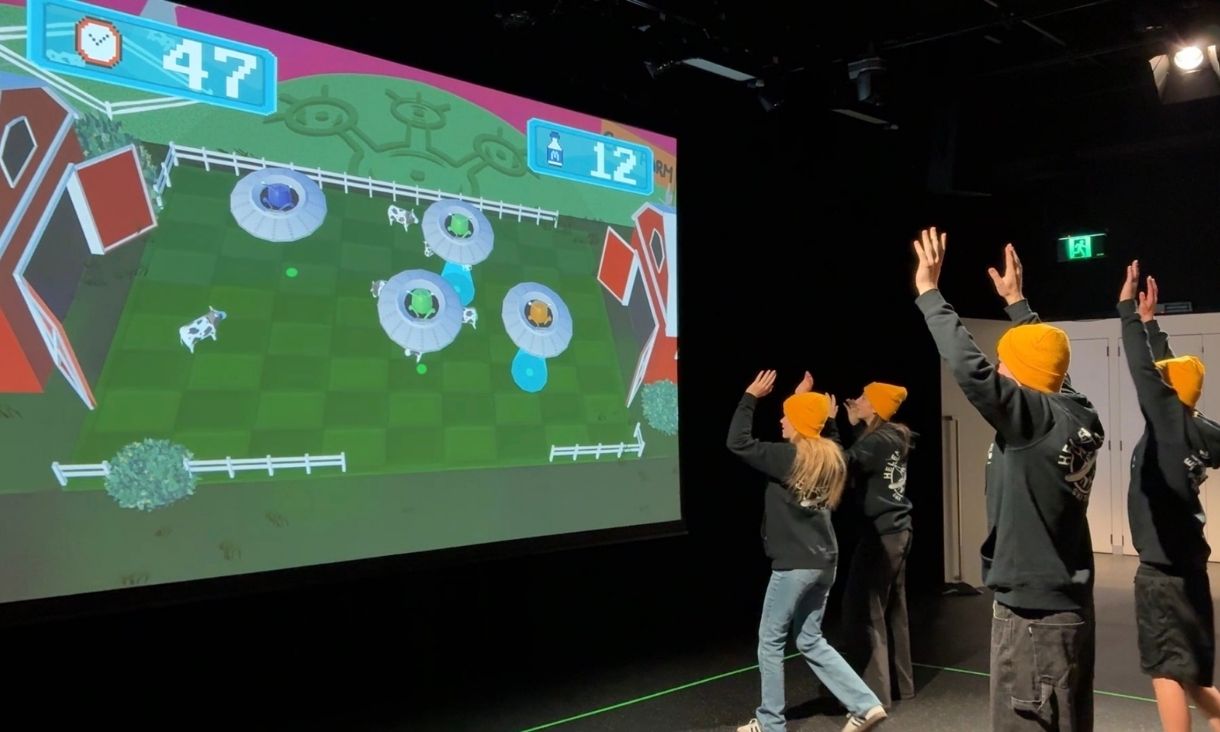
Dee Fisher was part of the group that made Cownapping: The Game! - a fast-paced, motion-tracking game where two or more players control individual UFOs with their movement in an active space, in order to abduct as many cows as possible in under a minute.
She said one of the major challenges her group faced was setting up and connecting the ZED camera software with her project software.
"Many hours were put into making sure the camera that picked up the movement of the players would move the UFOs as accurately as possible," she said.
"While the technical complexity presented a steep learning opportunity, the key outcome was effectively designing for fun. This was evidenced by the engagement of visitors to the ACMI Audience Lab, from young to old."
Collaborating with the experts at CODE
A key feature of the collaboration was access to CODE's expertise in interactive systems, game engines, spatial design, audiovisual production, and technical art.
Students engaged with CODE team members through studio visits, technical support sessions, and feedback exchanges, allowing them to refine both the conceptual and technical dimensions of their projects.
Professor Deb Polson, Director CODE, said the Centre was impressed with the student response to the brief.
"Beyond developing compelling concepts, students were challenged to think as installation designers: balancing interaction design, technical systems, spatial choreography and public experience within the constraints of a complex immersive platform."
"Even with a very specific brief and format, the student groups designed and delivered wildly diverse ideas that the ACMI public delighted at."
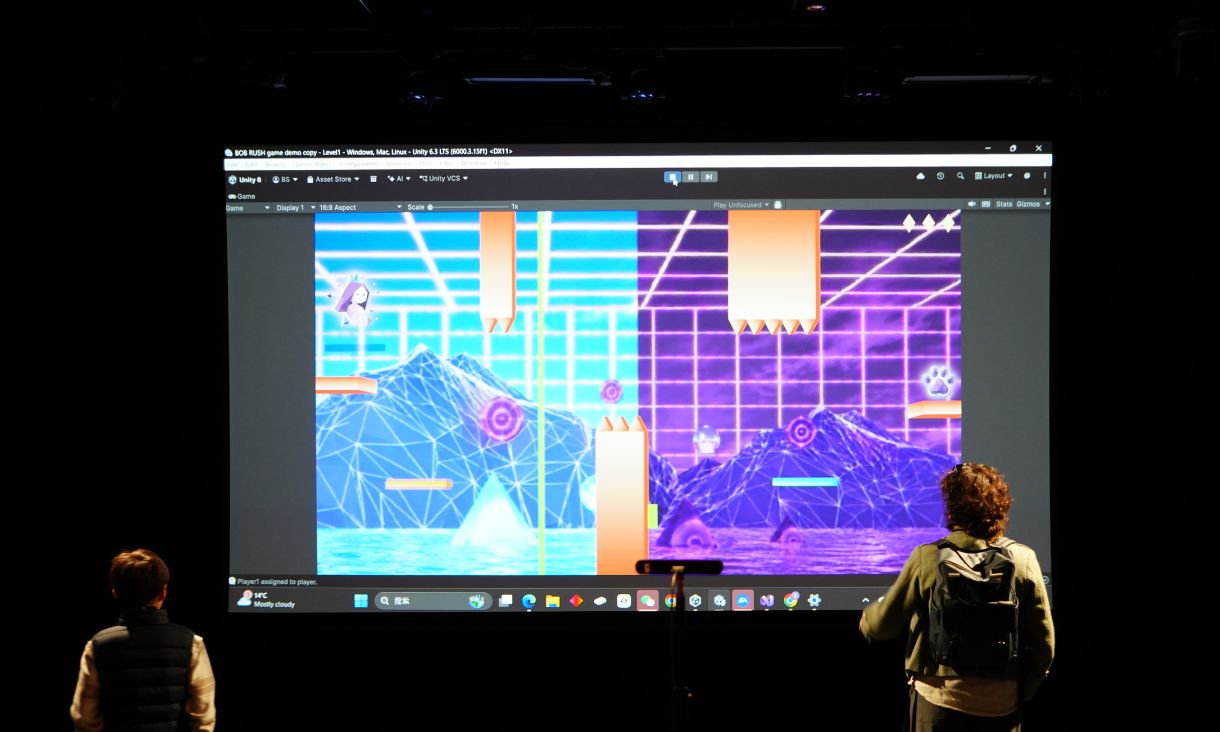
Polson said the designs fulfilled the brief of installations that could transition awkward encounters into beautiful moments.
"We witnessed several family groups playing these student games together - going from tentatively standing still, to loudly shouting instructions to each other - squealing and laughing in delight and celebrating their cooperative achievements with group high fives and air punches," she said.
"Very few public projects result in this kind of joyful physical exhaustion that we witnessed. It was truly remarkable!"
Brandon said CODE gave his group support and valuable feedback, including helping to figure out the game architecture and implementing AI-assisted coding.
"We gathered many valuable pieces of feedback from CODE, that pointed out issues that we might not have spotted ourselves," he said.
"I've learned the importance of continuous iteration, testing, and feedback in supporting a project's growth and expansion."
Testing on real audiences
One of the important elements of the project was the possibility for students to test their final projects through the ACMI + RMIT Audience Lab.
The Audience Lab a public-facing program that supports creators to present works-in-development at ACMI and gather real-time audience feedback. For students, this creates a unique opportunity to take a major project beyond the classroom and into a professional public testing environment.
The Lab also aligns closely with the aims of the Major Project course: to support students in developing ambitious digital media works through structured production, collaboration, testing, documentation, and professional presentation.
Mai Anh said it was amazing to showcase her project at such a recognisable Australian institution.
"It felt like my biggest honour, both with how much I've loved the museum personally, and how much it is recognised in Australia," she said.


