
With AI, it's now possible for researchers to predict the three-dimensional structures of proteins directly from their amino-acid sequences.
But what biologists really want to predict, says Columbia biophysicist Hashim Al-Hashimi, is how RNA and DNA-encoded molecules behave inside their natural cellular environments.
"Sometimes people forget that the point of solving structures is to understand function," says Al-Hashimi, the Roy and Diana Vagelos Professor of Biochemistry and Molecular Biophysics. "What we really want to predict is activity-how effectively a molecule performs its biological job inside the cell. Today's AI models cannot do that."
New research from Al-Hashimi's lab now shows such predictions can be made from biophysical principles for at least one type of molecule: the coterie of small RNAs that regulate gene activity inside the cell.
The ability to predict an RNAs activity could unlock new types of drugs, solve current mysteries surrounding genetic diseases, and improve in silico modeling of cells.
Prediction depends on ensembles
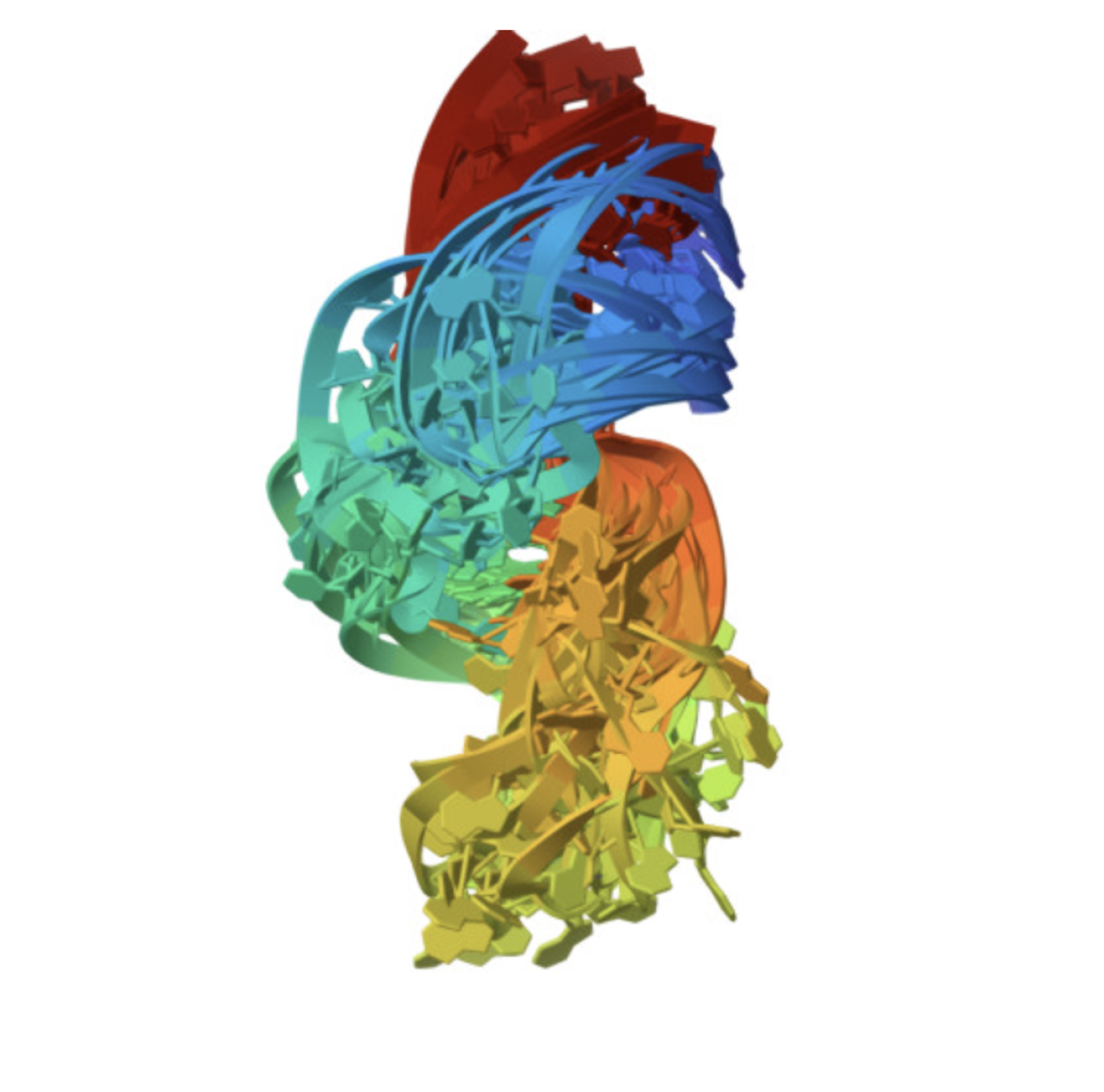
The TAR RNA molecule in several of its conformation. Image from RCSB PDB.
A key step in predicting the activity of an RNA, the new research found, is understanding how sequence changes the ensemble of structures that an RNA can adopt.
Most RNA molecules are notoriously flexible: "They can't stay still. Each one can adopt different shapes, sampling a variety of structures over a period of time," Al-Hashimi says.
Some of these structures are more stable than others and dominate the ensemble. Others are a flash in the pan-lasting just picoseconds-but may be the most biologically active.
Predicting an RNA's cellular activity from its sequence, then, must take the RNA's ensemble into account.
Accuracy from biophysics, not AI
To develop a predictive model, the Al-Hashimi lab first experimentally determined the ensemble of TAR, an HIV RNA, and the ensembles of TAR with single point mutations at most of its 27 nucleotides. They also measured the activity of these 27 different TARs. (TAR binds an HIV protein to initiate viral replication inside infected cells).
The team found that the RNA's activity could be predicted from its sequence with existing biophysical models that are normally used to predict an RNA's secondary structure. With these approaches, the team computed the biological activity of 1000s of different TAR sequences directly from their sequence. "This [work] shows us that molecules must also evolve their sequences to ensure they have the right balance of different conformational states."
Altogether their results revealed why several residues of TAR are highly conserved through the new concept of ensemble conservation. "Most mutations in TAR are rejected because they dramatically change its activity by altering its ensemble, not its contacts with other molecules," Al-Hashimi says. "This shows us that molecules must also evolve their sequences to ensure they have the right balance of different conformational states."
The same predictive model worked for another HIV RNA, called RRE, and should work for similar RNAs from any organism, Al-Hashimi says. The team's next goal is to optimize these models for larger complex RNAs, and make them more accurate when predicting activity inside a cell.
New drugs and new understanding
Many diseases are regulated by RNAs like TAR that can adopt different conformations.
"There are many examples of genetic disorders that are linked to single nucleotide polymorphisms in non-coding RNAs like TAR," Al-Hashimi says. "Now, with the ability to predict how certain mutations shift an ensemble and others don't, we can begin to build mechanistic models of what's going on with these genetic disorders."
The models may also speed the development of new types of drugs that shift RNA ensembles to alter activity in the cell or interfere with the ensemble's most active members.
"Drugs are now largely developed with a lock-and-key mechanism in mind," Hashimi says. "If we think about ensembles, we have a real opportunity to expand our capabilities and potentially create even more powerful drugs," Al-Hashimi says.


