
Do actions in the virtual world stay in the virtual world? A new performance directed by postdoctoral fellow Dr. Zach McKendrick explores dark themes relevant to today's rapidly advancing digital technologies.
"If we do this well, the audience isn't just watching a story about immersive technology. They're experiencing what it's like to navigate overlapping realities and recognizing that choices made in virtual spaces still belong to us, long after they take off the headset," says McKendrick.
Two disciplines, one unique vision
Over two years as a Provost's Interdisciplinary Postdoctoral Scholar, McKendrick has had a foot firmly planted in the faculties of Mathematics and Arts working with Drs. Daniel Vogel and Craig Kaplan in computer science and Dr. Andy Houston in theatre and performance. His work focuses on immersive digital technologies and theatre and performance practice.
As an actor, director and researcher in human-computer interaction (HCI), including work in social robotics and drones, McKendrick is uniquely qualified for this dual and interconnected focus. His postdoc research explores how immersive technologies - virtual reality (VR), augmented reality, and extended reality-support theatre and performance for actors, directors, and audiences, and, how these practices help create what he calls a wholistic virtual experience.
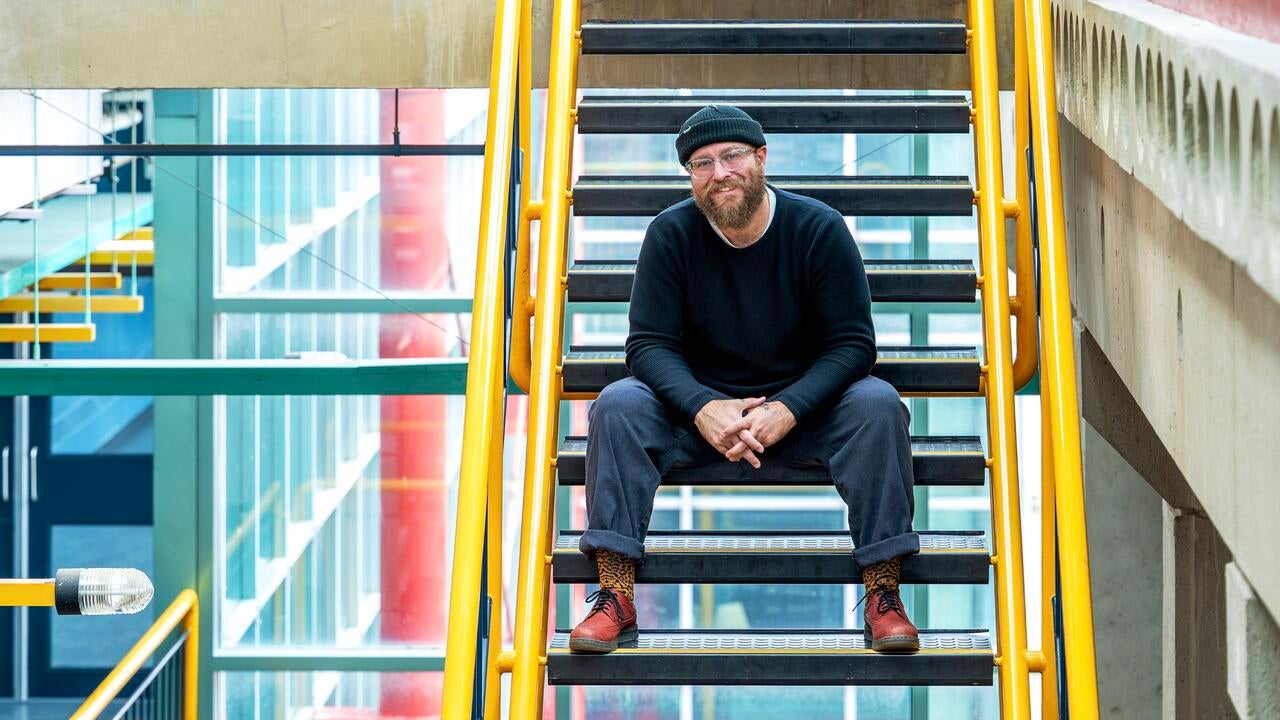
Now McKendrick is wrapping-up his work in the HCI lab and the Theatre of the Arts, with The Nether, which opens on March 25.
"I always intended to culminate my postdoc research with a creative work. The Nether felt like the right choice for Waterloo-especially given its ethical questions around government oversight, digital privacy, morality in virtual spaces, and self-representation. These themes connect directly to my research on avatars, embodiment, and virtual identity."
Technology and performance come together
Described as a crime drama and haunting sci-fi thriller, The Nether is about a young detective who uncovers a disturbing form of entertainment, triggering an interrogation into a VR world where people go to escape, to perform, to indulge, and to do harm. "At its core, the play asks a deceptively simple but deeply unsettling question: If something happens in virtual reality, does it still count as real harm?" says McKendrick.
Written by American playwright Jennifer Haley in 2014 - well ahead of its time, McKendrick points out - The Nether was intended for traditional staging with the online scenes represented through costume and set changes. "But we're doing something different by translating those scenes into actual VR, which wasn't technologically feasible when the play premiered."
Waterloo's Theatre and Performance program has produced numerous shows that integrate sophisticated digital technologies, but The Nether is groundbreaking as a layered, immersive hybrid performance where half the action happens in a virtual world.
How is this hybrid show experienced by the live audience? McKendrick says they will see actors playing their characters on stage as well as enacting their VR avatar whose virtual world is projected on a large screen. "The VR world we're depicting intentionally avoids photo realism to clearly differentiate virtual from real. So audiences will see VR stylized environments within which the actors' avatars perform, while the physical actors remain visible as they move safely within 'shadow boxes' onstage."
Innovative audience engagement
But that's not all for groundbreaking: a limited audience can attend virtually via their own VR devices or desktop through VRChat. "They'll be able to move within the virtual world as flies on the wall," says McKendrick, "and when the action returns to the physical interrogation room, three cameras provide a live feed into their VR view."
In addition, each performance will be followed by one-hour symposium for which audiences are encouraged to stay. These include a talk with the playwright and discussions with researchers from across Waterloo on themes such as digital creativity and digital governance.
This immersive version of The Nether is not an easy endeavour - in fact it's highly challenging and complex both technically and socially. On the technical side, there are many collaborators working and troubleshooting alongside McKendrick. Resourcing costly VR gear was among the challenges, but the team was able to access enough Meta Quest 3 headsets, "the latest in wearable VR," thanks to a generous loan by Dr. Cosmin Munteanu's TAG Lab in Systems Design Engineering.
On the social side, the play comes with a clear content advisory and rationale for why this show now. Audiences are encouraged to read the production website which functions as both a dramaturgically enriched program and an educational resource.
"Theatre is meant to be a safe space to explore dangerous things, and I believe this play is a great example of that philosophy," says McKendrick.
The Nether runs March 25-28 in Theatre of the Arts. Visit The Nether website


