
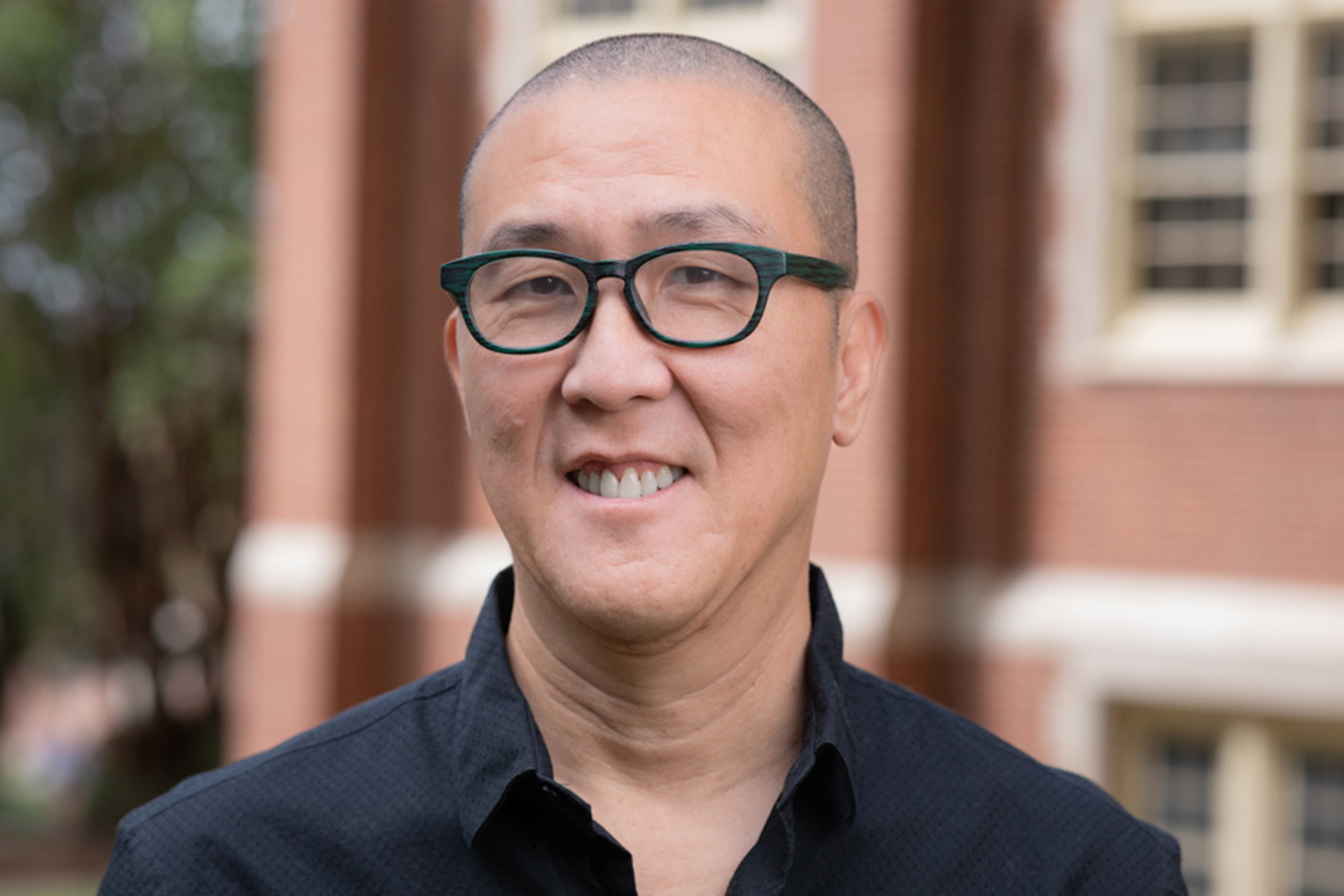
A Florida State University religious studies scholar has earned a competitive grant from one of the country's leading humanities research organizations to support the translation of two pivotal texts into English and shed light on ancient Buddhist practices and traditions.
Jimmy Yu, the Sheng Yen Professor of Chinese Buddhism in FSU's Department of Religion, has earned the Robert H. N. Ho Family Foundation Public Impact Grant in Buddhist Studies from the American Council of Learned Societies, a non-profit organization supporting humanities and social science scholars.
The $50,000 grant will support two directions of Yu's project, "Interdependence: Bridging Chinese Huayan Buddhism and Western Buddhist Practice." First, the grant includes the translation of two pivotal Huayan Buddhist texts, "Contemplation on the Extinction of Delusion and the Cultivation of the Source of Profound Implications in the Flower Garland" and "Commentary on the Contemplations on the Flower Garland Dharmadhātu." Second, the grant subsidizes Yu to take a one-year sabbatical to lead retreats and workshops around the country based on the translations.
"Winning this grant came with great excitement and pride," Yu said. "Now that these texts are translated, people can engage with their teachings, connect them to their own fields of study and apply them to everyday life. I hope it sparks interest in secular, religious and academic fields."
ACLS was founded in 1919 following the end of World War I to rebuild international scholarly collaboration. Today, its mission is to advance knowledge that improves human experience by supporting those researching human endeavors of the past, present and future. This includes the grants in Buddhist studies, which support projects that make the knowledge of Buddhism more accessible and improve the public's understanding of Buddhist art, texts and traditions.
"Religious studies scholars like Jimmy remind us that the arena of our research is the world outside of our offices and libraries."
- Martin Kavka, chair of FSU's Department of Religion
Yu studies Chinese Buddhism from historical, textual and anthropological perspectives, with a particular interest in how it was practiced in everyday life. Analyzing ancient texts written in classical Chinese, he examines both lived religious traditions and philosophical beliefs from Huayan Buddhist texts. Some of his specific research areas include Chinese Buddhist history from the years 1100 to 1800, bodily rituals and Chan and Zen studies - a major part of which is meditation.
"The grant has given me time to bridge the academic study and the practice of Buddhism together by using my text translations and annotations to design hybrid meditation retreats," Yu said. "The retreats, scheduled for this year and next, are aimed at English-speaking Buddhists who wouldn't normally be able to read classical Chinese texts and are seeking greater access to ancient Huayan teachings."
Huayan Buddhism is a school within Chinese Buddhism that developed during the Tang dynasty from 618 to 907 C.E. It centers around the interconnectedness of all things, borrowing from its core phrase, "One is all, all is one." For this project, Yu is translating Huayan texts from classical Chinese into English and using them as the foundation for avenues like public lectures known as Dharma talks, mainstream Buddhist journal articles and digital media productions.
The hybrid meditation retreats resulting from these translations will be held at the Barre Center for Buddhist Studies in Barre, Massachusetts, later this year; the San Francisco Zen Center in San Francisco in 2027; Great Vow Monastery, Oregon, in 2027; and the Tallahassee Chan Center in Tallahassee in 2027.
"Religious studies scholars like Jimmy remind us that the arena of our research is the world outside of our offices and libraries," said Martin Kavka, chair of FSU's Department of Religion. "The retreats he is planning and the various publications that will stem from his work will give Buddhist practitioners in the U.S. a greater self-knowledge about the stakes of their own practices and address a deep lack in Westerners' understanding of Buddhism."
Yu earned his doctorate in Buddhist studies from Princeton University in New Jersey in 2008 and joined FSU's faculty that same year. At FSU, he teaches both graduate and undergraduate courses in Chinese and Japanese religious traditions.
Outside the classroom, Yu is an editor for the Journal of Chinese Buddhist Studies and the Sheng Yen Series in Chinese Buddhism through Columbia University Press. He's also the founder of the Tallahassee Chan Center, a nonprofit meditation sanctuary that hosts meditation sessions and retreats and has authored six books centered on Chinese and Chan Buddhism.
To learn more about research conducted in FSU's Department of Religion, visit the department's website.


