
The University Scholar Program supports high-achieving undergraduates as they pursue sustained, faculty-mentored research projects that often span multiple years
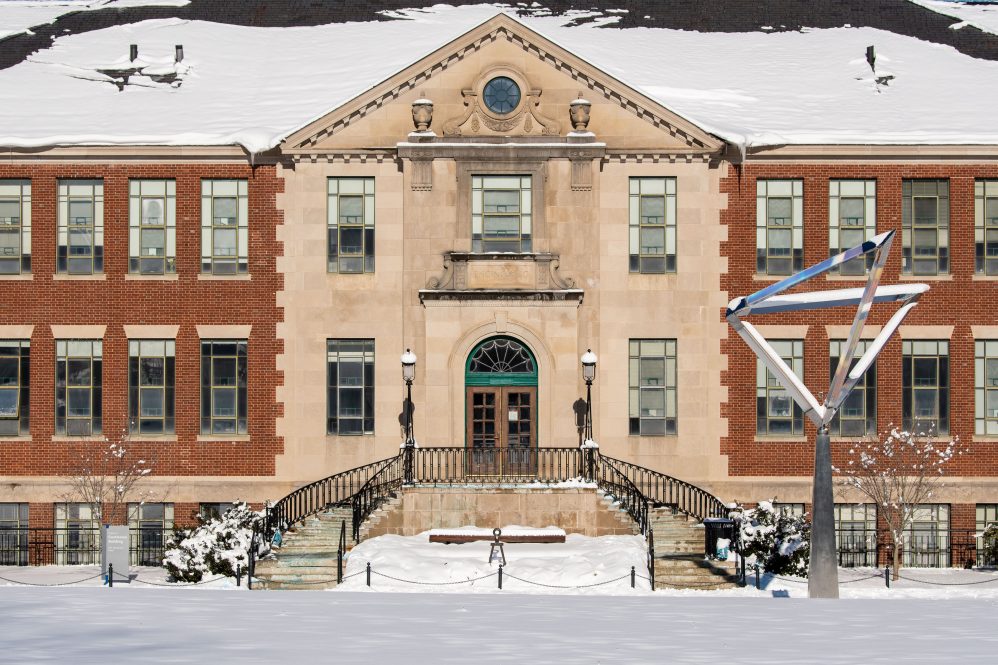
Five University Scholars from the UConn College of Engineering are exploring intense research projects while earning their undergraduate degrees.
Two University of Connecticut students are leveraging the University Scholar Program to pursue ambitious, interdisciplinary research projects that address pressing environmental and energy challenges-from microplastic pollution in soil ecosystems to artificial intelligence-driven inspection of solar infrastructure.
The University Scholar Program allows students to design an in-depth research project and to craft a learning plan that supports their academic goals during their final three semesters. Each student is mentored by an advisory committee of three faculty.
Admission to the University Scholars Program is based on an application submitted during the first semester of a student's junior year. Applications are reviewed by an interdisciplinary committee of faculty members who may select up to 30 university scholars in any given year.
Investigating Microplastics at the Microbial Level

Mehr Chhatre '26 (ENG), a chemical engineering major from Hamden, Connecticut, is conducting in-depth research on how microplastic pollution affects organisms critical to soil health and nutrient cycling. Working in the Shor Research Lab, Chhatre's project examines how exposure to contaminated versus uncontaminated microplastics affects protist motility and abundance, offering new insight into the downstream ecological impacts of plastic pollution.
Supported by the National Science Foundation's Emerging Frontiers in Research program, Chhatre has been involved in this work since her first year at UConn. Her university scholar project builds directly on that foundation, allowing her to deepen the experimental design and data analysis behind the research.
"This project lets me ask more complex questions about how engineered materials interact with biological systems," Chhatre said. "The University Scholar Program gave me the structure and support to take a long-term research idea and turn it into a rigorous, independent study."
In addition to the physical lab work on the impacts of microplastics and contaminants, Chhatre's project also aims to understand plastic and pollutant regulation, through exploring current scientific policy. Chhatre is analyzing how her research can fit into that landscape.
Chhatre has presented her findings at national and regional conferences, including the AIChE Student Conference and the Emerging Researchers National Conference, earning third place in the AIChE Undergraduate Poster Competition's Environmental Division. Beyond the lab, she serves as president of UConn's iGEM synthetic biology team, a diversity, equity, and inclusion leader within the Society of Women Engineers, and a peer mentor in the Honors Program.
She has also completed chemical engineering internships at Eastman Chemical Company and Pfizer, where she applied data analysis, process optimization, and digital manufacturing tools to real-world production challenges.
Using AI and Drones to Improve Solar Infrastructure

Nicholas Bailey '26 (BUS, ENG, CLAS), a dual-degree student in Management and Engineering for Manufacturing and Applied Mathematics, is applying artificial intelligence and drone technology to improve the efficiency and reliability of solar panel installations.
As a university scholar, Bailey is developing a drone-based inspection pipeline that combines visual and thermal data with foundation machine learning models to detect defects in solar panels. His research integrates physics-informed modeling with machine learning to quantify performance degradation and assess the return on investment for UAV-based inspections at small- and medium-sized manufacturing sites.
"My goal is to bridge advanced AI techniques with practical decision-making," Bailey said. "I wanted to figure out where the problems are and which ones actually matter for the bottom line."
Bailey's work builds on his experience with the Southern New England Industrial Training and Assessment Center through UConn, where he leads energy efficiency assessments for manufacturing facilities and translates technical findings into business-focused recommendations for industry clients. His research has been presented at the IEEE MIT Undergraduate Research Technology Conference, and he has received multiple fellowships supporting clean energy and sustainability research.
In addition to his research, Bailey is deeply involved in teaching and mentorship, serving as an undergraduate teaching assistant in accounting and artificial intelligence courses and mentoring other students in applied data analysis and engineering economics.
Advancing Research Through the University Scholar Program
The University Scholar Program supports high-achieving undergraduates as they pursue sustained, faculty-mentored research projects that often span multiple years. Five UConn College of Engineering students were chosen in the 2025 year. Chinmaya Vobbineni '26, Wyeth Haddock '26, and Zhengyang Wei '26 were also selected this year.


