WMO's Global Seasonal Climate Update provides temperature and rainfall predictions for October-December
Geneva, Switzerland (WMO) - Sea-surface temperatures in the central and eastern tropical Pacific are forecast to increase to record levels during October-November-December 2026, reflecting the strengthening of the El Niño event which will drive weather patterns and impact economies, ecosystems and communities across the globe.
The monthly Global Seasonal Climate Update from the World Meteorological Organization (WMO) says that El Niño will continue to intensify ahead of its forecast peak in December. It is likely to bring above-average temperatures to much of the globe and shift rainfall patterns, increasing the risk of drought and floods in different regions.
The Global Seasonal Climate Update provides authoritative information about large-scale climate drivers. These include the El Niño-Southern Oscillation (ENSO), the Indian Ocean Dipole (IOD) and tropical Atlantic sea-surface temperatures which all impact seasonal temperature and rainfall. It complements WMO's El Niño/La Niña Update , which is issued quarterly.
"El Niño is firmly established and strengthening rapidly. WMO forecasts indicate a near-100 per cent likelihood that it will persist through February 2027, potentially being one of the strongest since at least 1950," said WMO Secretary-General Celeste Saulo.
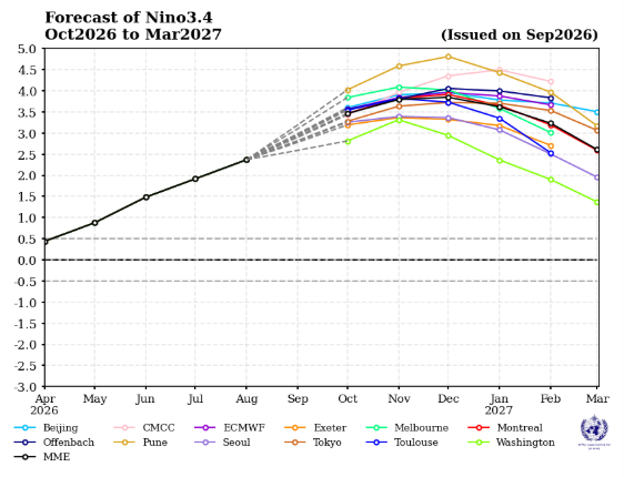
That near-certainty figure isn't one model. It's a consensus across thirteen national and international centres - from Washington to Tokyo to London to Pune - built on real-time exchange of ocean buoy, satellite and radiosonde data coordinated by WMO.
"El Niño doesn't add new heat to the planet. It releases heat the ocean has already been storing beneath the surface - which is why a strong event so often becomes one of the hottest years measured (as with 2024)," Celeste Saulo told the Global Heat Forum in Bangkok. "The ocean it's drawing from is the warmest we've ever measured it. There is simply more heat available to release," she said.
Sea-surface temperature anomalies across the central-eastern equatorial Pacific, the region at the heart of El Niño, is measured by the widely used Niño 3.4 index. This increased markedly from an average +1.6 °C above normal in June 2026 to +2.5 °C above normal in August.
For October-November-December, the seasonal average Niño 3.4 sea surface temperature anomaly is forecast to reach approximately +3.7°C, peaking around December. This is the highest since observations began and is stronger than the previous record of + 2.6 °C in November 2015-January 2016.
Other ocean basins are also contributing to the seasonal outlook. A positive Indian Ocean Dipole, a climate pattern that can strongly influence rainfall around the Indian Ocean, is expected to peak in October and then decline. The October-December seasonal anomaly is forecast at about +0.5°C.
Meanwhile, sea surface temperatures in the equatorial Atlantic basin are forecast to remain above normal, according to the Global Seasonal Climate Update.