
New study links climate stress to the disappearance of early human species Homo floresiensis, the 'hobbits' of Flores
A team of international scientists has uncovered compelling new evidence that severe drought, caused by a changing climate, sparked one of the great mysteries in human evolution: why did the 'hobbits' of Flores vanish? The study, published yesterday (Monday 8 December) in Communications Earth & Environment, reveals the Homo floresiensis, and one of its main prey, the Stegodon florensis insularis, both of which once lived on the eastern Indonesian island of Flores, abandoned the Liang Bua cave during a prolonged period of aridity that lasted for thousands of years.
University of Wollongong (UOW) scientists were among the team from Australia and Indonesia who led the research, which combined precise chemical records from cave stalagmites with isotopic data from fossil teeth of the Stegodon, a species of pygmy elephant. The results reveal an extensive drying trend beginning around 76,000 years ago, culminating in severe summer drought between 61,000 and 55,000 years ago.

It is the first time scientists have reconstructed a season-specific rainfall record for the critical period leading up to the disappearance of Homo floresiensis, showing how progressive drought and competition for resources may have driven their departure from Liang Bua and, ultimately, their extinction.
"Our results show that the ecosystem around Liang Bua became dramatically drier just around the time that Homo floresiensis vanished," said Dr Mike Gagan, Honorary Professor at UOW. "Summer rainfall fell to about half of modern levels and river-bed water sources became seasonally dry, placing ecological stress on both hobbits and their prey."
The discovery builds on decades of groundbreaking research from UOW into Homo floresiensis, the remains of which were first uncovered in 2003 in Liang Bua cave. The fossil type specimen was dubbed the 'Hobbit' due to its tiny stature and radically challenged the prevailing theories of human evolution and dispersal across the globe. Homo floresiensis disappears from the fossil record around 50,000 years ago. However, the fate of the Hobbits, and why they disappeared from Flores, has remained an enigma.

To reconstruct past climate variability, the team turned to stalagmites, which act as a natural archive of rainfall, from deep within Liang Luar cave, just a few hundred metres from Liang Bua. Using measurements of magnesium-to-calcium ratios and oxygen isotopes, the team reconstructed both summer and winter rainfall, and how it changed through time. At the same time, oxygen-isotope measurements of fossil tooth enamel show that Stegodon relied on nearby river-bed, low-flow water sources.
The fossil record reveals a steep decline in the population of Stegodon around 61,000 years ago, signalling a terminal decline in Liang Bua's largest herbivore population, and an important food source for the hobbits.
"The synchronous declines in surface freshwater, Stegodon and Homo floresiensis after 61,000 years ago mark the compounding effects of ecological stress," said Dr Gert van den Berg, Honorary Fellow at UOW's School of Science. "Competition for dwindling water and food probably forced the hobbits to abandon Liang Bua altogether."
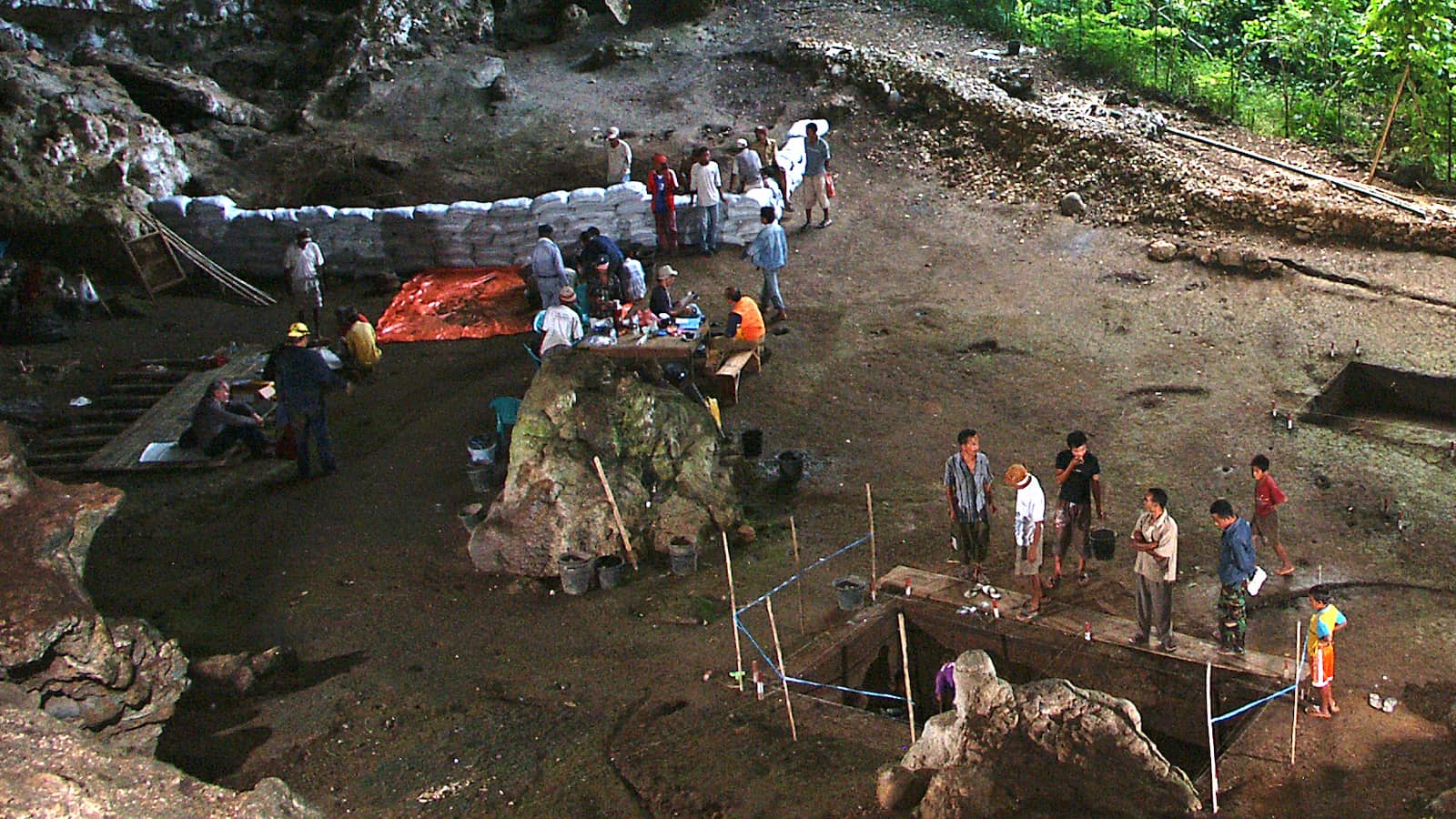
The research clarifies the timeline of humans on Flores. While Homo floresiensis fossils pre-date the earliest evidence of modern humans on the island, Homo sapiens were traversing the Indonesian archipelago around the time the hobbits disappeared.
"It's possible that as the hobbits moved in search of water and prey, they encountered modern humans elsewhere on the island," Dr Gagan said. "In that sense, climate change may have set the stage for their final disappearance."
The discovery highlights how environmental conditions can reshape the course of species survival, and how changing rainfall and freshwater scarcity influenced the fate of our closest relatives.
About the research
'Onset of summer aridification and the decline of Homo floresiensis at Liang Bua 61,000 years ago' by Michael K. Gagan, Linda K. Ayliffe, Mika R. Puspaningrum, Gerrit D. van den Bergh, Nick Scroxton, Wahyoe S .Hantoro, Heather Scott-Gagan, Scott A. Condie, R. Lawrence Edwards, Hai Cheng, Jian-xin Zhao, John C. Hellstrom, Alena K. Kimbrough, Matthew J. Gagan, Bambang W. Suwargadi, Joan A. Cowley, Bronwyn C. Dixon, Garry K. Smith, Neil Anderson, Henri Wong and Hamdi Rifai, was published in Communications Earth & Environment: https://www.nature.com/articles/s43247-025-02961-3
Caption for main photo: The jawbone and ridged molar of an adult Stegodon florensis, the larger-bodied ancestor of the pygmy Stegodon florensis insularis at Liang Bua. This fossil specimen is from the Mata Menge archaeological site in the So'a Basin, about 80 km east of Liang Bua, and dates to about 700,000 years ago. The scale bar is 10 cm. Credit: Gerrit van den Bergh


