
A smoking cessation program developed to support pregnant Aboriginal and Torres Strait Islander women in Australia has been adapted for pregnant women experiencing socioeconomic disadvantage in Germany, with promising early findings.
Southern Cross University's SISTAQUIT team partnered with researchers at the Leibniz Institute for Prevention Research and Epidemiology (BIPS) to adapt and test the Australian model through routine midwifery services in the German city of Bremen.
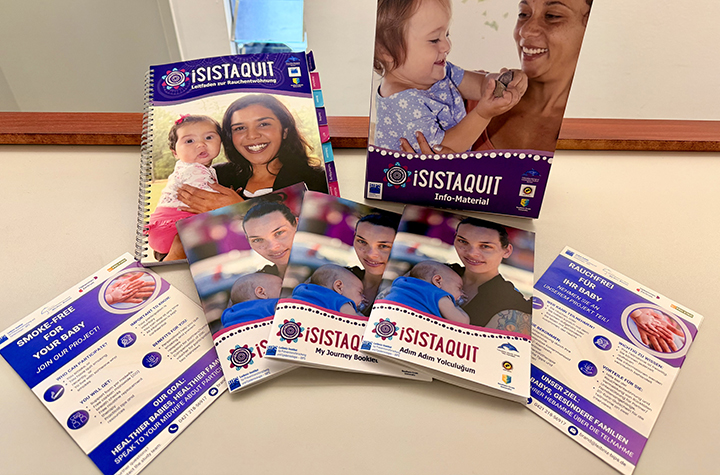
The adapted SISTAQUIT materials used by midwives in Bremen, including the 'My Journey' booklet, available in four languages (credit BIPS).
In both countries, the key to success is culturally trained midwives and health workers, upskilled in evidence-based smoking and vaping cessation.
At its heart, the international collaboration recognises that socioeconomically disadvantaged pregnant women in Europe face strikingly similar inequities in tobacco-related harm to that experienced by Aboriginal and Torres Strait Islander women in Australia.
"As a GP who has worked in health equity for two decades, the opportunity to adapt SISTAQUIT to a high-priority low socioeconomic population is close to my heart, bringing together these two areas of my interests and expertise," said Southern Cross University's Professor Gillian Gould, the SISTAQUIT Chief Investigator.
The Australian team mentored the German team through every phase, sharing training curricula, patient-facing materials, and hard-won implementation lessons, while the German team contributed systematic adaptation methods and new practice partnerships with midwifery services reaching disadvantaged families. Knowledge flowed in both directions, and every step was grounded in the realities of the practitioners and communities who deliver and receive care.
The English language resources were translated into German, French and Turkish.
Prize for collaboration bridging research and practice
The international collaboration demonstrates how implementation science can bridge research and practice, ensuring that effective healthcare interventions are translated into real-world settings and benefit the communities they are designed to serve.
The Society for Implementation Research Collaboration (SIRC), a professional network dedicated to advancing the implementation of evidence-based practices in health and human services, honoured the Australia-Germany partnership with its 2026 Mission Award. The SIRC Mission Award recognises outstanding achievement in advancing implementation science to improve health outcomes.
"The SIRC Mission Award recognises the strength of international collaboration and, most importantly, the leadership, wisdom and commitment of Aboriginal and Torres Strait Islander communities who have guided the SISTAQUIT program from its inception," said Professor Gould.
"We are honoured to receive this recognition and share it with all our partners, health services, researchers, clinicians and community members who have contributed to the SISTAQUIT's success.
"In particular, the SIRC Mission Award honours not only the teams but the midwives and mothers in two hemispheres whose engagement make this work possible, and strengthens the case for scaling equitable, culturally responsive cessation care to other settings."
Doctoral candidate Bibiana Barrera Bernal is the project leader in the Smoke-Free Pregnancy feasibility team at the Leibniz Institute for Prevention Research and Epidemiology (BIPS).
"For me, this collaboration was a bridge: bringing an evidence-based intervention across the world to the families in Bremen who carry the greatest burden of tobacco-related harm and adapting it together with the midwives who serve them," said Ms Barrera Bernal.
"That is what equitable prevention means to us: care that reaches the people who need it most, in their own context and on their own terms."
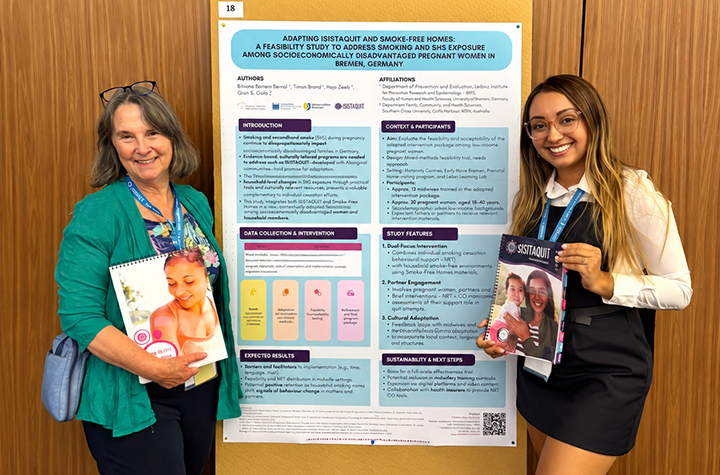
Southern Cross University's Professor Gillian Gould (left) with Bibiana Barrera Bernal from BIPS presenting the Bremen feasibility study at the 2025 SRNT-E (European Chapter of the Society for Research on Nicotine and Tobacco) (credit BIPS).
Smoking is a major health risk for mothers and newborns
Tobacco smoking is the major contributor to low birthweight in Aboriginal and Torres Strait Islander babies. While many Aboriginal and Torres Strait Islander women are motivated to quit smoking during pregnancy, there are challenges to achieve this.
Created 10 years ago by Professor Gould and her team, SISTAQUIT's evidence-based program is designed to support health professionals in providing culturally responsive smoking cessation care during pregnancy. Through strong community partnerships and Indigenous leadership, the program aims to improve maternal and infant health outcomes while supporting women to achieve smoke-free pregnancies. The program provides training for health professionals using the ABCD approach – Ask; Brief advice; Cessation; Discuss the psychosocial context – to incorporate an assessment of the social determinants of a patient's health. It also includes community outreach to promote the quit smoking message.
In Germany, smoking in pregnancy has fallen overall but remains strongly patterned by social disadvantage: national data show around 27% of mothers in low socioeconomic status families smoked during pregnancy, compared with under 2% in high-status families. Second hand smoke in the home adds to this, as smoke-free home rules are less common in disadvantaged households.
Despite this, Germany has no equity-oriented cessation support in routine antenatal care, and neither nicotine replacement therapy nor carbon monoxide monitoring is standard practice, even though midwives see nearly every pregnant woman.
Translating SISTAQUIT into the German context
BIPS adapted SISTAQUIT for socioeconomically disadvantaged pregnant women and their families in Bremen and delivered it through routine midwifery services: the Pro Kind home-visiting programme and two community midwifery centres. While many participating families have migrant backgrounds, eligibility was defined by socioeconomic disadvantage (low income, unemployment, receipt of benefits, or other psychosocial risks).
"We were looking for a programme with strong evidence, genuine co-design roots, provider training at its centre, and a family dimension, and SISTAQUIT offered all four," said Ms Barrera Bernal.
"The target group in Germany is defined by socioeconomic disadvantage rather than ethnicity, delivery sits inside existing midwifery services, and we added materials for smoke-free homes and a pathway for partners who smoke."
The feasibility trial ran from October 2025 to June 2026 across three services in Bremen. Data collection is complete, the analysis is in its final stages, and the scientific manuscript is in preparation.
"The findings will inform the design of a potential future effectiveness trial," said Ms Barrera Bernal.
"We recruited above our targets, retained nearly all participating women through follow-up, and found the trial was highly acceptable to them: almost all women would recommend taking part, midwives reported clear gains in knowledge and confidence in cessation counselling, and all responding midwives were willing to keep using the intervention."
Professor Gould was thrilled with the outcomes.
"Together, we traced a complete implementation science arc: from community co-design, through rigorous trial evidence, to national scale-up, and now international transfer, sustained by a partnership in which researchers, midwives, community organisations, and families with lived experience of disadvantage shape the work at every stage," said Professor Gould.


