
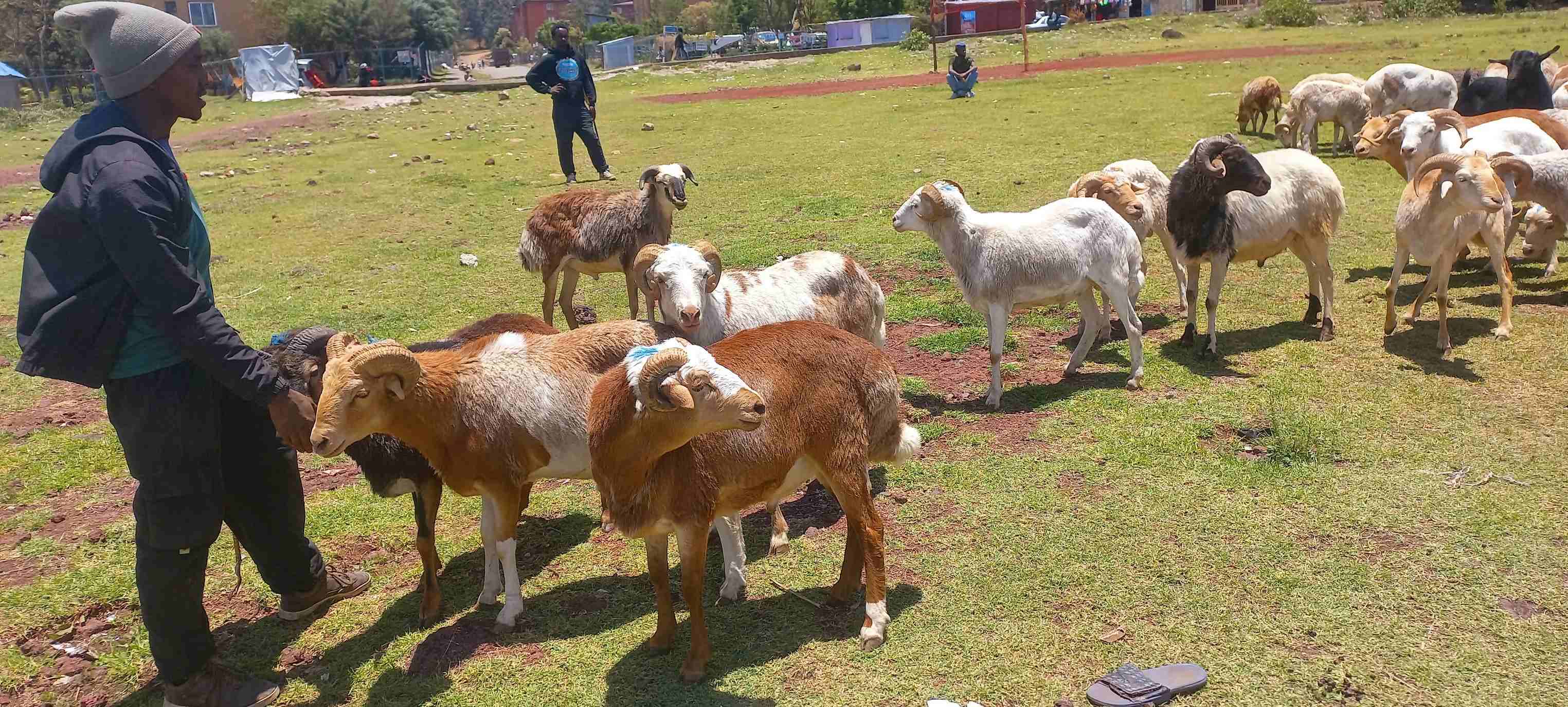
At dawn in Ethiopia's Menz province, Mr Nekatibeb Feredegn, a farmer, watches over his sheep as they scatter across the hills.
For years, his flock has been his safety net, something to rely on when crops failed, emergencies struck or funds were needed. He sold animals only when necessary, often at low prices, and with little control over when, how or to whom. Today, his approach has changed.
'These sheep are now my business,' said Mr Nekatibeb. 'I plan for the market. I feed them well and earn more than ever before. When I look at my sheep today, I don't just see animals, I see my future growing.'
His story reflects a community transformation shaped by ACIAR-supported research, strategic partnerships and persistence.
A system full of potential
Ethiopia is home to millions of sheep and goats, vital to the livelihoods of smallholder farmers, especially women and landless households.
Yet for years, the sector struggled to deliver meaningful income.
Low productivity, limited access to quality feed, weak market systems and poor access to finance kept many farmers trapped in subsistence farming.
In community-based breeding programs (CBBPs) farmers have worked collectively to improve the productivity and resilience of their local breeds. The CBBPs serve as an alternative to centralised, government-controlled breeding schemes, focusing on pooling local animal resources, training farmers in selective breeding and establishing communal recording systems.
CBBPs are an effective way for improving the genetics of small ruminants, as the programs consider farmers' needs, views and decisions, actively involving them throughout.
CBBPs are one of the most accessible and inclusive pathways to improve rural livelihoods.
But to unlock their full potential, we must move beyond productivity and connect farmers to markets, services and opportunities that create lasting impact.
Dr Steven Crimp,
ACIAR Research Director
Small sheep, big business
In Menz, the results are already visible. What began as a small pilot livestock market has grown into a dynamic rural economy.
In 2024, farmers sold just 124 sheep during the Ethiopian New Year market. By the 2025-2026 Christmas season, sales have surged to 2,153 sheep.
Over five festive cycles, farmers sold 5,662 sheep, earning around A$475,000 in revenue.
These figures highlight a fundamental shift in herd management and the economic returns of this practice change.
'In the past, farmers were producing without clear market signals,' said Dr Tesfaye Getachew, a scientist at ICARDA. 'Now production is driven by demand, and farmers know what the market wants and are preparing their animals accordingly.'
Even the animals reflect the progress.
Menz sheep, traditionally one of Ethiopia's smallest breeds, now average 38 kilograms, with some exceeding 50 kilograms.
Better genetics, combined with improved feeding and organised marketing, are translating into encouraging income gains.
Youth lead transformation
Nearly half of the participants are youth, many of whom are establishing businesses in fattening, aggregation and livestock trading.
The introduction of production units has generated new roles throughout the value chain, transforming livestock into a business opportunity.
'I used to think farming was just something our parents did,' said Mr Bereket Siamregn, a young, ambitious farmer. 'Now I see sheep fattening as a viable business. I can earn income within months, not years.'
Instead of keeping animals for one to two years, farmers can now fatten and sell sheep in three to four months, improving cash flow and making the sector more attractive to youth.
Unlocking finance, particularly for women
Access to finance has historically restricted growth in livestock systems.
To address this, the project is trialling an innovative model that enables live animals to be used as collateral for loans.
So far, 100 households have accessed loans amounting to approximately A$159,000, allowing them to invest in feed, breeding, and fattening.
For women farmers, this shift is particularly significant.
'Before, it was difficult to access loans because we had no formal collateral,' said farmer Ms Fantaye Shenkutie. 'Now, I can use my sheep to get credit. I have expanded my flock and increased my income.'
Scaling the vision
The success in Menz is now spreading to other regions.
In Konso, southern Ethiopia, the model is being adapted for goat systems, with youth and women already participating in organised fattening and marketing.
The goal is to build a system that integrates genetics, markets, finance and people into a unified livestock economy.
If realised, the Menz sheep cluster alone could support annual sales of over 123,000 sheep, driven by hundreds of production units.
The work continues
Despite strong progress, challenges remain. Markets remain largely informal, transport costs are steep and digital systems are still evolving. Many farmers continue to encounter barriers to finance and services. But the project has helped catalyse a shift from livestock being a safety net to being a business and part of an integrated system.
As Mr Nekatibeb reflects, 'When our sheep improve, our lives improve. Now we are planning, not just surviving.'
And in that shift lies the true impact of this work.


