

< (Bottom, from left) Professor Dong-Hwa Seo, Researcher Jae-Seung Kim, (Top, from left) Professor Kyung-Wan Nam, Professor Sung-Kyun Jung, Professor Youn-Seok Jung >
Batteries are an essential technology in modern society, powering smartphones and electric vehicles, yet they face limitations such as fire explosion risks and high costs. While all-solid-state batteries have garnered attention as a viable alternative, it has been difficult to simultaneously satisfy safety, performance, and price. Recently, a Korean research team successfully multiplied the performance of all-solid-state batteries simply through structural design—without adding expensive metals.
KAIST announced on January 7th that a research team led by Professor Dong-Hwa Seo from the Department of Materials Science and Engineering, in collaboration with teams led by Professor Sung-Kyun Jung (Seoul National University), Professor Youn-Suk Jung (Yonsei University), and Professor Kyung-Wan Nam (Dongguk University), has developed a design method for core materials for all-solid-state batteries that uses low-cost raw materials while ensuring high performance and low risk of fire or explosion.
Conventional batteries rely on lithium ions moving through a liquid electrolyte. In contrast, all-solid-state batteries use a solid electrolyte. While this makes them safer, achieving rapid lithium-ion movement within a solid has typically required expensive metals or complex manufacturing processes.
To create efficient pathways for lithium-ion transport within the solid electrolyte, the research team focused on "divalent anions" such as oxygen and sulfur . Divalent anions play a crucial role in altering the crystal structure by integrating into the basic framework of the electrolyte.
The team developed a technology to precisely control the internal structure of low-cost zirconium (Zr)-based halide solid electrolytes by introducing these divalent anions. This design principle, termed the "Framework Regulation Mechanism," widens the pathways for lithium ions and lowers the energy barriers they encounter during transport. By adjusting the bonding environment and crystal structure around the lithium ions, the team enabled faster and easier movement.
To verify these structural changes, the researchers utilized various high-precision analysis techniques, including:
- Ultra-high-resolution X-ray scattering
- Pair Distribution Function (PDF) analysis
- X-ray Absorption Spectroscopy (XAS)
- Density Functional Theory (DFT) modeling for electronic structure and diffusion.
The results showed that electrolytes incorporating oxygen or sulfur improved lithium-ion mobility by 2 to 4 times compared to conventional zirconium-based electrolytes. This signifies that performance levels suitable for practical all-solid-state battery applications can be achieved using inexpensive materials.
Specifically, the ionic conductivity at room temperature was measured at approximately 1.78 mS/cm for the oxygen-doped electrolyte and 1.01 mS/cm for the sulfur-doped electrolyte. Ionic conductivity indicates how quickly and smoothly lithium ions move; a value above 1 mS/cm is generally considered sufficient for practical battery applications at room temperature.
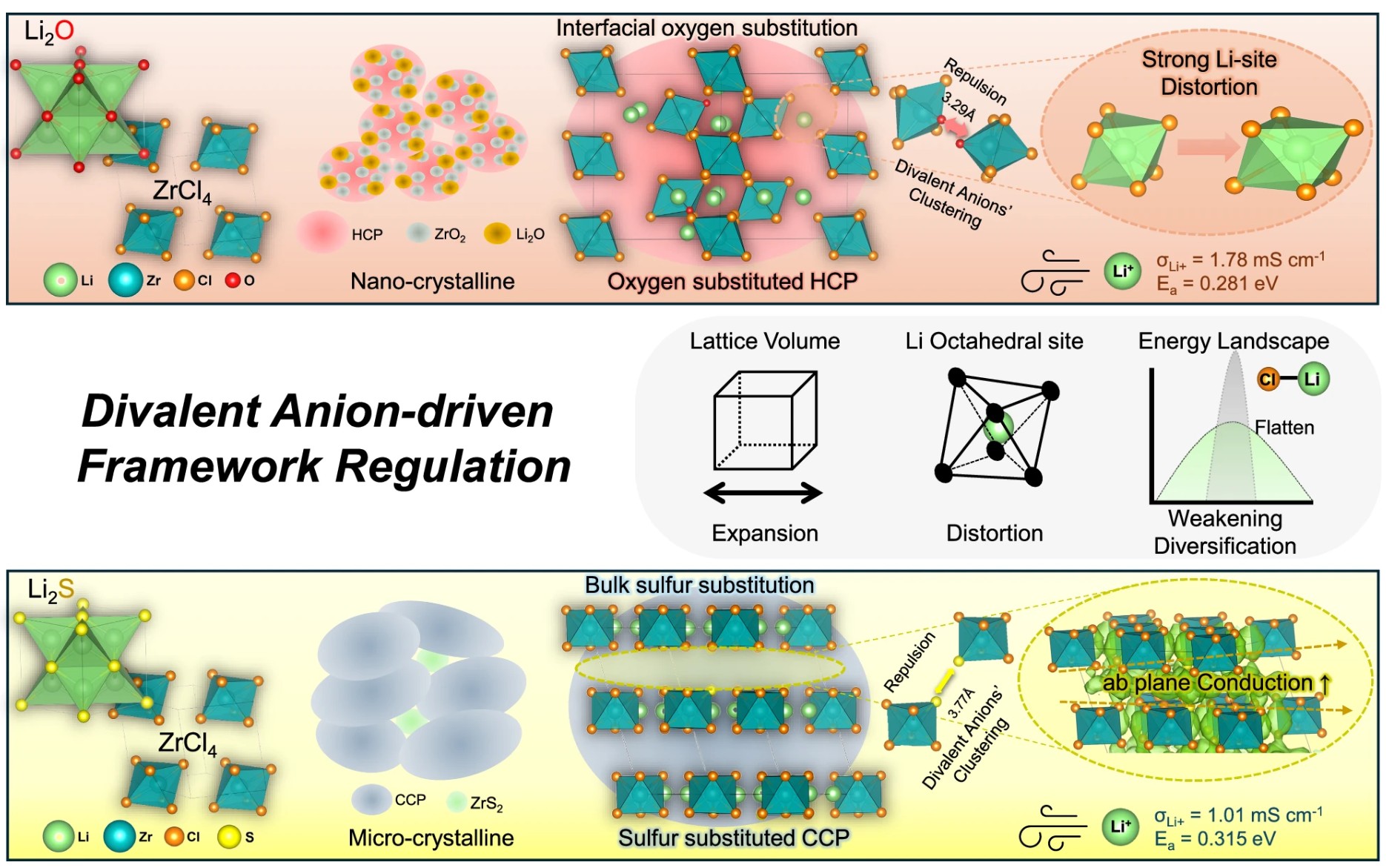
< Structural Regulation Mechanism of Zr-based Halide Electrolytes via Divalent Anion Introduction >

< Atomic Rearrangement of Solid Electrolyte for All-Solid-State Batteries (AI-generated image) >
Professor Dong-Hwa Seo stated, "Through this research, we have presented a design principle that can simultaneously improve the cost and performance of all-solid-state batteries using cheap raw materials. Its potential for industrial application is very high." Lead author Jae-Seung Kim added that the study shifts the focus from "what materials to use" to "how to design them" in the development of battery materials.
This study, with Jae-Seung Kim (KAIST) and Da-Seul Han (Dongguk University) as co-first authors, was published in the international journal Nature Communications on November 27, 2025.
- Paper Title: Divalent anion-driven framework regulation in Zr-based halide solid electrolytes for all-solid-state batteries
- DOI: https://www.nature.com/articles/s41467-025-65702-2
This research was supported by the Samsung Electronics Future Technology Promotion Center, the National Research Foundation of Korea, and the National Supercomputing Center.


