
Australia's seasons
For most of Australia, weather at the start and end of each year is generally warmer, and the middle of the year is cooler. Days are longer at the start and end of the year and shorter in the middle of the year.
Four seasons - the typical weather year
Australia's weather year is typically divided into 4 seasons, based on the European model. Australian summer, autumn, winter and spring are defined as:
- summer - the warmest 3 months: December, January and February
- winter - the coolest 3 months: June, July and August
- spring and autumn - the 3-month transition periods between summer and winter.
You can view maps of average daily maximum temperature for winter, spring, summer and autumn across Australia here.
Two seasons - the tropics
For Australia's northern tropics, there is less difference between average temperatures in 'winter' and 'summer'. This means the European 4-season model isn't relevant. In the tropics, each year is divided based on rainfall patterns:
- wet season - the months that generally include the heaviest rainfall (October to April)
- dry season - the months that generally see less rain (May to September).
The arrival of heavy rains varies by year and location. Our Northern Rainfall Onset tool gives guidance on the timing of enough rainfall to stimulate plant growth after the dry season.
Three, 5 or 6 seasons - Indigenous weather knowledge
Over thousands of years, Indigenous Australians have maintained local calendars. These divide each year into seasons based on weather patterns and plant and animal life-cycle events. You can see some of these calendars on our Indigenous weather knowledge pages.
Solstices and equinoxes
The annual variation in temperatures throughout the year is a result of the tilt of the Earth's rotation axis.
Think of the axis as a line from the north pole to the south pole, through the centre of the Earth. We rotate around the axis once every 24 hours, and we orbit the Sun once every year. Our rotation axis is tilted about 23.5 degrees relative to the plane of our orbit around the Sun.
As we orbit the Sun, this tilt angles the southern hemisphere towards or away from the Sun at different times of the year.
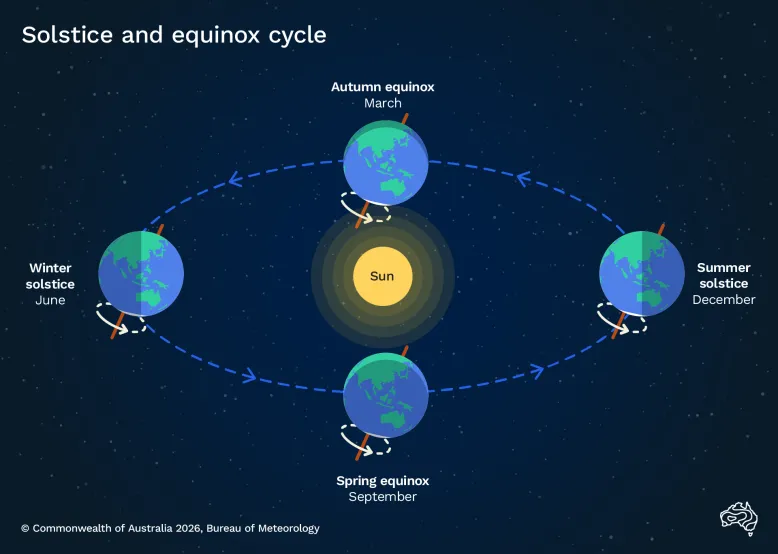
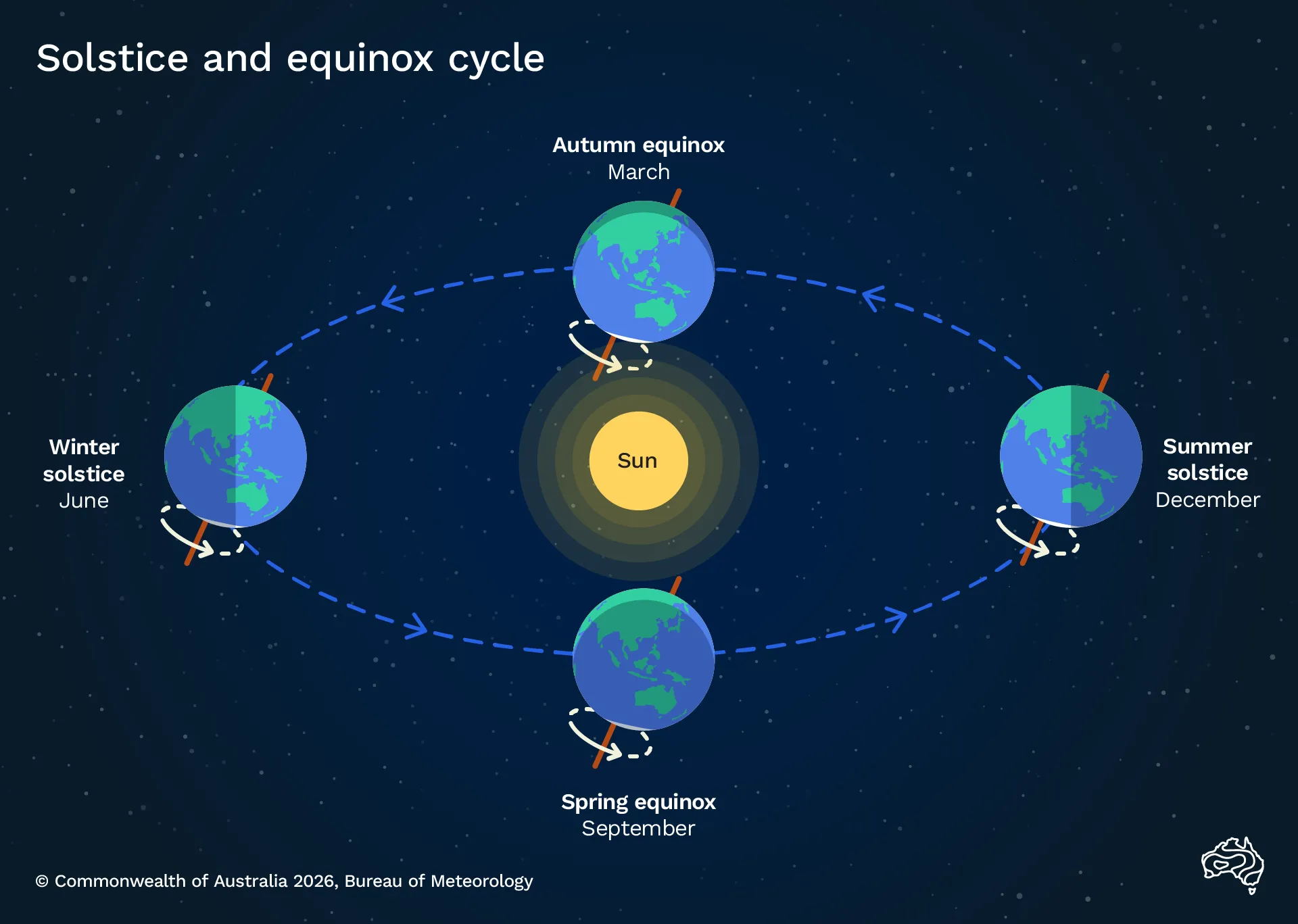
Earth has seasons because its axis is tilted. Earth rotates on its axis as it orbits the Sun, but the axis always points in the same direction.
From the surface of the Earth, this means the midday Sun appears further north or south in the sky depending on the time of year. It also means that the number of hours of daylight we experience within each 24-hour rotation of Earth varies. This depends on where we are in our orbit around the Sun. The exact position of the Sun at midday and the number of hours of daylight also depend on where on Earth you are (your latitude).
The solstices are the 2 times each year when Earth's tilt angles the northern and southern hemispheres furthest towards or away from the Sun. This creates the largest difference between daylight and night-time hours.
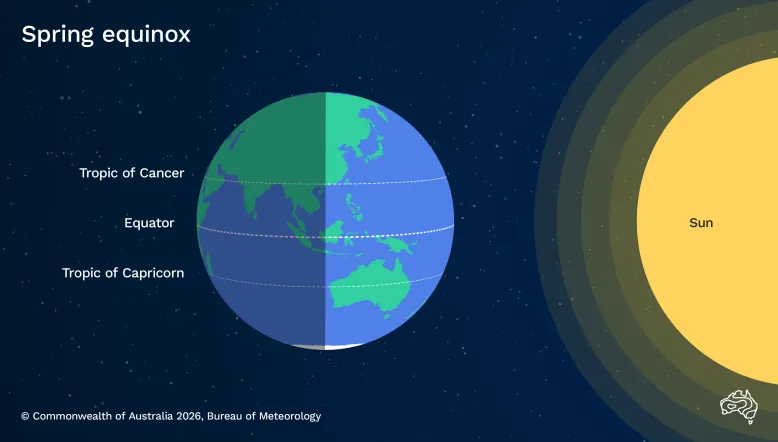
The two equinoxes, in between the solstices, are when the tilt of Earth's axis is side-on to the Sun. This means our north and south poles are the same distance from the Sun. On those dates, the Sun appears directly above Earth's equator and there is the least difference between daylight and night-time hours.
Spring equinox
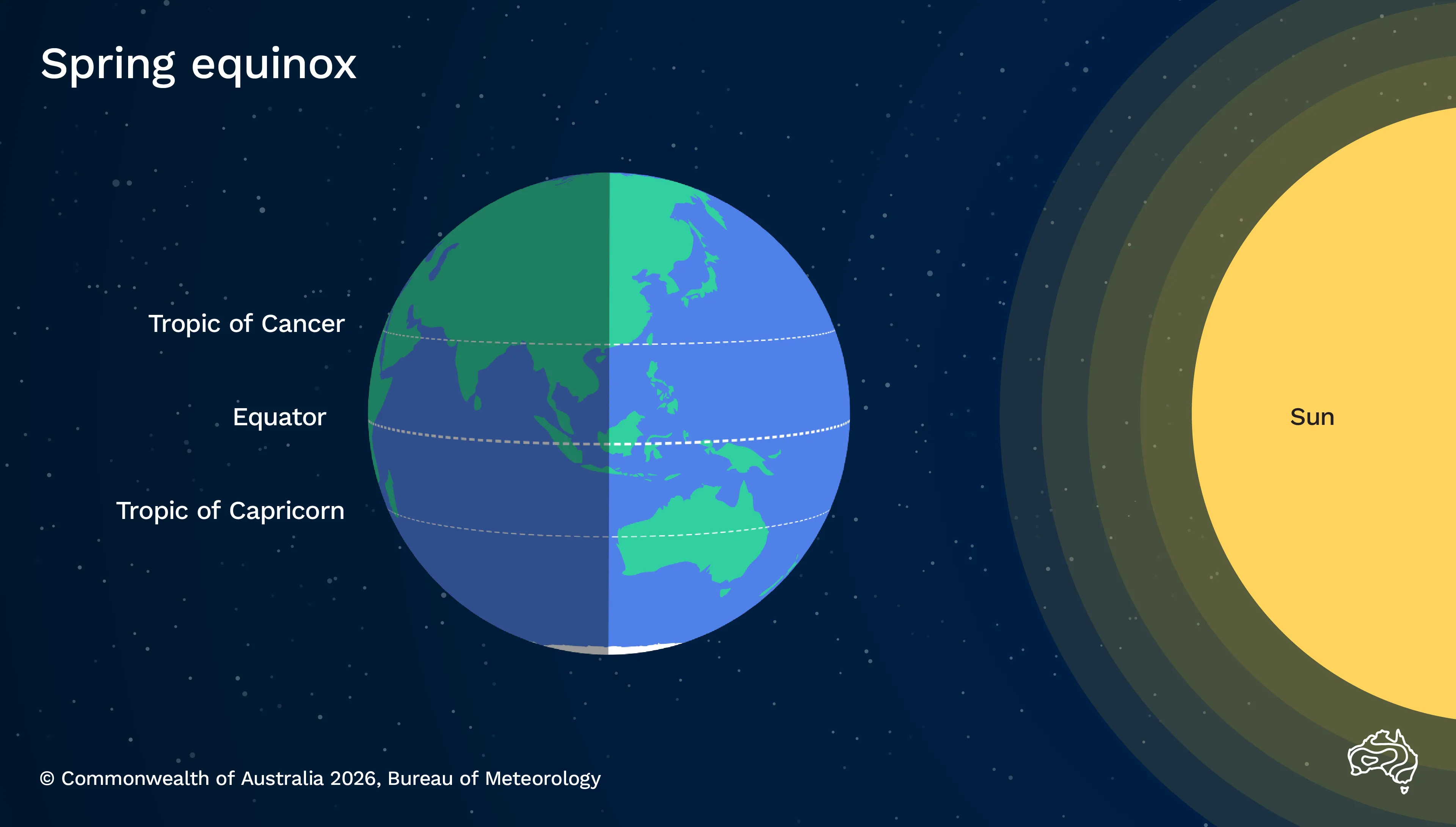
The date and time at which the centre of the Sun is directly over the equator in late September is called the equinox. This comes from the Latin for 'equal night'.
In the southern hemisphere, this marks the tipping point from days being shorter than nights, to days becoming longer than nights.
In fact, days and nights are equal in length (each 12 hours) for the southern hemisphere 2 or 3 days before the technical spring equinox.
Most of Australia sees about 12 hours 8 minutes of daylight on the spring equinox. This is because our atmosphere refracts (bends) sunlight so that we can see the Sun:
- just before it's risen in line with the horizon
- just after it's passed below the level of the horizon at sunset.
Summer solstice
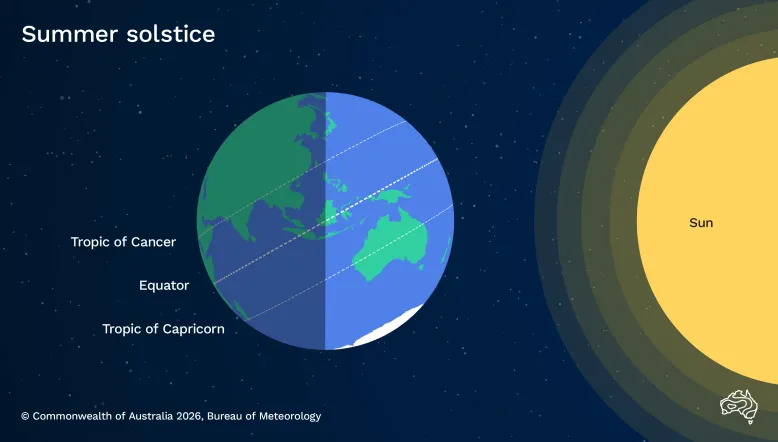
After the September equinox, the tilt of Earth's axis increasingly angles our south pole towards the Sun. This means the Sun appears further south in the sky each day until it's over the Tropic of Capricorn around 22 December. This is the southern hemisphere's summer solstice.
The word 'solstice' comes from the Latin for 'sun-stopping'.
At this point, the Sun stops appearing to move south each day. After this, it appears further north in the sky each day.
Autumn equinox
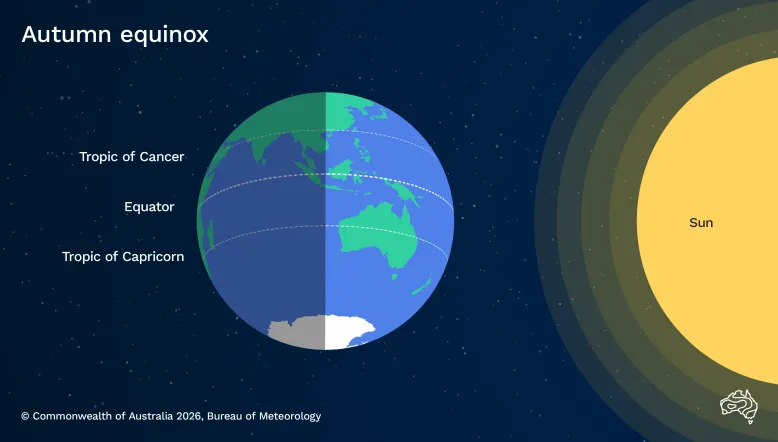
The Sun crosses over the equator again in late March, and days and nights are again the same length.
Winter solstice
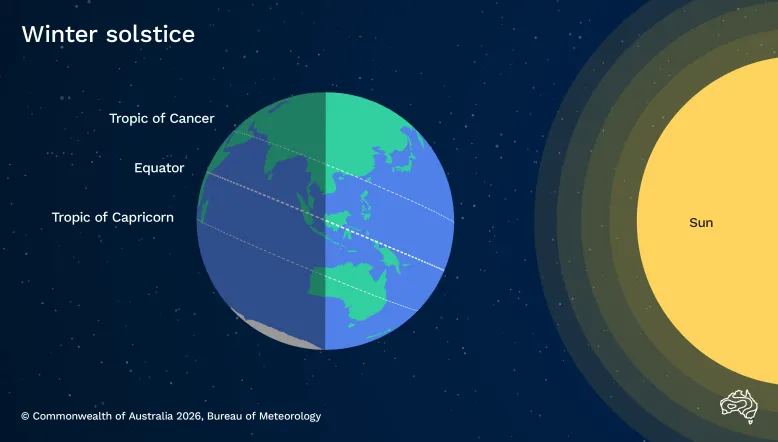
After the March equinox, the tilt of Earth's axis angles the southern hemisphere further away from the Sun. This means days in Australia become shorter than nights. The Sun continues to move north in the sky until it's over the Tropic of Cancer in late June - the southern hemisphere's winter solstice.
At the winter solstice, days are at their shortest. How many hours of daylight you'll see depends on how far north or south you are. Hobart only sees around 9 hours of daylight at the winter solstice but 15 hours of daylight at the summer solstice. Darwin only varies between about 11.5 hours daylight at the winter solstice and about 12.5 hours of daylight at the summer solstice.
You can find sunrise and sunset times for your location for any date on the Geoscience Australia website.
The difference in average temperatures between December and June is more pronounced in the 'temperate' south of Australia than in the tropical north. Southern parts of Australia therefore have distinct seasons. They have warmer, longer days in summer and colder, shorter days in winter.


