
Debris is still raining down on Earth more than 100 million years after the giant cosmic explosion that created it. A study published this week in Nature Astronomy by an international team concludes that this occurred using measurements of rare isotopes within a slow-growing ferromanganese crust recovered from the depths of the Pacific Ocean.
The study was led by Dr Dominik Koll and Professor Anton Wallner at the Helmholtz-Zentrum Dresden-Rossendorf (HZDR) in Germany and involved HZDR in collaboration with ANSTO and ANU in Canberra.
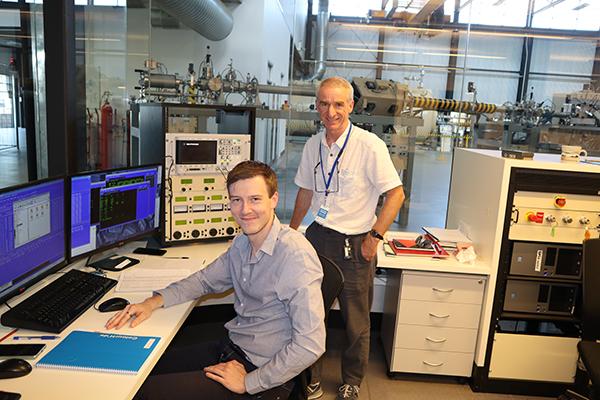
The tell-tale signature of this cosmic explosion is the detection of just a few hundred atoms of the longest-living of plutonium radioisotopes, Pu-244, with a half-life of 81 million years, found in a kilogram of crust.
"The absence of the curium radioisotope Cm-247 (half-life 16 million years), which was also produced in the explosion, tells us it happened a very long time ago. But not more than about 1 billion years ago - otherwise the Pu-244 would also be undetectable", said Dr Michael Hotchkis, who made the measurements at ANSTO's Centre for Accelerator Science on the Vega accelerator and co-author on the paper.
So what was this cosmic explosion? Most likely a merger of two neutron stars, that generated a kilonova explosion, among the brightest objects in the galaxy when it happened. Neutron star mergers are believed to be responsible for the creation and distribution of about half the heavy elements that exist today in the universe.
"Did this event affect life on Earth? That's an open question, to be investigated in further research," said Dr Hotchkis.
The key to the insights from this work was the development of the world's most sensitive instrument for detection of rare isotopes of heavy elements, including the plutonium and curium analysed in this study.
"Having such a capability at ANSTO provides Australia with a world-leading instrument that can be applied to various technological and scientific research, including nuclear monitoring to support the Australian government's nuclear non-proliferation objectives," said Dr Hotchkis.
A lump of ferromanganese crust weighing 1.9kg was recovered from the bottom of the Pacific Ocean in 1976, at a depth of 4830m.
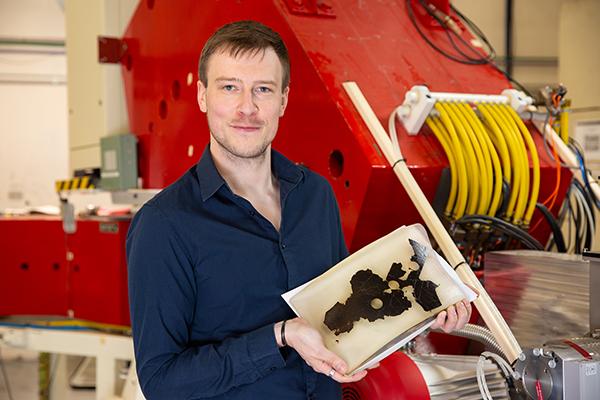
Three cores were drilled out providing age-depth profiles at three places in the crust - these were dated using the isotope Be-10 (half-life 1.5 million years). The isotope Fe-60 was also measured in one core, using the HIAF accelerator at ANU in Canberra. The crust grows so slowly that each core, measuring up to 3cm, spanned more than ten million years.
The remaining crust was imaged with computed x-ray tomography and encased in resin. This enabled the crust to be carefully cut away, layer by layer, by computer-controlled machining, to produce nine 90g samples, each corresponding to ~1 million years of growth. It was expected from earlier work that even with 90g of rock, fewer than 100 atoms of Pu-244 would be detectable in each layer.
Each sample was divided in three parts and processed to extract the plutonium. These samples were taken to the Centre for Accelerator Science for plutonium isotopic analysis. Just before completion of processing, scientists at the Centre had hit on a technique to maximise the sensitivity of their atom-counting method, accelerator mass spectrometry.
The Fe-60 analysis revealed previously known supernova signatures at 2 and 7 million years ago, with greater precision than ever before.
Some experts expected that the Pu-244 would follow a similar pattern to the Fe-60, with spikes also at 2 and 7 million years. Such a result would have indicated that heavy elements are produced in supernova explosions. However, this was not found to be the case - rather, the few atoms of Pu-244 detected were spread rather evenly throughout the layers. This showed that the plutonium was arriving on earth as a continuous influx, independently of the supernova events.
To better understand what this result meant, Dominik Koll returned to the sample solutions from which he had extracted plutonium. From these samples, he extracted another long-lived trans-uranic element, curium. Cm-247 has a half-life of 16 million years: long compared to the age of the samples in the core, but much shorter than the half-life of Pu-244 at 81 million years.
According to the theory of nucleosynthesis (creation of elements), about half the heavy elements present in the universe can only be produced in cosmic explosive events, in a process of rapid neutron capture known as the r-process. The rest of the heavy elements are produced in stars.
The r-process is known to occur in very rare cosmic events known as kilonovae, when two neutron stars merge.
Notably, the actinides, including thorium and uranium, and transuranics, such as plutonium and curium, can only be produced by the r-process. Theories of r-process nucleosynthesis suggest that both Cm-247 and Pu-244 are produced simultaneously, in roughly equal proportions.
The curium samples were analysed at ANSTO. No conclusive evidence of curium of interstellar origin was found.
"The instrument sensitivity was not in question - it is even better at detecting curium atoms than plutonium atoms. The only possible explanation is that the cosmic explosion responsible for the plutonium happened so long ago that the curium has already decayed away to practically nothing," said Dr Hotchkis.
Careful evaluation of the data demonstrated that the hypothesised kilonova event occurred more than 100 million years ago.
The research team is now on the hunt to learn more. They surmise that there may be ancient rock strata somewhere on Earth that could support this r-process event and the dust it distributed into interstellar space.
Or perhaps there is evidence in dust that has lain undisturbed for millions of years on the surface of the moon.


