
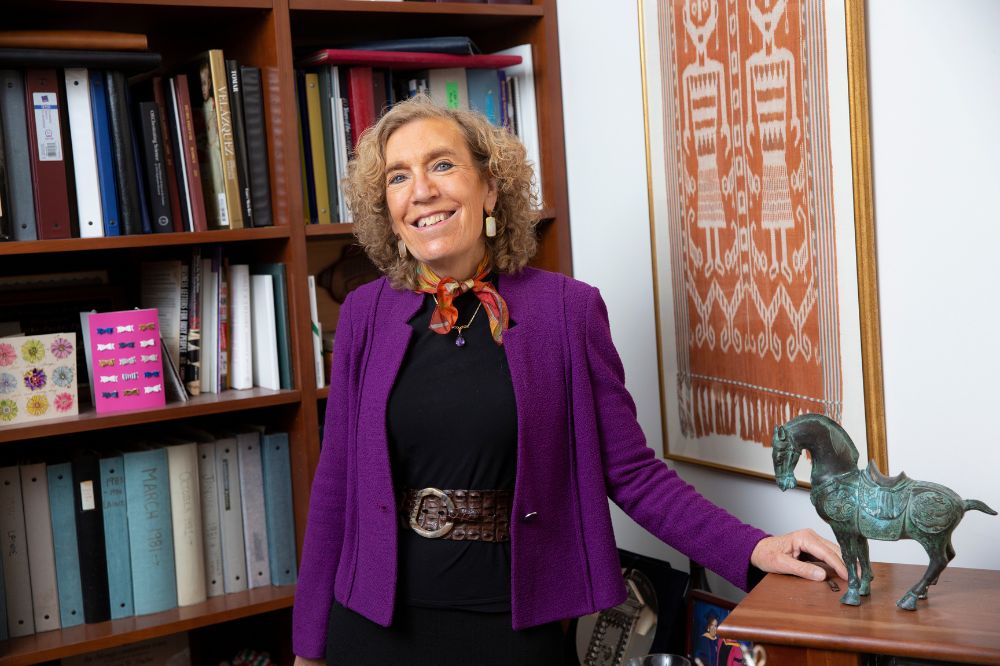
Elaine Fuchs has spent decades uncovering why our bodies are so good at regenerating skin-and how we might harness that understanding to combat illness, hair loss, and perhaps even the aging process itself. (Credit: John Abbott)
Your skin is in a constant state of reinvention. Every month, your body sheds and regenerates its entire outer layer-a complete turnover powered by tiny, tireless stem cells. These same cells spring into action when you get a cut, healing wounds with remarkable speed.
Elaine Fuchs, the Rebecca C. Lancefield Professor at Rockefeller University and a Howard Hughes Medical Institute Investigator, has spent decades uncovering how skin stem cells do what they do, and what happens when they turn dysfunctional. Her work has helped define how stem cells fuel regeneration, how they interact with the immune system-and how they sometimes become the seeds of cancer or chronic inflammation.
These discoveries have far-reaching implications. By understanding how stem cells replenish tissues and keep us healthy, Fuchs is reframing how scientists think about aging, disease, and inflammation throughout the entire body.
We spoke to Fuchs about what makes these cells so fascinating-and so useful.
What are skin stem cells and what makes them unique from other kinds of cells?
These stem cells are the cells throughout our epidermis which produce new skin, sweat glands, and hair follicles. They do this constantly, replenishing our entire barrier with the outside world every four weeks. Similar processes are essential for the survival of our body and the health of all the other organs that are tucked away inside our skin. When we get a cut or a scrape, our skin stem cells are also responsible for rebuilding the damaged area. Compared to most other human stem cells, these cells have a nearly unmatched ability to regenerate tissue. And that's in the face of a constant barrage of stressors from the outside world. I think it's fair to say the skin is the most resilient, regenerative tissue in our bodies.
Is that what makes it such a powerful system for studying regeneration and resilience in general?
Most cells in our body decline with age-they start to divide less often or do their job less well. But skin stem cells are incredibly hardy, not only in response to inflammation, disease, and wounds, but also with aging. If you put skin stem cells from an older animal into a young animal, the skin continues looking and functioning in a youthful way. That tells us that it's not these cells that are changing much with age, even as other skin cells around them are. That fountain of youth is something we'd like to better understand-and translate to other tissues and types of stem cells! If we can understand more about how these cells cope so well with stress and trauma, maybe we can learn how to make other cells in the body more resilient.
Are there diseases linked to skin stem cells?
Absolutely. 15% of the world's population has either psoriasis or eczema, both of which are caused by inflammation of skin stem cells and too much proliferation-the stem cells produce more skin layers than usual. At the same time, non-melanoma skin cancers are the most common cancers worldwide, and they are generally triggered by mutations in skin stem cells. These are both enormous health problems and they're on the rise.
But I'm also mindful that, beyond their physical symptoms, skin diseases carry a unique psychological burden because they're so visible. Every little detail and every abnormality on skin is noticeable.
What have you discovered about skin stem cells that most surprised you?
One of the most exciting discoveries from my lab has been that skin stem cells don't just respond to injury or inflammation-they remember it. We found that after an inflammatory episode, these cells store a kind of "memory," allowing them to recall past experiences even months or years later. That memory can help them heal wounds more quickly or fight off pathogens more effectively.
But there's a flip side. The same memory that trains them to respond faster can also make them more prone to overreacting, which we think contributes to chronic inflammatory diseases like eczema or psoriasis. Even more striking, memories may leave the cells more vulnerable to developing cancer later in life.
My lab has developed tools to isolate skin stem cells directly from tissue and analyze them in fine detail to try to understand how memories work and how a stem cell catalogues its experiences inside its nucleus after injury or inflammation.
How did your work on skin stems cells lead you to study hair loss?
Hair follicle stem cells are the other type of adult stem cells in the skin. My team has studied them for a long time because it turns out they're a really great model for studying how stem cells awake from a resting state and begin to make tissue. We've discovered how different molecular signals can make hair follicle stem cells produce new hair or, in the case of skin injuries, to actually produce new epidermis.
Using some of these signals, we've been able to coax adult mice to grow new hair follicles. The challenge is that when you make hair follicle stem cells more active, you also can increase the risk of cancer because you're signaling cells which are long-lived to divide. So a question there for treating hair loss is whether we can figure out a way to stimulate hair follicle formation without increasing the risk of skin cancer.
It sounds like you're often thinking about how to translate your findings. How do you connect your research to treatments for patients?
Even when we're carrying out molecular studies on stem cells, my lab is always trying to look at the big picture and adjust the driving questions we ask so that we can bridge the gap between basic science and medicine. When I began my career, I knew I wanted to study diseases like cancer, but I also knew that I would never understand what goes wrong in skin cancer if I didn't first understand healthy skin. The saying "You won't understand what's abnormal until you understand what's normal," has really guided my career. We've finally reached the point where we can start to say we understand what's normal in skin stem cells and that means we can ask big questions about disease. That's an incredibly exciting place to be. It means that what we do next could be truly transformative.
In terms of how we think about that bench-to-bedside translation: At Rockefeller, I have the ability to collaborate with researchers across not only basic science but also the clinical side of things. Right now, in my lab, I have three MD/PhD students who have finished their medical residencies; two of them work in medical oncology and one in the burn unit. They are currently helping take our studies in mice and translate them to humans by looking at patient skin samples and probing how skin stem cells are different in healthy versus diseased cells. One question we are currently trying to address-and which exploits our findings-is whether we can derive therapeutics that will kill the mutant stem cells that propagate cancers without harming the normal stem cells that give rise to healthy tissue.


