
What do wooden casks tell us about trade and everyday life between 1300 and 1800? PhD candidate Jeroen Oosterbaan studied the life cycle of this shipping container and has shown how these everyday objects played a key role in the development of international trade networks.
Although casks had been in use since Roman times, they became essential to trade and the movement of goods during the late Middle Ages. They made it possible to store and preserve large quantities of products, and to transport them over long distances. Beer, herring and other goods could be kept for longer, allowing traders to serve larger markets. 'I like to think of the cask as the shipping container of the late Middle Ages', he says. 'They made large-scale freight transport cheaper and more efficient.'
Oosterbaan mapped the production, trade and (re)use of casks. He combined archaeological data with written sources and used dendrochronology to discover the origin of the wood used to make them. He discovered, for example, that the cask played an important role in the growth of trade networks. These originally ran from present-day western Germany and northern France to the Netherlands, later expanding to Poland and the Baltic region.

Rule lovers
The use of casks in trade was often regulated in remarkable detail, with historical regulations even specifying how herring had to be packed inside a cask. Inspectors then checked whether everything had been done in accordance with the rules. 'We really do love our rules, don't we? In that respect, things weren't much different in the past', says Oosterbaan. The growing trade also left its mark on the cityscape. Large wine casks could weigh more than 300 kilos when full, making them too heavy to be moved by hand. As a result, special cranes were built in major port cities, often tellingly known as 'wine cranes'.
More casks, more knowledge
Oosterbaan's research has become possible thanks to the growing number of casks discovered by archaeologists over the past few decades. This is because of construction work in historical city centres, for example, and improved sonar technology at sea, which means more shipwrecks are being discovered. Furthermore, wooden objects are exceptionally well preserved in the Dutch soil.
'We're living in one big wet delta', says Oosterbaan. 'In many ways, we're sitting on a goldmine.' Many casks also owe their survival to a second life as cesspits or wells. By stacking several casks on top of one another, people created sturdy well shafts that remained buried in the ground for centuries.
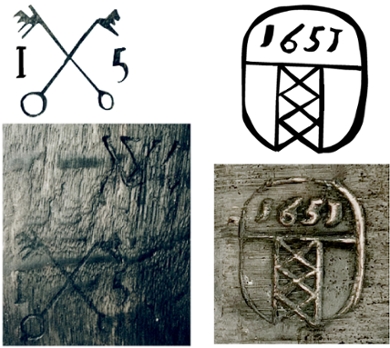
Bringing order to thousands of cask marks
For his research, Oosterbaan combined archaeological finds with historical sources. He examined the archives of coopers' guilds (association of craftsmen who made casks), toll registers recording the movement of goods and taxes levied, and other documents from the late medieval and early modern periods. 'Written sources mainly show what this looked like on paper. Archaeology allows us to add what it was like in practice.'
Oosterbaan brought together thousands of marks carved on casks. Some marks proved to have been made by the coopers who had made the casks, whereas others were linked to quality control, ownership or production. The new classification method Oosterbaan developed helps researchers identify and interpret these marks more effectively. As a result, casks can tell us not only about the people who made them, but also about trade routes, production processes and the inspectors responsible for quality control.
An unexpected discovery
The study of cask marks also led to an unexpected discovery. Using three letters found on several casks, Oosterbaan managed to reconstruct a trading network that ultimately led to the name of a ship. He identified the Burgzand Noord 4 shipwreck at the island of Texel as the 18th-century frigate 't Hart. 'That was one of those side quests that I couldn't resist pursuing', he says.
The discovery will soon be followed up: as a postdoc researcher at Saxion University of Applied Sciences, Ooosterbaan will continue investigating the ship and its connection to the Dutch history of slavery. What began as a study of casks has led to new stories about trade, seafaring and the people behind that history.
PhD defences by researchers from Leiden University can be watched live online. Jeroen Oosterbaan will defend his dissertation entitled The life cycle of casks: the production, use and reuse of casks in the Netherlands (1300-1800) on Thursday 2 July, from 10:00 to 11:00 hrs.


