
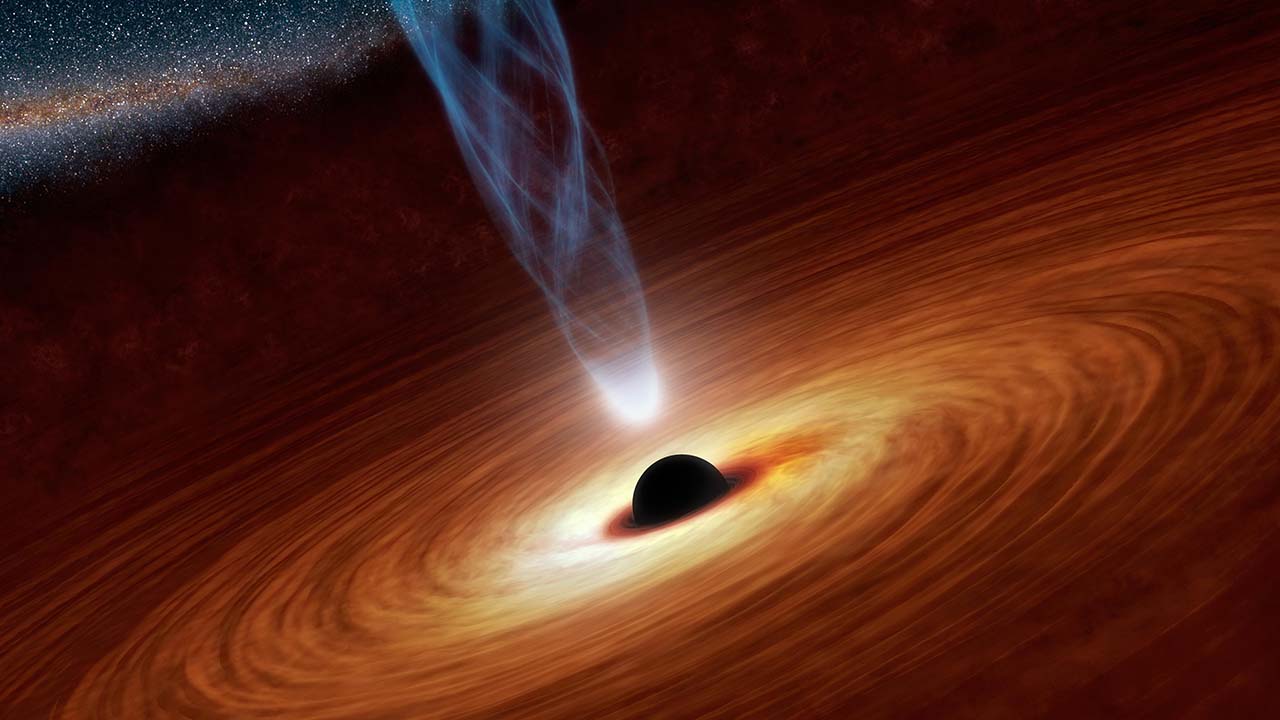
An international research team has discovered a supermassive black hole growing rapidly while radiating bright X-rays and radio waves. This combination of features contradicts the current models of black hole growth, requiring astronomers to look for a new explanation.
Supermassive black holes, millions to billions of times the mass of the Sun, sit in the centers of most galaxies. They grow by pulling in surrounding gas. As gas spirals inward, it can power a compact region of hot plasma known as a corona which emits X-rays. Some supermassive black holes also form a jet of outflowing material that emits strongly at radio wavelengths.
But if gas falls towards a supermassive black hole too quickly, radiation from the gas starts to push back on the material flowing behind it, causing the flow to slow down. This sets a self-regulating "Eddington Limit," a speed limit on how fast gas can flow in. Like most speed limits, the Eddington Limit is broken sometimes, enabling rapid mass build-up over short cosmic timescales.
To test whether such extreme growth occurs in the early Universe, a team led by scientists at Waseda University and Tohoku University used the Subaru Telescope to measure the motion of gas around a supermassive black hole that existed when the Universe was less than 1.5 billion years old and found that it is accreting gas at 13 times the Eddington Limit. More surprisingly, the object also emits bright X-rays and radio waves. In the current models, super-Eddington accretion should change the gas flow and suppress X-ray and radio wave production. This unexpected combination hints at physical mechanisms not yet fully captured by current models of extreme accretion.
The team thinks the object is in a short-lived transitional stage. A sudden burst of inflowing gas may have pushed the system into a super-Eddington state, while a bright X-ray corona and a strong radio-wave emitting jet remained simultaneously energized for a limited time before the system settles toward a more typical regime.
This discovery offers a rare glimpse of time-variable black hole growth in the early Universe-an important step toward understanding the rapid growth of massive black holes.
Detailed Article(s)
"Rule-Breaking," Extremely Fast-Growing Supermassive Black Hole in the Early Universe
Subaru Telescope
Release Information
Researcher(s) Involved in this Release
- Sakiko Obuchi (Waseda Universiy)
- Kohei Ichikawa (Tohoku University)
Coordinated Release Organization(s)
- National Astronomical Observatory of Japan, NINS
- Waseda University
- Tohoku University
Paper(s)
- Obuchi et al. "Discovery of an X-ray Luminous Radio-Loud Quasar at z = 3.4: A Possible Transitional Super-Eddington Phase", in The Astrophysical Journal, DOI: 10.3847/1538-4357/ae1d6d


