
A new study led by Harvard biologists, in collaboration with the University of California San Diego, the Okinawa Institute of Science and Technology (OIST) and universities in Sweden, reveals how octopuses feel their way to potential mates with a "taste by touch" sensory system and can even couple at arm's length without actually seeing each other. Featured on the cover of Science, the researchers deciphered how one male appendage serves as a multipurpose organ for seeking, sensing, and seeding - and even continues to respond to female sex hormones after being severed from the body.
"The specialized arm for mating had been documented long ago, but it wasn't known that it's also a sensory organ," says Harvard University Professor of Molecular and Cellular Biology, Nicholas Bellono, senior author of the new paper. "This is the mechanism by which the octopuses recognize their mates and facilitate fertilization."
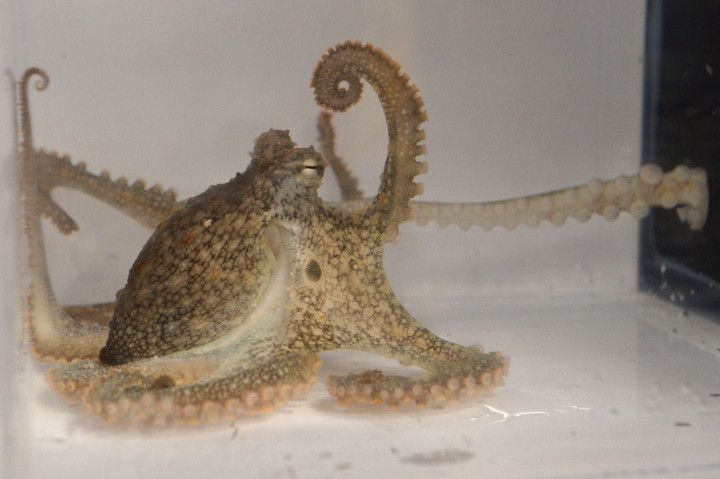
In male cephalopods, one of their eight arms, known as the hectocotylus, is devoted to reproduction. In mating, it snakes its way to the female mantle (a cavity in the main body containing the vital organs), finds the oviduct, and deposits a seed-containing packet called a spermatophore. The hectocotylus also contains a special groove for passing the sperm packet from the testes in the male mantle to the tip of the extremity.
The Bellono lab has done extensive research on the cephalopod sensory system. Octopus arms explore the seafloor like muscular tongues; a single suction cup contains some 10,000 sensory cells. Most of the 500 million neurons in the octopus are distributed in the arms - not the brain - and the appendages can operate autonomously.
Pablo Villar, a postdoc in the Bellono lab, was conducting a broad survey of octopus receptors and was intrigued to find the hectocotylus dotted with sensors just like the ones in the other arms.
"That was surprising, because the males generally don't use the hectocotylus for exploring or finding food," says Villar, lead author of the study. "They keep it close to their body, coiled up, and don't really use it for sampling the sea floor."
The scientists decided to let the animals demonstrate how they used this arm. They watched couplings of California two-spot octopuses, Octopus bimaculoides, native to the Pacific coast of the Americas.
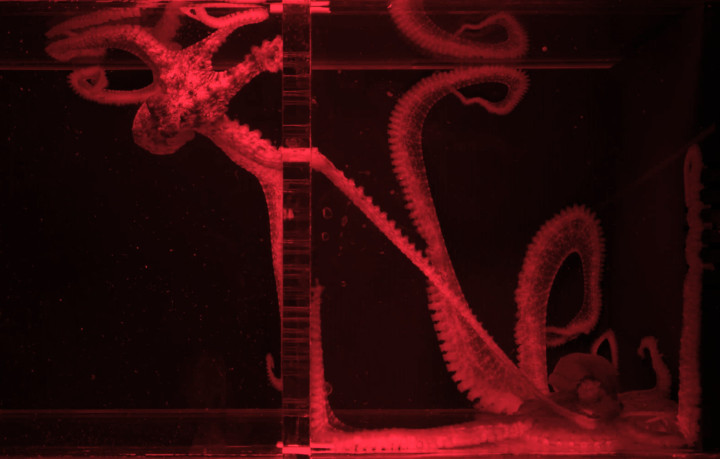
The scientists put male and female octopuses on either side of a black barrier in a saltwater tank. The divider contained small openings just wide enough for the arms.
Even without visual cues, the male could reach into the other compartment, find the female, and insert the hectocotylus tip into her mantle.
Females - who had the ability to retreat to an unreachable corner of the tank - often welcomed the outreach. The scientists described the scene: "Both the male and female paused all movement, sometimes for over an hour during spermatophore transfer."
"They mated through the divider," says Villar. "For us, that was the simplest and most clear demonstration that they can recognize each other just using chemosensation, and mate with no full body contact."
Researchers saw similar pairings between different males and females, even in complete darkness. When two males were paired, however, they did not attempt to mate. To the scientists, these clues suggested that females must emit some kind of sex signal.
The researchers analyzed tissue samples from female reproductive organs and found them enriched in precursor molecules for the female steroid sex hormone, progesterone.
Indeed, two experiments showed the power of progesterone. When researchers amputated a hectocotylus and exposed the appendage to progesterone, they saw that it moved vigorously.
In another experiment, researchers placed male and female octopuses on either side of a barrier, but just before mating, the female was replaced by tubes coated with progesterone. The males probed the progesterone-laden tubes like a female mantle, but showed no interest in tubes smeared with other chemicals.
Peering through an electron microscope, the researchers saw that the hectocotylus tip was dotted with small sucker cups like the ones on other arms. With staining and single cell sequencing techniques, they revealed that these tissues were densely laced with nerves and sensory cells. These clues indicated that this arm played some vital sensory function.
The research team also studied whether sensory systems for mating were present across a phylogenetically and geographically diverse spread of cephalopods.
Professor Sam Reiter, head of OIST's Computational Neuroethology Unit, notes, "Our lab studied Abdopus aculeatus, a local octopus found in Okinawan waters, carrying out behavioral studies and obtaining tissue samples for transcriptomic analysis. We found that A. aculeatus was also able to mate without any visual cues, suggesting that many different octopus species around the globe might use sensory mating systems."
Next, the Harvard team sought to pinpoint which chemotactile receptors detected female sex hormones. Only one receptor, CRT1, responded strongly to sex steroids, including progesterone. This receptor was already known for its role in detecting microbes on the surface of the octopus' prey, making its additional role in mating all the more surprising.

Progesterone is an ancient hormone that is conserved - meaning it has been retained through evolutionary history - but among octopuses, its receptors have undergone unique modifications in each species.
The team discovered that chemotactile receptors showed evidence of recent rapid evolution, perhaps because these sex steroids help these animals to recognize potential mates of their own species and distinguish them from other closely-related species.
Bellono says the study underscores how sensory biology can maintain reproductive barriers between lineages and even contribute to the branching of new species - the great problem identified by Charles Darwin. This sex signaling system exemplifies what biologists call diversifying selection, which sharpens the distinctions between closely-related species.
And it all started with a little curiosity over an unexpected discovery.
"There's also a philosophical point about how one does science," adds Bellono. "Support and emphasis to be open-minded and follow what diverse biology shows us is actively being deterred. But this study shows that approach can produce something very fundamental - not only about octopuses mating, but also about the origin of species, which is like the biological question."
Adapted from original press release by Kermit Pattison / Harvard Staff Writer, available here.


