
Reposted from the Wilkes Center.
A new collaborative report from University of Utah researchers and coordinated by the Wilkes Center for Climate Science & Policy provides Utah Department of Natural Resources, Department of Environmental Quality and policymakers with a comprehensive analysis of the growing risks posed by dust from the exposed lakebed of Great Salt Lake, the potential costs of controlling that dust, and the long-term benefits of stabilizing lake levels.
Commissioned by the Utah Division of Water Resources as a key input for the Great Salt Lake Basin Integrated Plan, the report "Options and Costs for Great Salt Lake Dust Control," provides state planners with scientific, economic and engineering data to evaluate when and where lakebed dust control measures may be warranted.
"We have an opportunity to be strategic about how we address Great Salt Lake dust," said Kevin Perry, a professor of atmospheric sciences at the University of Utah and lead author of the report. "That means using better data to identify the highest-risk areas, protecting communities that face the greatest exposure, stabilizing the lake wherever we can, and reserving engineered controls for places where the evidence shows they are necessary."
As Great Salt Lake water levels declined in recent years, more than 800 square miles of lakebed have been exposed to potential wind erosion. Perry's research has identified approximately 70 square miles as active dust hotspots, with that area potentially expanding to as much as 187 square miles if protective surface crusts continue to degrade or groundwater levels decline.
The report emphasizes that the state faces costs whether it acts or fails to act-and that decisions made today can significantly affect those future costs.
"The state commissioned this research to give our agencies the empirical data needed to make informed policy decisions," said Laura Vernon, Great Salt Lake Basin Planner at the Utah Division of Water Resources. "As we finalize the Basin Integrated Plan, these findings will shape long-term water management recommendations and emphasize the point that delivering water to the lake is the single most cost-effective way to suppress dust and prevent billions in taxpayer-funded mitigation."
Faculty from four different University departments and two colleges prepared the comprehensive report, including:
Kevin Perry, Professor, Department of Atmospheric Sciences
John C. Lin, Professor, Department of Atmospheric Sciences , Scientific Director of the Wilkes Center for Climate Science & Policy
Paul D. Brooks, Professor, Department of Geology & Geophysics
Alberto Garcia, Assistant Professor, Departments of Economics and the School of Environment, Society & Sustainability
Sara Grineski, Professor, Department of Sociology & Criminology; School of Environment, Society and Sustainability
Derek Mallia, Research Associate Professor, Department of Atmospheric Sciences
D. Kip Solomon, Distinguished Professor, Department of Geology & Geophysics
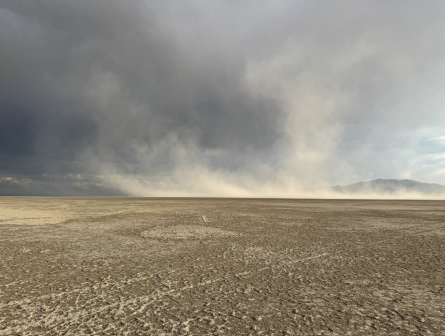
Kevin Perry photographed this dust storm on the Great Salt Lake playa on July 9, 2025.
Five key takeaways
- Great Salt Lake dust is a growing regional air-quality concern-but not all exposed lakebed poses the same risk.
The research distinguishes between exposed lakebed and areas that are actively generating dust that reaches populated areas. The authors recommend sustained, comprehensive monitoring and source attribution to identify the locations creating the greatest risks before committing to large-scale engineered controls. Better data can help Utah avoid both underreacting to significant health risks and spending billions on areas that do not pose material public exposure.
- Dust exposure is not shared equally across northern Utah communities.
Tooele County residents have the highest average modeled exposure, followed by Salt Lake County. The analysis also identifies higher modeled exposure among several racial and ethnic groups, foreign-born residents, non-citizens, people with lower educational attainment and people without health insurance. The findings underscore the importance of considering community-level exposure and population vulnerability when setting monitoring and mitigation priorities.
- The health costs of continued lake decline are substantial.
At a lake elevation of 4,192 feet, Great Salt Lake dust is associated with an estimated $115.79 million in annual health costs, including approximately 6.24 premature deaths, 17,052 work-loss days and nearly 17,748 school absences each year. Under the report's low-lake scenario of 4,183 feet, annual health costs rise to $133.67 million. At the minimum healthy elevation of 4,198 feet, they fall to $73.39 million. Through 2060, the report estimates that maintaining current conditions would result in $5.79 billion in cumulative health costs, compared with $3.71 billion if the lake were restored to and maintained at the minimum healthy elevation. At the historical average elevation, cumulative health costs fall to an estimated $1.89 billion.
- Engineered dust controls are possible, but potentially expensive and water-intensive.
The report evaluates numerous approaches, including precision surface wetting, flooding, dynamic water management, brine caps, managed vegetation, chemical suppressants, gravel, tillage and artificial surface roughness. No single approach is appropriate for every location. Estimated 50-year costs range from about $3.3 million to $448 million per square mile, depending on the technology and site. Applied across the currently identified 70 square miles of active hotspots, projected costs range from approximately $3.2 billion to more than $31 billion. Those costs could increase by roughly 2.7 times if active hotspots expand to 187 square miles.
- Stabilizing lake levels may be the most durable long-term way to reduce dust at its source.
Higher lake levels cover exposed playa, reduce dust-generating surfaces and can reduce the amount of water needed for some peripheral mitigation measures. The modeling estimates that average dust exposure in northern Utah would be approximately 15% lower under a healthy-lake scenario than under a very-low-lake scenario, with reductions exceeding 50% for some communities bordering the lake. The report concludes that lake-level stabilization and targeted engineered controls should be viewed as complementary strategies, not alternatives.
Animation of a large-scale dynamic water management strategy where water is temporarily stored in Farmington Bay to reduce dust emissions. Known dust hotspot locations are indicated by round circles. Animation credit: Kevin Perry.
A framework for policy decisions
The report recommends that Utah pursue a phased, evidence-based approach to dust management. Other policy recommendations include:
- Complete the Utah Dust Observation and Research Network and strengthen monitoring and source attribution to identify the areas posing the greatest risks.
- Develop a formal "weight-of-the-evidence" framework that integrates air quality, source attribution, exposure, health impacts, toxicology, engineering feasibility and water requirements before major investments are made.
- Prioritize stabilization of existing dust hotspots before they expand, while testing promising control technologies through small-scale pilot projects.
- Conduct engineering analyses to determine which dust-control measures are most appropriate for specific areas of the lakebed.
- Evaluate both action and inaction as long-term costs, including potential health damages, emergency mitigation, regulatory compliance costs and infrastructure obligations.
The full report, "Options and Costs for Great Salt Lake Dust Control," was prepared by University of Utah researchers for the Utah Division of Water Resources as part of the Great Salt Lake Basin Integrated Plan, with support from the Wilkes Center for Climate Science & Policy.
Banner photo: Exposed playa of Great Salt Lake, Sept. 4, 2023. Proto credit: Chris Carlson.


