
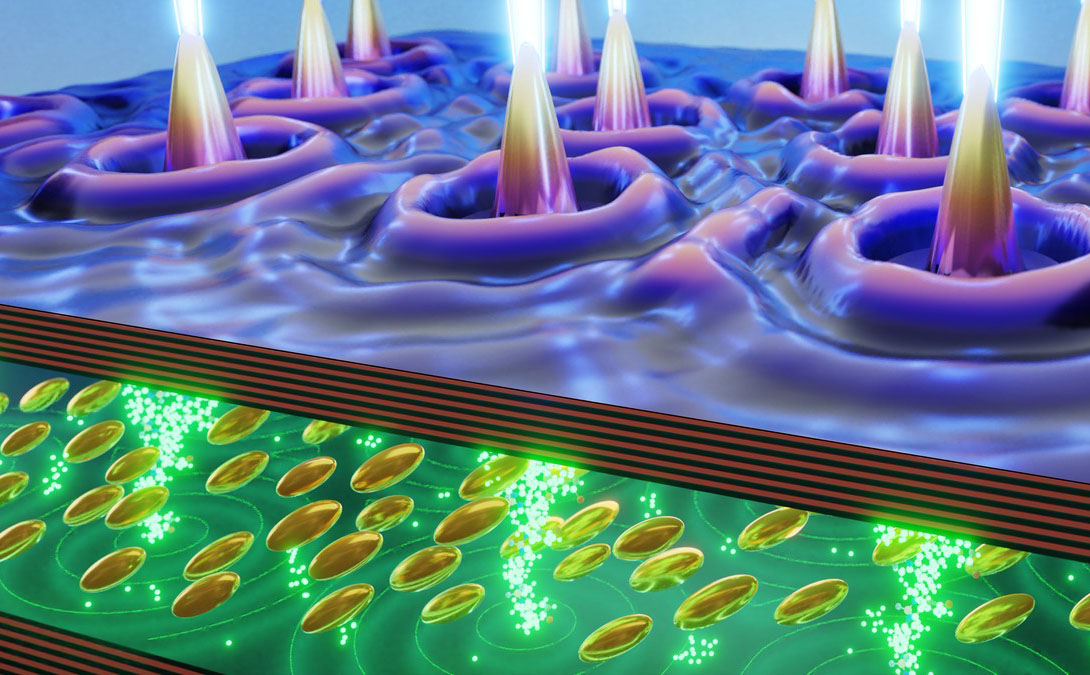
An international team of researchers has for the first time achieved spontaneous synchronisation of multiple, microscopic lasers, at room temperature, to create a coherent and reconfigurable light source.
The discovery could be a first step in paving the way towards lower-cost, reconfigurable and accessible photonic computing.
Most standard computers utilise electrons to process data, but photonic computers use particles of light, and have the advantage of being faster, being able to handle more data simultaneously and requiring less energy.
Scientists led by the University of Southampton have developed a way to align tiny lasers, tens of times smaller than the width of a human hair, into a collective, macroscopic state known as 'super-mode'. Synchronising the lasers has a long-goal potential to increase processing speed and efficiency in future computers and optical technologies.
The physicists, also from the University of Warsaw and Military University of Technology in Poland, and the Institut Pascal, Université Clermont Auvergne in France, have published their findings in the journal Nature Communications .
The team achieved the 'super-mode' state using a system based on liquid crystals and organic dye molecules. The spatially separated microscopic lasers were realised within an optical microcavity - a microscopic structure designed to confine light in miniscule volumes.
The scientists spontaneously synchronised microscopic laser beams so they behaved as a unified emitter of 'coherent' light, all locked at the same frequency and the same phase.
This kind of control of lasers has mostly been observed before in highly specialised semiconductor microcavities operating at cryogenic temperatures - below minus 250 degrees Celsius - but the team successfully achieved it at room temperature.
"Our results show that you don't need complex light-matter coupled states or low temperatures to achieve this kind of collective behaviour of light," said Dmitriy Dovzhenko of the Optoelectronics Research Centre at the University of Southampton, the first author of the article, who conceived the experiment. "We can obtain similar effects in a much simpler and more practical platform, which offers all-optical reconfigurability, electrical tuneability and robust operation under ambient conditions."
A key advantage of the new platform is its electrical tunability. By applying a small voltage, researchers can reorient the liquid crystal molecules inside the cavity, changing how light propagates and how the lasers operate. Additionally, due to the optical reconfigurability, the relative position of the microscopic laser can be easily re-arranged within the same device.
Commenting on the success of the team's system, Jacek Szczytko from the Faculty of Physics at the Univeristy of Warsaw said: "This is a fundamentally different way of coupling lasers. Instead of relying on strong interactions between light and matter, we use the propagation of light itself."
As the system operates at room temperature and uses well-established materials, it offers a promising path toward future practical devices.


