
Rich Callasky strongly believes his wife is still here today because of the decision to come to UConn John Dempsey Hospital.
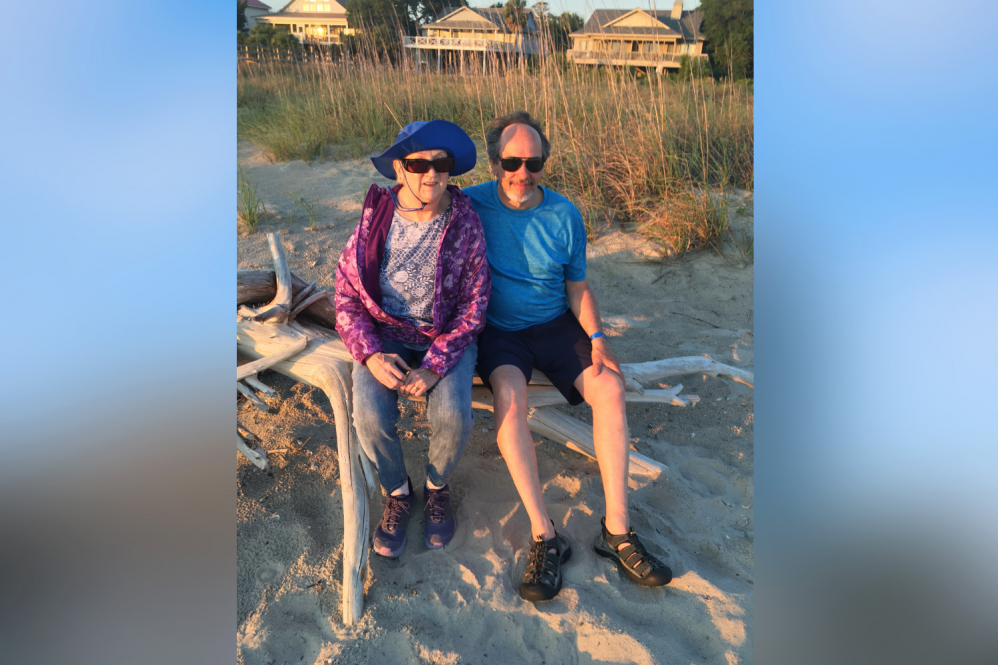
Chris and Rich Callasky (photo provided by Rich Callasky)
 When Chris Callasky called her husband one afternoon in July 2024, she sounded frightened and confused. She was sitting in her car and couldn't figure out how to put it in park.
For weeks, the 66-year-old had been experiencing unsettling lapses. She forgot PIN numbers. Used the wrong credit cards. Repeated herself. At times, she couldn't remember how to roll down a car window. Friends noticed changes, too. At the pool, Chris seemed "spacey." Her walking looked off. This was not the person they knew – a woman who exercised four to five times a week, kickboxed, golfed in a weekly league, gardened, traveled often, and fiercely valued her independence.
But that phone call marked a turning point.
"She called me and said she couldn't keep the car stationary," her husband, Rich Callasky, recalled. "She didn't know how to park it."
That prompted a visit to Chris's primary care provider who ordered bloodwork after she failed a brief cognitive test. The results came back fast and alarming. Her calcium level was critically high, nearly 14, far above the normal range. The lab urged immediate action.
Rich didn't hesitate. He brought Chris to the Emergency Department at UConn John Dempsey Hospital.
"I strongly believe she's still around today because of that decision," he said. "It was the best move we ever made."
At UConn Health, clinicians quickly recognized that Chris's symptoms were not dementia, but metabolic, caused by a dangerous imbalance in her blood. Further testing revealed something far more serious: her bone marrow was nearly completely blocked, no longer producing red blood cells, white blood cells, or platelets.
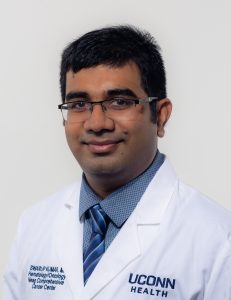
Within days, hematology specialists refined the diagnosis to plasma cell leukemia, an extremely rare and aggressive form of multiple myeloma
"She was diagnosed with plasma cell leukemia, which we see in roughly one out of a million people," said Dr. Swarup Kumar, hematologist-oncologist at UConn Health's Carole and Ray Neag Comprehensive Cancer Center. "This is not typical myeloma. In this form, the cancerous plasma cells spill out of the bone marrow and circulate in the bloodstream."
That distinction matters profoundly. In most cases of multiple myeloma, malignant plasma cells remain largely confined to the bone marrow and progress over time. In plasma cell leukemia, those cells flood the bloodstream, disrupting normal blood production and damaging organs rapidly.
"This is a condition that can come on fast," Kumar said. "Patients can go from feeling relatively well to being critically ill in a very short period of time."
In Chris's case, the cancer had overwhelmed her bone marrow and caused calcium to surge into her bloodstream, a life-threatening complication that explained her sudden confusion and dementia-like symptoms.
"Her cognitive changes were most likely related to extremely high calcium levels," Kumar said. "We did not believe the cancer had spread to the brain. This was a metabolic effect of the disease, and it required immediate treatment."
"Plasma cell leukemia is not a condition where you have time to wait," Kumar said. "It's not something most clinicians see often, and the treatment decisions depend on recognizing exactly what you're dealing with as early as possible."
At UConn Health's Cancer Center, blood cancers are managed by a multidisciplinary team that integrates hematology, pathology, genetics, transplant medicine, and supportive care. That coordination allowed Chris's diagnosis to be refined quickly and treatment to begin without delay.
"This is where being part of an academic medical center really changes outcomes," Kumar said. "You have the infrastructure, the diagnostics, and the coordination to act fast."
Just days after arriving at UConn Health, Chris was admitted for intensive chemotherapy. Beginning July 17, she underwent four days of aggressive treatment and remained hospitalized until early August.
The toll was severe. She lost nearly 30 pounds. Her strength disappeared. Her cognition worsened temporarily as her body struggled to recover. Rich stayed overnight every night, sleeping on a hospital couch and working part-time during the day.
Then came the news that changed everything. A follow-up bone marrow biopsy showed 100 percent marrow recovery.
"The chemo worked," Rich said. "Her bone marrow was flowing again. I'll never forget that moment."
For Kumar, the response was extraordinary especially given the aggressiveness of the disease.
"She responded remarkably well to intensive chemotherapy," he said. "In cases like this, a strong early response gives us the opportunity to move forward with transplant and really consolidate that progress."
Rather than continue multiple rounds of chemotherapy, Chris's care team made a pivotal decision: proceed directly to stem cell transplant.
In September 2024, Chris became one of the earliest patients treated through UConn Health's then-new autologous stem cell transplant program.
Her stem cells were collected onsite through apheresis, processed and frozen in partnership with a New York-based blood center, then reinfused after high-dose chemotherapy designed to eliminate any remaining cancer.
"The goal of the transplant is to allow us to give very high-dose chemotherapy that we otherwise couldn't safely administer," Kumar explained. "We then restore the bone marrow using the patient's own stem cells."
On September 26, Day One of the critical 100-day recovery period, Kumar and team reinfused Chris's stem cells.
"He rubbed his hands on those frozen stem cell bags," Rich said. "He was hands-on, all the way."
For Kumar, being able to offer transplant at UConn Health is essential, particularly for aggressive diseases where time matters.
"In many places, patients would need to be transferred elsewhere for this level of care," he said. "Being able to do everything under one roof allows us to move quickly and keep care seamless." Kumar also acknowledges the Bone Marrow Transplant team at UConn Health under the leadership of Dr. Kapil Meleveedu, that made this possible.
After transplant, Chris's white blood cell count dropped to zero, leaving her with no immune system. Infection precautions were strict. Masks were constant. Small milestones such as walking 50 feet with an IV pole became victories.
"She never once felt sorry for herself," Rich said. "Not once." The only time she voiced fear was quiet and direct. "The only negative thing she ever asked was, 'Do the doctors think I'm going to die?'"
Gradually, her blood counts returned. She was discharged slightly earlier than expected. Strength and cognition began to improve.
"I just did everything they told me to do," Chris said. "As soon as they said I could exercise, I did."
Chris's recovery didn't end with cancer treatment. Ongoing cognitive concerns led to coordinated follow-up with specialists across UConn Health, including Dr. Germine Soliman, director of Geriatric Oncology Co-Management Program and Dr. Kevin Becker, director, Medical Neuro-Oncology a reflection of the cancer center's whole-person approach.
"Cancer care doesn't end when treatment is over," Kumar said. "Patients often need ongoing support from multiple specialists, and that collaboration is a major strength of our program."
Today, Chris remains in remission. She receives monthly infusions, takes maintenance therapy, and undergoes regular PET scans and bone marrow monitoring.
"With a disease this aggressive, our approach is to keep pressure on the cancer even after transplant," Kumar said. "We follow patients very closely because we never want to wait for symptoms to tell us something is wrong."
If the cancer returns, it is far more likely to be detected early when fewer intensive treatments, including immunotherapy such as CAR-T, bispecific T cell engagers or clinical trials, will be available.
By early 2025, Chris cautiously resumed traveling. A masked Thanksgiving trip to Newport marked a turning point. Reclaiming life starting with hair appointments and shopping for new clothes followed.
Rich credits not only the medicine, but the environment.
"They don't alarm you at UConn," he said. "They're professional, calm, and positive and that matters."
For Kumar, Chris's outcome reflects something larger than one case.
"Given how aggressive this form of myeloma is, the fact that she is more than a year and a half out and in remission is very meaningful," he said. "Her outcome reflects the timing, the coordination of care, and the support system around her."
For Chris and Rich, it comes back to one instinctive decision and a place prepared to act when minutes mattered most.
Kumar is quick to emphasize that Chris's recovery reflects the work of an entire team. He thanked the myeloma care team at UConn Health, including Kate Hooper, APP, Kristina Valladares, RN, and the many ancillary staff members across the Neag Comprehensive Cancer Center, as well as the entire Blood and Marrow Transplant and Cellular Therapy team for their coordinated, behind-the-scenes efforts.
"Caring for patients with aggressive blood cancers requires seamless collaboration," Kumar said. "From advanced diagnostics to transplant and long-term follow-up, it truly takes a dedicated, multidisciplinary team to deliver care that is not only effective, but compassionate and well-rounded. That's what we strive to provide here at UConn Health."


