Experts offered their responses to the question 'Will AI Replace Us?'
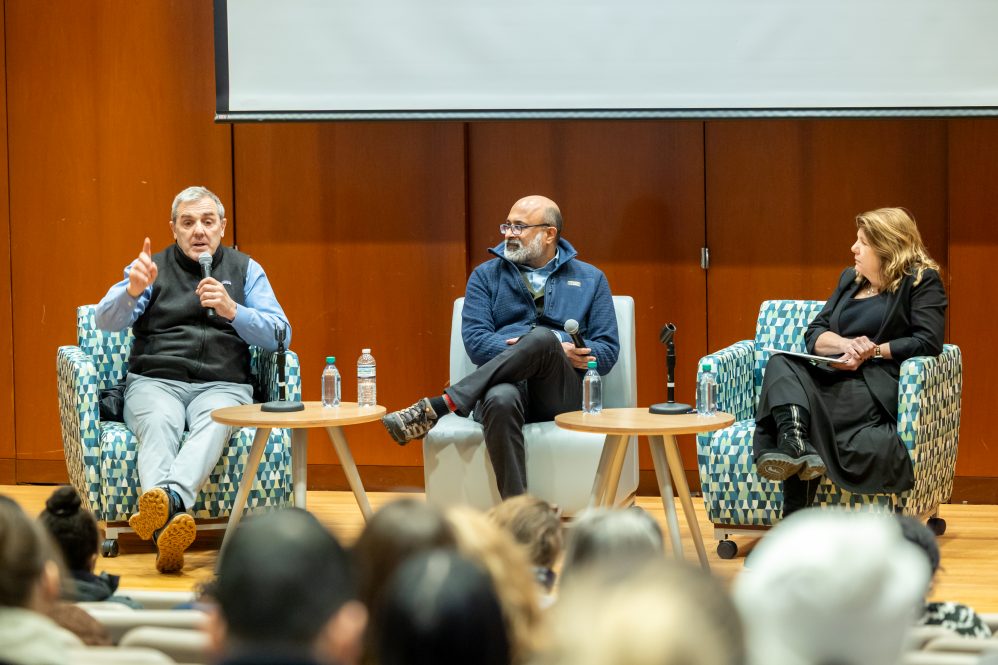
From left, Interim Chief Information Officer for UConn Ted Laskaris, Roger Sherman Professor of Law at UConn Law Sachin Pandya and Director of the UConn Humanitites Institute Anna Mae Duane sit on the "Will AI Replace Us?" panel in Konover Auditorium of the Dodd Center for Human Rights on Wednesday, Feb. 5, 2026. (Sydney Herdle/UConn Photo)
With millions of people now using generative AI to complete tasks both large and small, there is considerable anxiety about how this technology will impact the future of work. Are jobs now at risk because of AI? What is the right approach to integrating AI into the workplace - optimism or skepticism?
A recent panel, co-sponsored by the UConn Humanities Institute (UCHI) and the University of Connecticut Professional Employees Association (UCPEA) union, sought to answer the looming question: "Will AI Replace Us?"
The panel brought together three speakers with experts in various dimensions of technology and AI.
Sachin S. Pandya, the Roger Sherman Professor of Law at the UConn School of Law, spoke from his perspective as a legal expert. Pandya researches the use of computational tools in legal settings, as well as US work and anti-discrimination law. In his opening remarks, he discussed ways in which various US states are proactively tackling issues of AI and work. New York, for instance, passed a 2025 law protecting civil servants' employment rights (ensuring they can't be replaced by AI) for at least three years. On the flip side, Montana passed a "Right to Compute" statute which limits the government's ability to regulate AI use by private individuals and businesses.
Pandya's examples highlight how political questions (what is more important - protecting the public's safety and security, or individual freedom?) are already shaping the legal landscape in which AI is flourishing. Decisions we make now will determine exactly how, and to what degree, AI intertwines with our lives in the coming years.
Speaking to this issue, state Sen. James Maroney arrived virtually to the panel, fresh from attending Gov. Ned Lamont's address at the start of the 2026 legislative session.
"I'm thinking about this question ['Will AI Replace Us?'] in terms of the state of Connecticut," said Maroney, adding that his office is focused on putting protections into place for Connecticut residents.
Maroney, whose work on tech legislation has been recognized nationally, identified housing and employment as two areas of particular concern. Recently, he shared, landlords and employers alike have been embracing the controversial practice of using AI tools to scrape external data on prospective tenants and employees - oftentimes unbeknownst to the applicants.
"We want to make sure that, since so many companies and so many landlords are using these tools, that you have the opportunity to see what it's based on and correct anything that's wrong," said Maroney.
Maroney also spoke to the employment equity issues raised by AI. For example, he said, the jobs currently most threatened by AI - among them administrative assistants and customer service representatives - tend to be held by women, often women of color. They are also important entry-level positions from which careers can be built, said Maroney.
UConn interim Chief Information Officer Ted Laskaris shared his perspective from the Information Technology Services team, where he oversees and coordinates the University's vast information technology system - all the hardware and software that makes the learning, research, and communication at UConn possible.
Laskaris emphasized that adapting to changing technology has long been a critical skill in the workplace.
"A year from now, if you're doing your job the same way you are today, you're doing something wrong - and your manager's doing something wrong," he said.
He also stressed the opportunities created by AI. Rather than thinking of generative AI as a one-stop-shop that can replace human work, Laskaris said, we should recognize that its outputs should be subject to human review. There is still a need for human expertise to ensure the accuracy and efficacy of AI outputs - like people to test AI-produced code for quality assurance before it goes out to users.
"I am not afraid of [AI], and I don't think it's going to cannibalize as much as we think it will," said Laskaris. "To the degree that it does, there is so much other work that is going to come from that automation."
The second half of the event featured a question-and-answer session, with UConn community members asking questions about the environmental impact of AI and how people can work to protect critical-thinking disciplines in the university environment, which are crucial for fostering AI literacy and responsible use.
The afternoon's conversation reflected a key theme set out in the introduction by UCHI director Anna Mae Duane.
Duane, who is a professor of English, pointed out the active voice used in the construction "Will AI Replace Us?" — rather than the passive-voice "Will We Be Replaced by AI?" The wording was intentional, she said; it emphasizes agency and avoids the idea "that we are powerless to decide or shape what work is, what it means, and what it's for."
"This is a moment when we need what universities do, more than ever," Duane said. "It will take every one of us to ensure we're moving forward towards a future that is in alignment with our values."
The "Will AI Replace Us?" panel was one iteration of a continual series of "AI cafes" hosted by UCHI, building on the Institute's groundbreaking research into the human dimensions of AI. Learn more on the UCHI website.