For centuries, scientists have been fascinated by critical steps in animal evolution, such as the advent of multicellularity or the ability to fly. One such evolutionary step many have heard about is vertebrate adaptation to land. Adventuring onto land is one of the best-known stories of vertebrate success, a strategy that drove their diversification.
But how did animals that evolved to live underwater develop the ability to survive on land?
Researchers at The University of New Mexico have uncovered a surprising piece of that evolutionary puzzle: a toxin that helps African lungfish transform their skin to survive outside water.
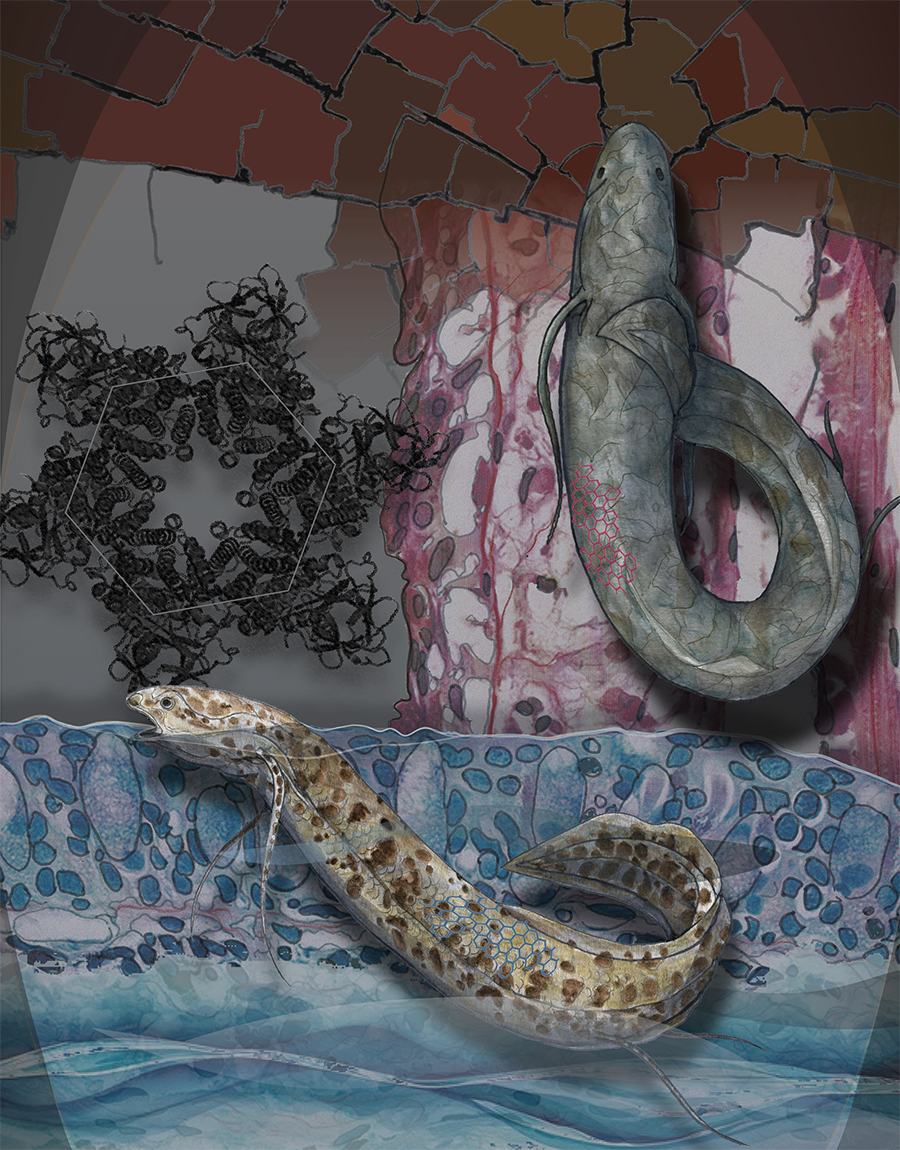
The discovery was published today in the scientific journal Cell, shows how African lungfish use a naturally occurring toxin to remodel their skin when they move from water to land each year as droughts hit Africa. The findings offer new insights into how animals adapt to dramatically different environments and highlight an unexpected role for the immune system in that process.
The team, led by UNM Professor Irene Salinas and first author Dr. Daphne Siciliani, a postdoctoral fellow of the Life Sciences Research Foundation and researcher in the Salinas lab, published a breakthrough in understanding land adaptation: a molecular innovation found in African lungfish that can change lungfish skin from an aquatic to a terrestrial configuration.
Why does the skin need to be different in water and on land?
The skin is our largest and most immediate barrier separating animals from the external environment. Fish, including lungfish, have skin that is a mucosal lining that continuously secretes mucus, much like the human gut and lungs do. However, once outside water, lungfish and any animal moving to land must protect these mucosal barriers from dryness, ultraviolet damage, and many other threats not found in water. This can happen through a biological process generally called tissue remodeling, a phenomenon that, for instance, allows a mother's mammary glands to start making milk to feed newborns.
Five years ago, this team of researchers began to search for mechanisms that would allow lungfish to be so plastic and adaptable, particularly in the skin. As immunologists, Salinas and her team hypothesized the immune system may be implicated in this process, since they had already observed that immune cells called granulocytes flood the African lungfish skin when territorialization is induced in the laboratory.
"I never thought we would stumble upon something as cool and exciting as a toxin," Salinas said. "Serendipity revealed a unique gene in the lungfish genome that was expressed in the skin in aquatic lungfish, but levels increased tremendously when animals were adapted to land. Unfortunately, this was a risky project."
"We knew nothing about this toxin or its relatives when we started to look at the available databases," Siciliani said. "Additionally, lungfishes are not known to be venomous or toxic to humans or any other animals, making this discovery even more puzzling."
To test the toxin's function, the team generated a recombinant version of the toxin, Protop-CrTX, and exposed different skin cell types to it. The experiments showed that the toxin punched tiny holes in target cells, and potassium then leaked outside of the cell, causing damage. Except in lungfish, where the toxin punches holes, but the cells seem to have evolved to prevent potassium leakage and repair the pores.
"In a series of experiments, we show that a drop of this toxin is sufficient to turn the skin of an aquatic lungfish into skin that resembles a land-adapted lungfish, demonstrating that this toxin is a tissue-remodeling molecule," Siciliani said. "Interestingly, over evolutionary time this toxin has been repurposed to better support tissue remodeling functions. This happened by adding many pieces to an originally simple gene that contained only one exon."
The team believes that the ancestral toxin gene originated in a bacterium and was transferred to marine lungfish ancestors millions of years ago. Over time, African lungfish repurposed this toxin so that it became less toxic and better at self-inflicting skin remodeling.
Where does the immune system come to play?
In this study, Siciliani et al. demonstrate that granulocytes, those fast-moving immune cells that flood the skin upon land adaptation, are the cells responsible for secretion of the toxin in the skin. Having granulocytes, quick migratory cells, as the main courier for this toxin allows African lungfish to sculpt skin regions on demand, a perfect example of how the immune system is not only a system to battle danger but also helps with everyday physiological functions in our bodies.
This work, funded by two National Science Foundation awards and the Life Science Research Foundation, was made possible by many researchers in the Salinas lab, including Ottavia Benedicenti, a former postdoc in the lab, and Marijan Posavi, a bioinformatics specialist. Additionally, collaborators outside UNM in the U.S. and Europe participated in this study.