
For the fifth year in a row, University of New Mexico Associate Professor and Honors College Chair Jason Moore will be leading an international group of students, faculty and researchers on field research along the Pilcomayo River in Paraguay as the team attempts to answer questions about how to best understand the fossil record. This year's group will feature a total of 19 people from five countries, including seven UNM undergraduates.
The group proposes that the environment around the Pilcomayo is a better comparison to the fossil record of life on land due to the sediment actively accumulating from the Andes. To test this hypothesis, the future fossils found on the dig site are compared to fossils from Petrified Forest National Park in Arizona and Toadstool Geologic Park in Nebraska.
"This whole project really stemmed from 20 years of confusion on my part," Moore said. "I was trained as a classical field sedimentologist and paleontologist and I spent a long time working in the field, looking at the rocks that I was collecting my fossils from and not being able to link the environments that these rocks were forming in to the models of rock deposition on land that had been described to me as an undergraduate.
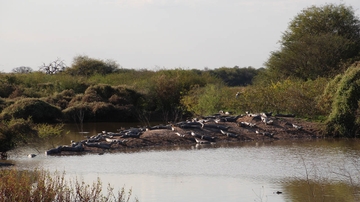
"The only parts of the rock record that you're going to get preserved are in the parts that are in sedimentary basins, where rocks will survive for millions of years. Most of the Earth's surface rocks just get eroded away…. And I realized pretty quickly that people hadn't been trying to understand the whys of fossil preservation under that model."
So far, through five years of data collection, Moore said that the data is lining up.
"We're beginning to see a lot of quite nice and interesting correlations that we haven't been able to make beforehand, so we're very positive about this project," he said.
In addition to the project's goals, each of Moore's undergraduates will be running a research project of their own, giving them the chance to oversee a field team themselves for work that will be presented at an international conference later this year.
"I would say that every student that I have taken with me has had a transformative experience there. I think, and this is something that has developed from my work in the Honors College, that there is a tendency in academia to underestimate what undergraduates can do," Moore said.
"You might think 'Well, this is very remote. This is high level work. So maybe it's the purview of graduate students.' But I have taken freshmen into the field with me, and they have really blossomed from these experiences."
This year, as part of the field research, the group will be posting on social media and running live events which will be streamed with the aim of giving a wider audience a look into what paleontology field work in the middle of remote landscapes looks like. The group's social media accounts can be found here.


