
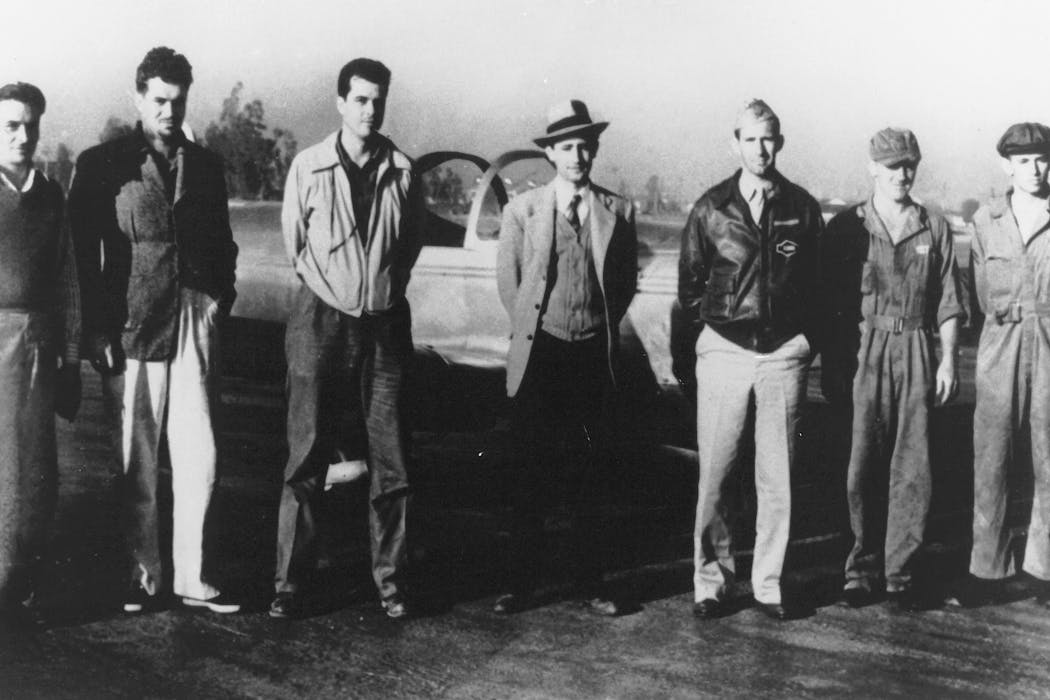
Frank Malina was a lot of things. The Texas-born aeronautical engineer co-designed the first jet-assisted take-off (Jato) rocket and the US's first operational high-altitude rocket. He co-founded and became director of Nasa's Jet Propulsion Laboratory - and along the way, joined a team of rocket engineers who became known as the "suicide squad" for their risk-taking approach.
Author
- Stephen Roddy
Lecturer, Radical Humanities Laboratory, Future Humanities Institute, University College Cork
Malina was also a pacifist and anti-fascist, a card-carrying member of the Communist party, and a painter and pioneer in the field of kinetic art - where motion, be it mechanically or naturally produced, is critical to the artwork. His efforts to bridge science and technology with the creative arts led to him launching Leonardo , MIT press's world-leading journal on the use of contemporary science and technology in the arts and music.
This series is dedicated to little-known but highly influential scientists who have had a powerful influence on the careers and research paths of many others, including the authors of these articles.
His exceptional approach leant a credibility to research at the intersection of art and technology, opening the door for generations who would follow in his footsteps - including my work in sound and music computing , combining media engineering and music composition techniques to produce auditory displays.
Today, such systems for presenting information through sound are ubiquitous, from our mobile devices to our cars. Yet if it wasn't for the efforts of figures like Malina, building bridges between the arts and sciences, fields like mine wouldn't exist at all.
The suicide squad
Malina is said to have disappointed his musician father when he expressed interest in science and maths as a child - eventually opting for a career in engineering. In 1935, two amateur rocket enthusiasts, Jack Parsons and Ed Forman, approached the young graduate student about forming a new rocket research group at the California Institute of Technology.
Parsons, the group's self-taught chemist, was an avowed occultist and a leading light within the Ordo Templi Orientis, an occult secret society that was headed by Aleister Crowley - the British occultist and ceremonial magician sometimes described as "the wickedest man in the world" . Forman was the mechanic and focused on the material construction of the rockets. Some early fumbles soon earned them the "suicide squad" tag.
The unorthodox pair adopted an intuitive, hands-on approach to rocketry which relied heavily on trial-and-error, and resulted in more than a few near misses. Malina provided the academic rigour, ensuring that experiments were designed and carried out to a high scientific standard.
Rocketry was still considered science fiction as the world approached the brink of war in 1938, so Malina was careful to describe their approach as "jet-assisted takeoff" when pursuing the US military for funding.
In fact, Malina was an avowed pacifist who claimed reluctance at "making rockets for murdering purposes". It might seem strange, then, that he would align himself with the US Army - but against the backdrop of rising global fascism, and limited options for funding, he had few other options to pursue his engineering ambitions.
Declared a fugitive
Having been thoroughly convinced of the complete failure of capitalism by his experiences of the Great Depression, Malina became a member of the Communist Party of the United States in 1938 - holding meetings at his home until the early 1940s as war raged across Europe.
But this proved problematic as he rose up the ranks of Nasa's newly founded Jet Propulsion Laboratory. By the time he took over as director in 1944, he was coming under increased surveillance from the FBI, who had been watching him since Parsons - secretly an FBI informant - had reported Malina's communist associations in 1942.
After the war, Malina became increasingly distressed with attempts by the army at JPL to co-opt his rocket designs to deliver nuclear weapons - confiding this to his psychoanalyst, who was also monitoring him for the FBI.
Malina became aware of the FBI's investigations after a run-in with an agent on a train journey in 1945. Increasingly disillusioned with the weaponisation of his rocketry research, he left for Europe in 1947 to take up the position with the new international agency Unesco in Paris. As its deputy science director , he hoped to find a more peaceful way of furthering the common global good through science.
In the US, he was branded a traitor as McCarthy era tensions heightened. At the height of this "red scare" in 1952, FBI director J. Edgar Hoover had him indicted and declared a fugitive, and his passport was revoked.
Pushing the possibilities of art
Throughout his scientific career, Malina produced paintings and drawings in his spare time. In 1953, at the age of 41, Malina resigned from Unesco to pursue a full-time career as an artist in Paris.
Initially, he explored the moiré effect , meticulously crafting overlapping grids of wire mesh, steel cords and metal components to reveal unique patterns when viewed from different angles. The Musée d'Art Moderne de la Ville de Paris soon acquired one of his first major abstract paintings, Deep Shadows (1954), which used these string-and-mesh techniques.
Increasingly drawing on his engineering background, Malina began integrating mechanical systems and lighting assemblies into his art, producing pioneering works that spanned the fields of light art and kinetic art . Not unlike his early rocketry work, Malina's art was rejected by traditionalists but celebrated by the European avant-garde for integrating cutting-edge science in art, and opening up radical new artistic possibilities.
In 1965, Malina's kinetic installation for the Pergamon Press building in Oxford, Cosmos , cemented his reputation as an artist. This labyrinth of fluorescent lights and painted plexiglass rotor wheels integrated his expertise as both rocket scientist and artist. It was restored and installed at Oxford Brookes University in 2019 .
Malina applied the same sytematic rigour to all his engineering and artistic experiments. This unusual combination saw him launch Leonardo in 1968 - an academic journal that enables artists to explain their work and methods in a manner similar to scientists. It has subsequently expanded into a torch-bearing organisation that publishes books, runs talks and provides support for an international network of researchers and artists.
The extraordinary career of Malina - who died in Paris in 1981 - blazed a trail for generations of interdisciplinary researchers who have followed in his wake. Yet both his scientific and artistic achievements were suppressed because he was labelled a communist traitor in the US.
For many years, Malina's significant contributions to rocketry - critical in putting a man on the Moon - were erased from official histories. The damage to his reputation also made it difficult for US institutions to publicly embrace his artwork.
Malina said he felt betrayed by a system that had raised up a former Nazi engineer like Wernher von Braun to the status of hero, while erasing the contributions of scientists such as himself for their links to communism. Thankfully, Malina's vision of interdisciplinary collaboration has outlived the harshest critiques of his detractors - a testament to the originality and ingenuity of his work.

Stephen Roddy is affiliated with the IEEE and the Radical Humanities Laboratory (UCC) his work has been supported by the Irish Research Council.


