
For millennia, the act of gazing at the night sky has connected us not only to the stars but also to one another. This simple, shared experience ignites our curiosity, inspiring philosophical and scientific quests to peer deep into the cosmos so we can better understand the universe and our place within it.
This shared search for knowledge and understanding comes together in Wonder Bound, an exhibition of cosmic imagery and scientific insights from the Hubble and James Webb space telescopes made possible by a collaboration involving the Vatican Observatory, Johns Hopkins University, and the Space Telescope Science Institute, a NASA partner located on JHU's Homewood campus. The show opened last month in Castel Gandolfo, Italy, at the Vatican Observatory's new Specola Gallery, located on the grounds of the Papal Summer Palace some 15 miles southeast of Rome. It's the gallery's inaugural exhibition, timed to coincide with the Catholic Church's 2025 jubilee, a celebration and pilgrimage that occurs every 25 years.
The immersive images "fill us with wonder, and indeed a mysterious joy, as we contemplate their sublime beauty," Pope Leo XIV said of imagery from the James Webb Space Telescope. His words reflect the show's intent to inspire awe, celebrate the tremendous knowledge gained through science, and acknowledge the many mysteries that remain.
Astrophysicist Ray Jayawardhana, Johns Hopkins University provost and one of seven scientists who contributed to the show, says, "These spectacular images transform particles of dust and gas into cathedrals of wonder and knowledge, revealing the unfolding story of the cosmos and our place within it. Every shimmering galaxy reminds us that we, too, are made of the same ancient light, and that in observing the universe, the universe is, in a very real sense, looking back at itself."
Other contributing scientists from Johns Hopkins and STScI include Nobel laureate cosmologist Adam Riess, astrophysicist Rosemary F. G. Wyse, planetary scientist Sabine Stanley, instrumentation expert Massimo Robberto, exoplanet researcher David Sing, and cosmologist Massimo Stiavelli, former head of mission for the James Webb Space Telescope.
Inside the hallowed halls
The exhibition—presented in both English and Italian—features 12 large-scale, full-color prints of iconic images from the Hubble and James Webb telescopes paired with insights and explanations from the contributing scientists that connect their cosmic beauty to the discoveries they've unlocked.
It begins with an overview of the telescopes: Hubble, which launched in 1990 and resides roughly 340 miles away in low-Earth orbit, and JWST, which launched in 2021 and hovers in deep space about a million miles from Earth. Together, the two telescopes have delivered nearly two million observations of more than 100 million astronomical objects, leading to thousands of scientific papers and countless stunning images that stir the imagination. The exhibition describes how these composite color works are painstakingly crafted—beginning with the telescopes' black and white photos and other information that's beamed back to Earth, followed by several technical and artistic steps.
Wonder Bound reminds visitors that wonder and inquiry are not opposites, but companions—that to study the cosmos is not only to trace the evolution of the universe, but also to glimpse a true measure of our own place within it. The light captured in the exhibition's images has traveled, in some cases, billions of years to reach us. In that way it evokes Carl Sagan's famous reflection, that we are all "made of star stuff."
"The exhibit offers the public an exceptional opportunity to see how the Hubble and James Webb telescopes are transforming our understanding of the universe," says Jennifer Lotz, director of STScI, "reshaping our scientific knowledge, and inspiring deeper questions about our place in the cosmos."
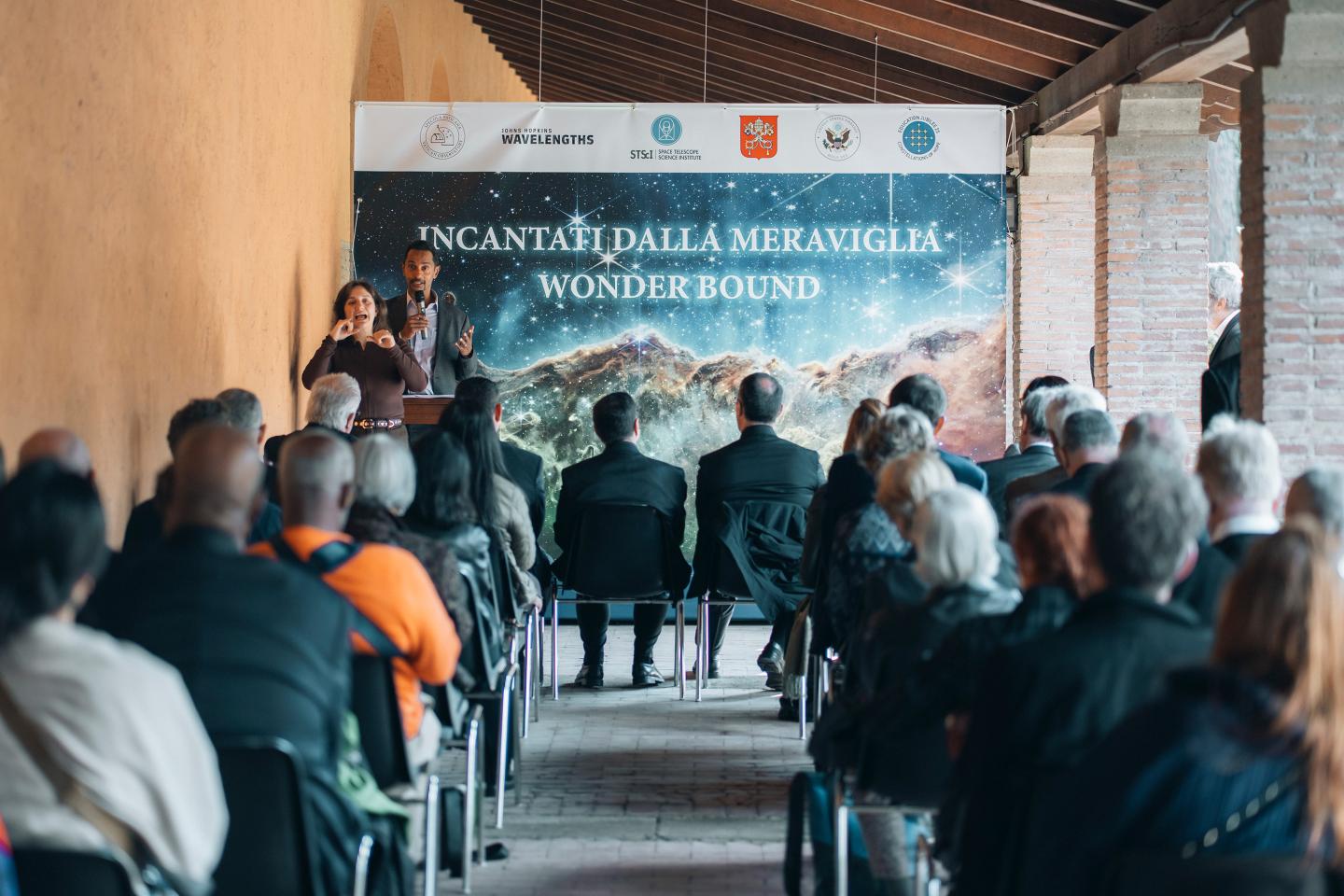
Image caption: Johns Hopkins University Provost Ray Jayawardhana speaks at the opening event for Wonder Bound in Castel Gandolfo, Italy
A team from the Johns Hopkins Provost's Office—including Anna Marlis Burgard, director of strategic engagement for the Wavelengths program in the Office of Research; Julie Messersmith, chief of staff and associate vice provost for strategic initiatives; and Emily Henson, director of provost's communications—worked with the scientists and the Vatican Observatory to arrange and curate the exhibit.
One of the most iconic images is that of the "cosmic cliffs," enormous plumes of gas and dust that measure up to seven light years tall and look like a rust-colored mountain range against a star-studded sky. Captured by JWST in infrared light, the image "provides us with some of the best insights yet into a complex region where young stars shape the very forces that created them," said Stiavelli, who led the JWST mission office at STScI from 2012 to 2024.
The pope's astronomers
The Vatican Observatory is among the oldest astronomical institutes in the world, tracing its roots back to 1582 when Pope Gregory XIII commissioned a study of the scientific data and implications involved in the Gregorian reform of the calendar—an effort undertaken to better align church holy days with their respective seasons.
Through the late eighteenth and early nineteenth centuries, several pontifical observatories were established throughout Rome, including one on the roof of St. Ignatius of Loyola church, where Jesuit priest Father Angelo Secchi—often referred to as the father of astrophysics—first classified stars according to their spectra, a technique still widely used in research today.
The Vatican Observatory in its current form was formally established in 1891 under Pope Leo XIII, who sought to affirm the church's commitment to "true and solid science." From a hillside behind the dome of St. Peter's Basilica, Vatican astronomers studied the heavens, including taking part in an ambitious international project to map the whole sky.
As Rome's light pollution grew, the observatory was moved to Castel Gandolfo on the grounds of the papal summer residence overlooking Lake Albano. It was there, through one its telescopes, that Pope Paul VI peered at the moon on the night of July 20, 1969, when Apollo made its historic lunar landing. Afterward, he radioed a message to the astronauts, praising their bravery for overcoming fear to take another step toward "knowing more of the universe."
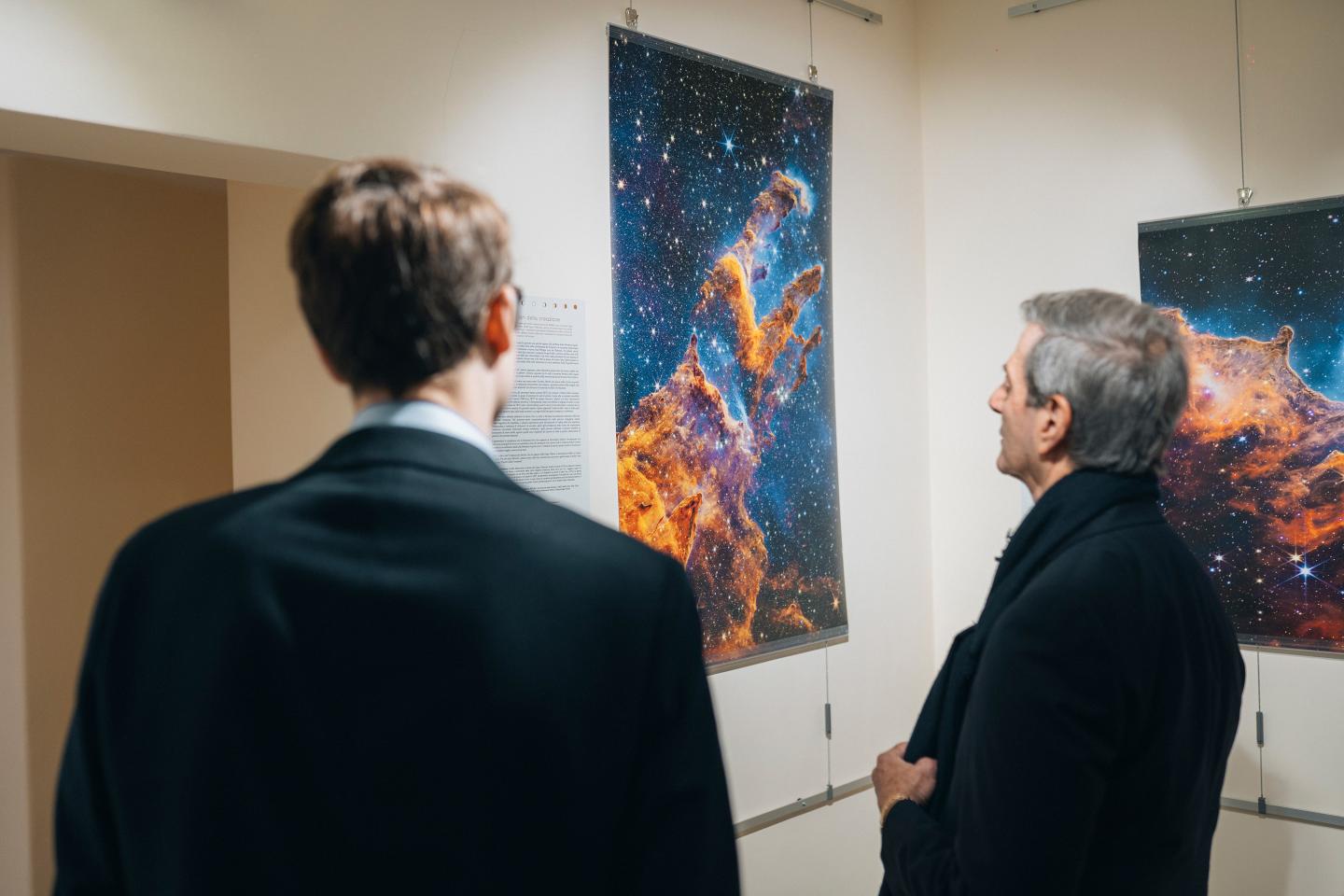
Wonder Bound is set against this rich history of astronomical inquiry and centuries-old conversation between the church and science.
Guy J. Consolmagno, a planetary scientist and meteor expert who is also a Jesuit brother and director emeritus of the Vatican Observatory, helped guide the vision and collaboration behind the exhibit.
"These remarkable images make you feel like you're immersed within the nebulae and the galaxies themselves," said Consolmagno, who met Burgard during a retreat in 2023, sparking the novel collaboration. "Displaying their beauty and the wonderful scientific discoveries connected to them are ways that we give glory to their Creator."
Wonder Bound will remain on view at the observatory's Specola Gallery for a year, after which the images will become part of the Papal Palace's permanent collection. It is also available for view on Bloomberg Connects. The exhibition is sponsored by Johns Hopkins Wavelengths, a program dedicated to connecting cutting-edge research with public audiences.


