
'As our country approaches its 250th birthday, it is fitting to give quality care to the vets who struggled and sacrificed'
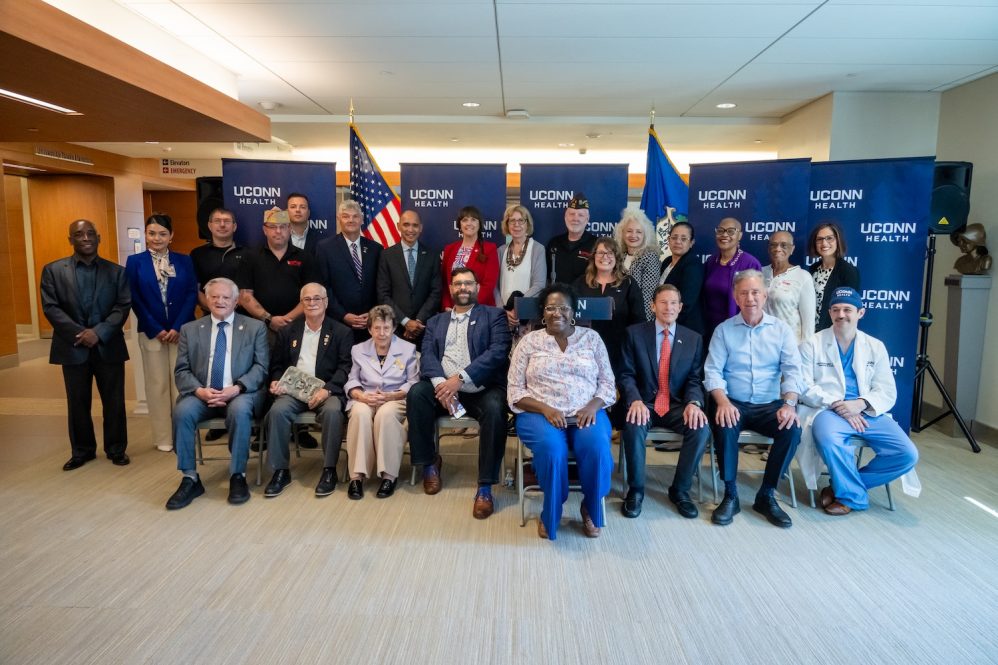
UConn Health hosted a Neuromodulation Center of Excellence for Veterans Launch Celebration on July 2, 2026. Gov. Ned Lamont, Sen. Richard Blumenthal, and several Connecticut legislators, representatives from the Department of Veterans Affairs several veterans, and UConn Health leaders and providers attended the press conference. (Tina Encarnacion/UConn Health photo)
Connecticut Gov. Ned Lamont met with Sen. Richard Blumenthal and Connecticut state legislators, veterans, and surgeons on July 2 to celebrate the one-year anniversary of UConn Health's cutting-edge neuromodulation center for advanced stroke rehabilitation.
Stroke is one of the leading causes of disability in people 60 and over, according to the Centers for Disease Control. It happens when part of the brain loses access to blood supply, and brain cells are damaged and die. Many people who have a stroke recover only partially, and may not be able to use their upper body or hands, severely limiting their ability to eat, write, or do other every day activities on their own.
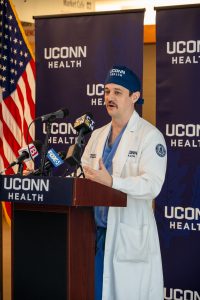
UConn Health neurosurgeon Dr. Christopher Conner was the first to offer stroke patients the Vivistem implant, an innovative technology that uses vagus nerve stimulation to push the brain to rebuild connections with the arms and hands. The UConn Health Neuromodulation Center of Excellence in the Brain and Spine Institute provides veterans with access to the Vivistem implant technology. The implant is FDA-approved but many health insurers, including the US Department of Veterans Affairs' VA health care, require onerous paperwork and approvals before they will pay for it. UConn Health is working to make it easier to access.
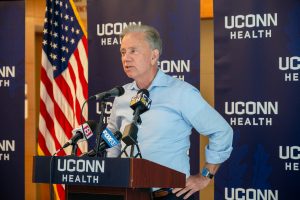
"This could help people regain use of their limbs," Gov. Lamont said, joking that the first time he heard the term neuromodulation he had to ask first ChatGPT, and then UConn Health CEO Dr. Andy Agwunobi, what it meant. But all joking aside, the governor emphasized the importance of the center and its work to make vagus nerve stimulation for stroke victims a standard, easily accessible part of stroke rehabilitation in Connecticut and beyond.
The state provided $2 million in initial funding for the program, thanks to efforts spearheaded by state representative Henry Genga, state senator Cathy Osten, and the Veterans with Disabilities Taskforce. The Vivistem implant surgery is done at UConn Health, and the ongoing rehabilitation therapy is done at Hartford Healthcare.
"This center for excellence is groundbreaking. So, so important," Sen. Blumenthal said, remarking that the invisible wounds of war are a heavy burden on our country's veterans. He referred to the $2 million in initial funding as a "great down payment" and said he is actively working on the federal level to obtain more funding for the center.
The center has treated 35 patients with the neuromodulation therapy so far but hopes to make the treatment much more widely accessible.
"From the outside, you look like there's nothing wrong. But there's something dreadfully wrong," for patients with neurological injuries from war or stroke, said Conner. Conner says after seeing how the Vivistem implant can make an enormous difference in people's quality of life, he feels compelled to make it easier to access.
"We want to get a big case study together and show it works," in a way that is undeniable, so insurers cover it as a matter of course, Conner said. Conner is also working on using the neuromodulation technology to help patients suffering from traumatic brain injury.
Members of the Veterans with Disabilities Taskforce spoke with legislators about the need to help as many veterans as possible.
"As our country approaches its 250th birthday, it is fitting to give quality care to the vets who struggled and sacrificed" to preserve the ideals on which America is founded, said retired Brigadier General and Connecticut Commissioner of Veterans Affairs Ron Welch.
Stroke survivors, caregivers and healthcare professionals interested in discovering how Vivistim Paired VNS Therapy helps improve upper limb function can visit Vivistim.com or contact the Neurosurgery Department at UConn Health's Brain and Spine Institute.


