
Kristina Hook draws on her long-term ethnographic fieldwork in Ukraine providing a zoomed-in view of the war as it is lived and fought
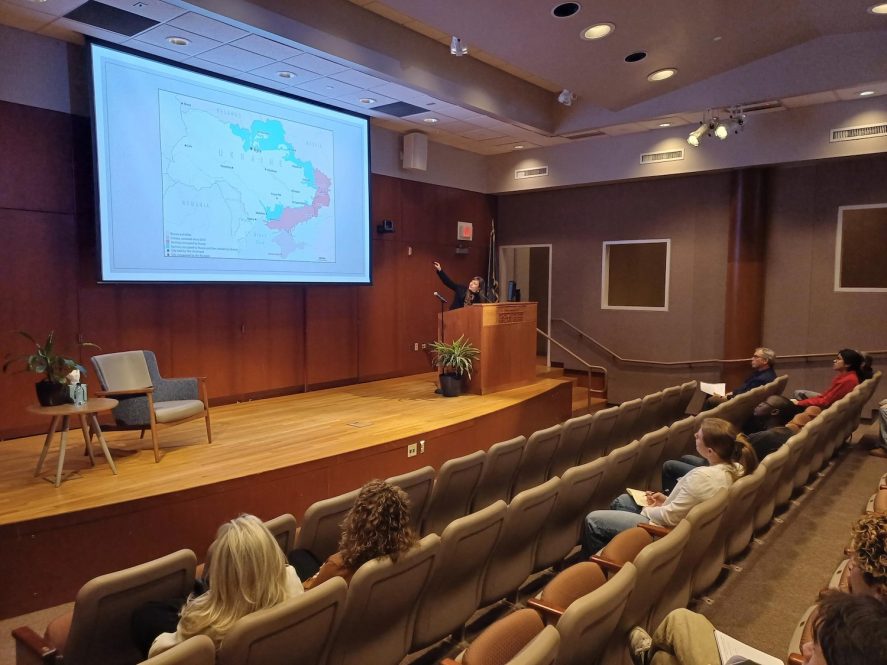
(Anna Heqimi/UConn Photo)
Russia escalated its war against Ukraine on Feb. 24, 2022, expanding an armed conflict and pattern of mass atrocities that began in 2014 and continue today.
Kristina Hook, an assistant professor of conflict management at Kennesaw State University, has conducted extensive fieldwork in Ukraine since 2015 and visited the University of Connecticut on April 23 to deliver a workshop and presentation that shared war trends and human experiences.
As an anthropologist specializing in analyzing genocides, Hook has worked in more than 30 countries across Eastern Europe, the Balkans, the Middle East, East Africa, Southeast Asia, and the Caribbean.
Last year saw the highest civilian death toll recorded in Ukraine since 2022, although since Russia occupies around 20% of Ukraine today, the exact number of casualties and atrocities are unknown. Hook said one example of the atrocities is "human safari" campaigns, in which Russian soldiers target and kill civilians using first-person view drones.
Hook said it's important to listen to Ukrainians tell their stories, since they're the ones who see the killing firsthand. When analyzing crimes against humanity through data and institutional-based frameworks, researchers often negate the power of listening to the people in the crosshairs.
"We need to listen. We need to believe," said Hook as she challenged the audience to think about who should be considered subject-matter experts in atrocity prevention.
Hook said the Ukrainian people find the country's history to be a source of strength, for instance the Holodomor that occurred from 1932 to 1933. It was a man-made famine executed by the Soviet Union that led to the deaths of millions of people.
Ukrainians are in the midst of it all, analyzing historical and present-day war patterns, and Hook said they have ideas on how to protect themselves – they just need to be heard and believed.
Hook said the "cost of the genocidal war that Russia is waging will begin to touch their pocketbooks," as Ukraine's drone interceptors cost significantly less and are striking down Russia's drones. It's one way that Ukraine is neutralizing Russia's operational capacity to wage war and protect civilians.
After the start of the war in 2022, the increase in atrocities coincided with topics of genocide retreating from the media, said Hook.
"When there is no media, the perpetrators thrive," she said, adding that there needs to be policy responses to show the perpetrators there will be consequences, including personal sanctions and travel bans.
This summer, Hook will return to Ukraine to continue her research and said she is looking forward to publishing her book 11 years in the making , "When the Ukrainian Sun Rises: From the Holodomor to the Frontlines in Moscow's Century of Violence. "
April is Genocide Awareness Month, which serves to remember those affected by mass atrocities, deepen understanding of genocide's underlying causes, and promote efforts to prevent future violence. The workshop and presentation were hosted by the Program in Holocaust and Genocide Studies (HGS) at the UConn Gladstein Family Human Rights Institute.


