Rutgers scientists uncover evidence that deep-sea salinity helped lock away carbon dioxide levels during the last ice age
Climate change has many culprits, from agriculture to transportation to energy production. Now, add another: the deep ocean salty blob.
In a groundbreaking study of ancient ocean geochemistry, a Rutgers researcher and a former Rutgers graduate student have found evidence that the end of the latest ice age some 18,000 years ago, a period of rapid planetary warming, coincided with the emergence of salty water that had been trapped in the deep ocean.
The findings, published in the journal Nature Geoscience, shed new light on how salt levels in the Earth's deepest waters may influence the amount of carbon dioxide - a principal heat-trapping gas - in the atmosphere.
"In today's oceans there are different major water masses, and each has a distinctive salinity," said Elisabeth Sikes, a professor in the Department of Marine and Coastal Studies at Rutgers-New Brunswick. "Researchers have long speculated that deep ocean salinity levels were linked to changes in atmospheric carbon dioxide across ice age cycles. Our paper proves it."
Oceans contain vast amounts of carbon dioxide, which absorbs infrared energy and contributes to global warming. Much of this carbon is taken up by marine organisms at the surface during photosynthesis. As these organisms live, die and sink, their remains break down and release the carbon dioxide into the deep waters. The differences in salinity of the deep layers of the ocean help form a barrier between the layers, keeping the gas from returning to the atmosphere.
Warming and cooling are cyclical, and this speeds up and slows down ocean overturning circulation - known as "the global ocean conveyor belt." During warm periods, like today, the ocean circulates faster, keeping deep water from gathering as much carbon dioxide. When ocean circulation slows and denser water sinks in cool regions, more carbon dioxide is trapped with it. Eventually, the accumulation of carbon dioxide in the deep ocean helps cool the planet, and the cycle repeats.
During the latest ice age, which peaked about 20,000 years ago, the deep ocean stored carbon dioxide more efficiently than today, Sikes said, which helps explain why average temperatures were much lower.

Scientists know that the planet's warming at the end of the last ice age was marked by a huge release of the carbon dioxide from the deep ocean. But what happened to the salt that supposedly helped lock carbon dioxide away has remained a mystery.
"The exact mechanism, the actual physical explanation for why that happens, is something researchers have been trying to resolve," said Ryan H. Glaubke, a postdoctoral research associate at the University of Arizona and lead author of the study. Research for the study was conducted while Glaubke was a graduate student in Sikes' lab at the Rutgers School of Environmental and Biological Sciences.
"This paper supports the idea that it's the salinity of deep ocean water - the 'salty blob' - that keeps carbon dioxide locked away for long periods of time," Glaubke said.
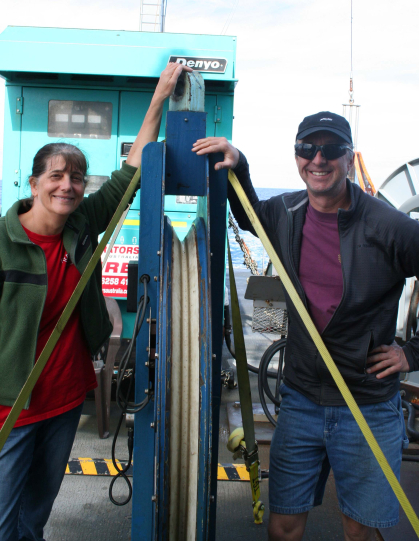
To reach this conclusion, Glaubke and Sikes analyzed the geochemical composition of sand grain-sized microfossils - formed by single-celled creatures called foraminifera - in marine sediments that they collected from the boundary of the Indian and Southern oceans, off the coast of western Australia.
The microfossils preserve information about the water in which they formed, including its salinity, Sikes said.
The researchers used these microfossil data to reconstruct a record of local salinity levels and found that at the onset of the last deglaciation, the shallow waters of the upper Indian Ocean suddenly became much saltier for several thousand years. This increase corresponded with other geochemical "fingerprints" that confirm the salt originated from the deep ocean.
The findings, the researchers said, are evidence of the crucial role the Southern Ocean plays in planetary climate. This is because it is one of the few places that truly deep waters - with their high load of carbon dioxide - surface and "exhale" the gas back into the atmosphere.
As researchers continue to study the current period of warming, they cannot neglect what happens in the Southern Hemisphere, Sikes said. While the ocean has absorbed about a third of all carbon emissions from human activity, without the deep ocean's "salty blob," carbon dioxide is stored less efficiently.
"In a way, the ocean has been our greatest champion in the fight against climate change," Glaubke said. "But without a pronounced 'salty blob' like the ancient glacial ocean had, it can't hold on to our carbon emissions forever."