An extra level of information gives new insights into a longstanding assumption
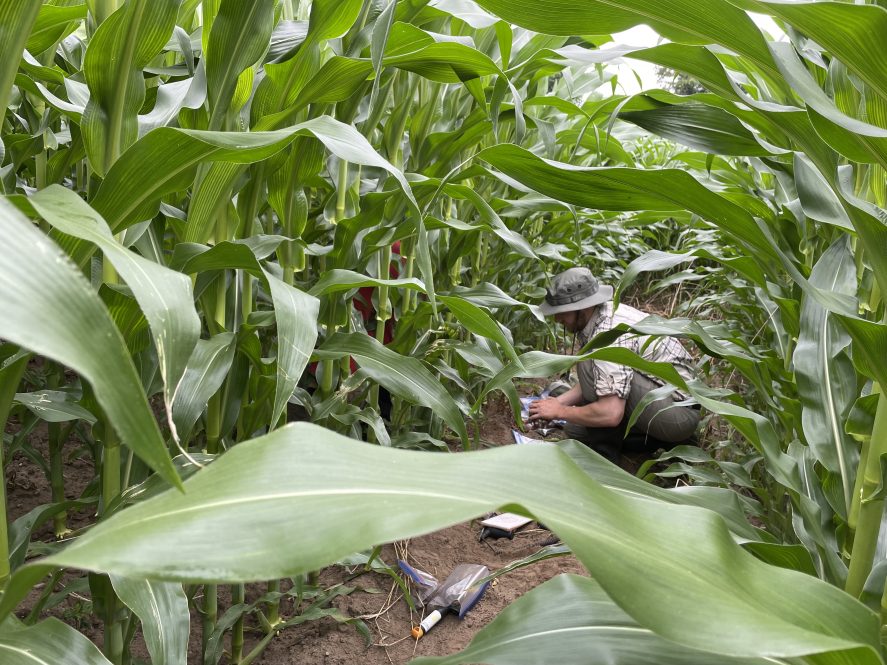
PhD student Joshua Snarski is using stable water isotopes to study how water is stored and released from soil in agricultural settings. (Contributed photo)
When it rains, what happens to the water once it enters the soil? Does the new precipitation mix with all of the water that was already there? In their recent paper in Water Resources Research, Department of Natural Resources and the Environment Ph.D. student Joshua Snarski and assistant professor James Knighton show the answer is more complicated than previously assumed, but knowing the age of water gives a more accurate picture.
Hydrologists use models to simulate what is happening in natural systems. Since hydrologic processes are complex, researchers need to make assumptions about some aspects, such as how water mixes within the soil profile. Though previous hydrologic research is focused on the amount and timing of precipitation, Snarski says shifting the focus to the age of water within the soil profile can reveal more about what is happening beneath the surface.
For this project, the researchers determined the age of water in the soil by looking at the stable water isotope compositions of soil water samples through time. Stable water isotopes are naturally abundant in the environment and do not interact with other elements within the system, Snarski explains, which makes them powerful tracers. Each rainstorm releases water with a unique isotope signature, allowing each precipitation event to be tracked.
"Precipitation acts as water inputs to the soil and assigning these 'new' water inputs with an age of zero days allows us to 'start the clock' on the soil water aging," says Snarski. "We collect precipitation and soil water samples to create a record of the volume and isotope signature of both the new water entering the soil and the existing water within the soil."
The researchers use these two water records to estimate the age of water in the soil profile over time. If you imagine a drop of rain traveling down through layers of soil, knowing the age of that water indicates its pace of movement, and that can provide insight into how water is stored within and released from soils. This information is especially crucial in agricultural settings, as farmers need to decide when and how much fertilizer to apply to fields to support crop growth.
The researchers focused on agricultural fields during the growing season, Snarski explains, which experience the most fertilizer applications and the dryest soil conditions, due to less precipitation and more water uptake by plants. This combination can lead to high concentrations of dissolved compounds in the soil water.
"When we see young water in deeper soil layers, we know that water is moving quickly and carrying with it dissolvable compounds, such as nutrients and pollutants," says Snarski. "If dissolved nutrients move too quickly through the rooting zone, crops can't access them, and they become a contamination risk for groundwater and surface waters. While fertilizers help farmers produce high crop yields, they pose a potential risk to nearby waterways. If excessive amounts of nutrients are quickly flushed to groundwater or transported with surface runoff, they can enter waterways and lead to eutrophication and hypoxia."
Next, the researchers calibrated two hydrological models to their soil water volume and isotope tracing data to test the assumption that soil water mixes fully. The first model assumed new water mixed fully with old water in each soil layer, while the second model allowed new water to bypass old water under certain conditions.
"The second model separates the soil profile into two groups: small and large soil pores. Basically, the small pores hold water under high tension, but can be drained by plant water uptake, while the large pores can replenish the small pores or percolate to deeper soil layers," says Snarski. "This simple separation of the soil by pore size allows for younger water in the large pores to bypass older water in the small pores."
The full mixing model estimated that the average age of water leaving the rooting zone in the mid-summer months was between 35 and 40 days old. This was a big difference to the model that considered pore size, which estimated that the age of water leaving the rooting zone was 10 to 15 days old. The collected soil water volume and water isotope data indicated that the second model was more accurate and better reflected conditions in the field, says Snarski. The results indicate that young water can bypass older water and that full mixing assumptions need to be reconsidered in hydrologic models. It also emphasized the importance of tracer data along with the volume of water.
"Because we have this extra level of information, the concentration of stable water isotopes, we were able to estimate the age of water through the profile," says Snarski. "If we were just measuring the amount of water in the soil, we wouldn't know how long it's been there, what pathways it traveled along, and which other sources of water its mixed with."
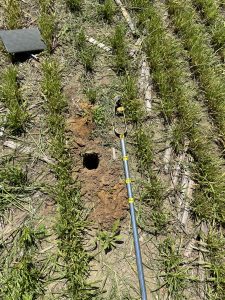
Snarski was surprised by how quickly the water was flowing through the rooting zone. This means that dissolved nutrients applied just before or during the summer may only be accessible to crops for between one to two weeks before entering deeper soils. This is a big problem not only in terms of crop growth and fertilizer costs, but also presents a concern for drinking water contamination. Knowing how water flows through the soil is an important detail that can help make agricultural practices more efficient, and it can be used to improve hydrologic models. This work also illustrates the nuances in effective modeling, Snarski explains.
"George Box put it well when he said all models are wrong, but some are useful. To make models more realistic, you must account for more processes, which quickly adds complexity. More complex models require more input data and a more experienced modeler to use them," says Snarski. "So, it comes down to a cost-benefit analysis. Does the improvement in the modeling results outweigh the cost of the added complexity? In our case, our second model has a more complex soil profile framework, but it better simulates soil water movement in the field and updates our understanding of how quickly water leaves the rooting zone."
Snarski is now looking at what other factors influence these dynamic processes.
"After controlling for soil type, landscape position, and climate conditions, we are looking at whether soil management in different crop fields effects the water ages through the soil profile," says Snarski. "If we see similar water ages across the various crop fields, crop type and soil management practices likely have a small effect on soil water movement. If we see large differences in the soil water ages, we will need to consider incorporating these factors into future models."