
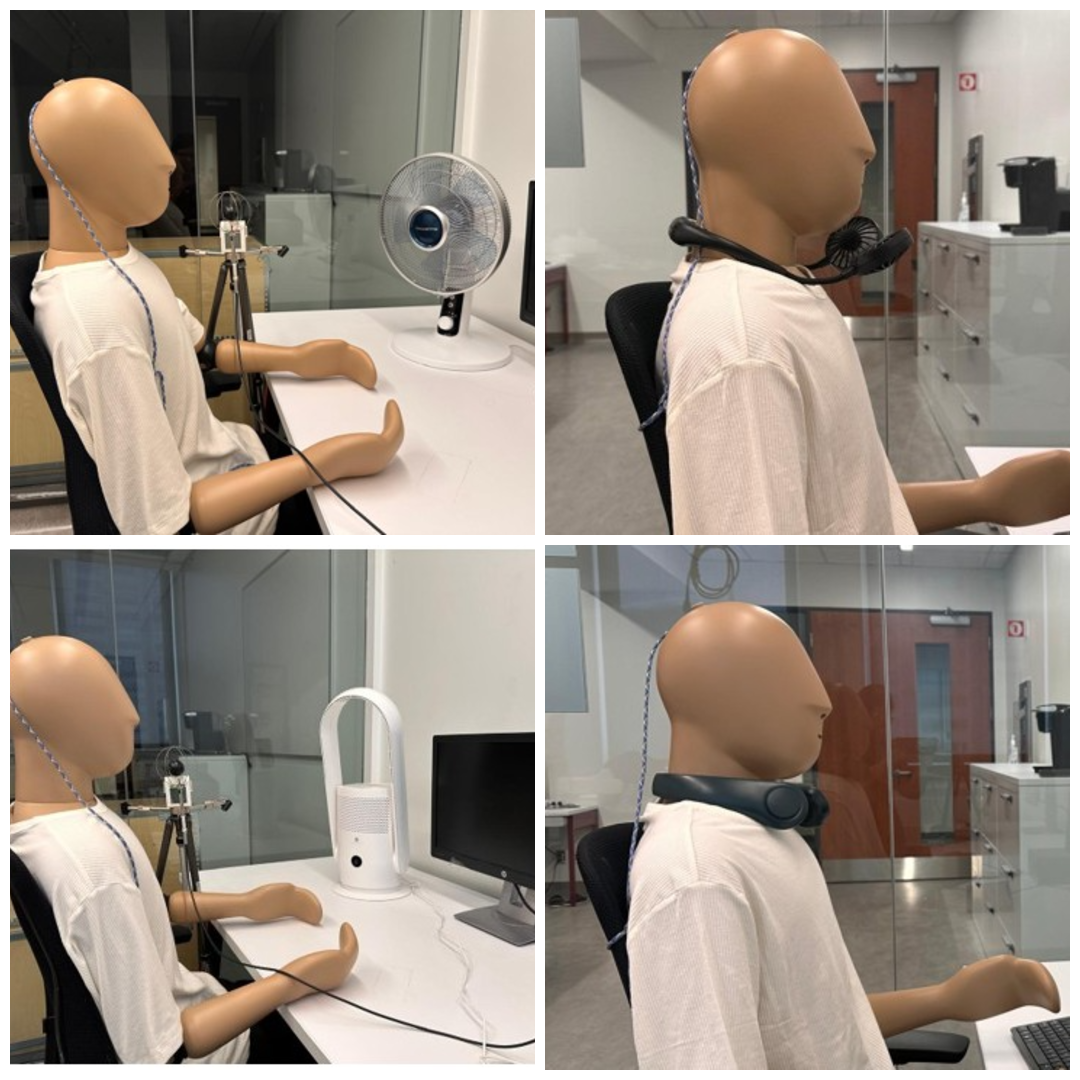
 Images courtesy Tazia Rahman
Small wearable fans that cool the face and neck can keep people almost as comfortable as conventional desk fans, according to a new study from Concordia researchers. Aside from taking up less space, these lightweight alternatives also use less power and avoid unwanted drafts that can bother nearby coworkers.
"These fans provide a way to still operate a centralized HVAC system while using less energy," says Mohamed Ouf, study co-author associate professor in the Department of Building, Civil and Environmental Engineering. "Targeted cooling is especially useful in cases where you have a few people occupying a large space, such as in places that emphasize hybrid work arrangements."
While the face and neck make up only about 5.5 per cent of the body's surface, they are especially sensitive to temperature. Researchers compared two types of wearable personal cooling devices - a face fan and a neck fan - with both bladed and bladeless desk fans. The team found that directing airflow to this region produced nearly the same improvement in overall thermal comfort as desktop fans.
The researchers tested the four devices in a controlled office environment set to 25 degrees Celsius using a sophisticated anatomical model (manikin) that simulates how the human body regulates heat. The 23-segment model measured changes in skin temperature, heat loss and overall thermal comfort while each fan operated at different speeds.
As expected, the bladed desk fan provided the strongest cooling. But the wearable face and neck fans closely matched the performance of the bladeless desk fan, delivering comfort comparable to a low-speed bladed fan.
The face fan produced the greatest localized cooling, increasing heat loss from the face by as much as seven watts, while both wearable devices cooled users enough to bring thermal comfort back into the neutral range.
The findings suggest that wearable fans could become a practical tool for reducing energy use related to air conditioning in offices, especially in cases where a few people are occupying a large space, such as hybrid workplaces.
This study was presented at the 12th International Conference on Indoor Air Quality, Ventilation & Energy Conservation in Buildings, held in May at the University of Southern California in Los Angeles, USA. The corresponding author is Tazia Rahman, MEng 2025. Additional research by Joyce Kim and Kehinde Bayode at the University of Waterloo.
Read the paper: "Comparative cooling efficiency of wearable and non-wearable personal comfort systems in office settings


