
Autumn update
Cooling autumn weather has not deterred the amazing work being done by our passionate staff, dedicated community groups and Traditional Owners. Together, we're powering way to get the fence started, building the Prom Sanctuary to conserve nature and fight extinction at Wilsons Promontory National Park.
Here are some recent highlights:
Bushbank: Last update, we shared that we'd started the second season of seed collection. Throughout autumn, we've collected heaps of seed for the Bushbank project. Excitingly, Parks Victoria staff have been able to use spatial imagery to identify and map eucalypts on the Yanakie Isthmus before contractors went out to groundtruth the mapping and determine which eucalypt species are present. This allowed us to identify and map two significant, healthy populations of Snow Gums (Eucalyptus pauciflora).
This is an incredibly exciting discovery for the Prom, as this species faces a variety of threats across its fragmented and declining distribution in Victoria. Given the great health of these Prom snow gums, seed was collected to go into storage as an insurance against future impacts on this species.
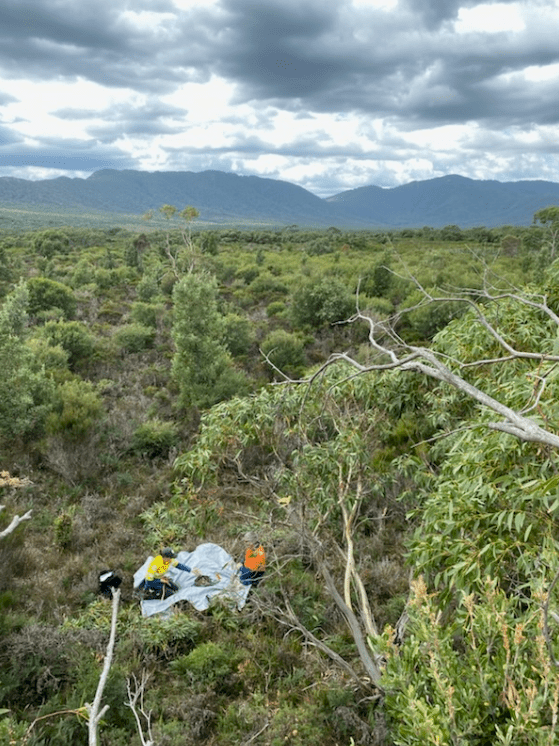
Caption: Sorting Snow Gum (Eucalyptus pauciflora) seed. Credit: Parks Victoria
Island weed works: Two trips to Bennison and Doughboy Islands in Corner Inlet were undertaken earlier in the season. Contractors were taken via boat, and camped overnight on the islands to treat various weeds. This included:
- Mirror Bush (Coprosma repens) and
- Blue Periwinkle (Vinca major)
Similarly, helicopter transport to Kanowna Island, allowed undertook a two-day effort controlling woody weeds, joined by staff from First Nations corporations. Corner Inlet and Kanowna Island are significant sites for international migratory birds. Controlling these invasive weeds islands improves the habitat for both the birds and the many other plants and animals that live on these offshore islands.
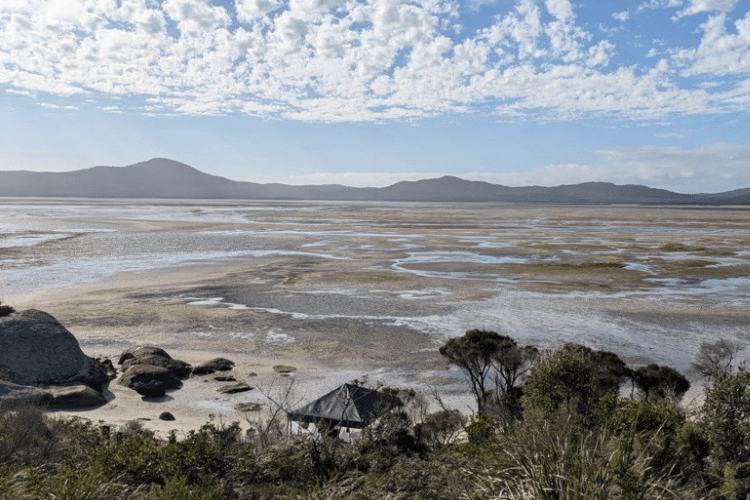
Caption: Bennison Island. Credit: Parks Victoria
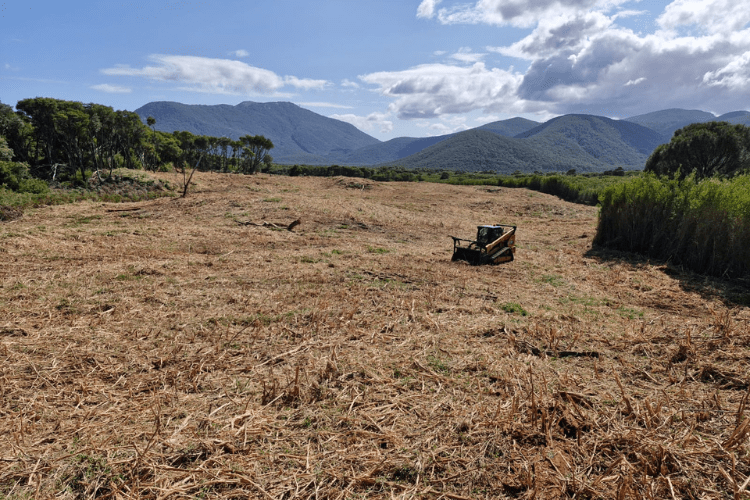
Caption: Mulching efforts in Oberon Bay. Credit: Parks Victoria
We've also expanded mulching works into new areas, with White Kunzea (Kunzea ambigua) being treated along 5 Mile Road. Like coast tea tree, kunzea is a native species that can form monocultures that outcompete all other plant species, massively impacting a healthy diversity of native plants and animals. Mulching on the heathland is critical in supporting a wide range of threatened species such as the Eastern Ground Parrot (Pezoporus wallicus) and Southern Brown Bandicoot (Isoodon obesulus).
One of Parks Victoria's lead project officers on this work, Lauren, recently presented at the Grassland Resurrection Forum in early May. This forum brought together Traditional Owners, land managers, researchers and conservationists to share knowledge and management strategies for managing Victoria's grasslands, with less than 2% remaining in the state.
Protecting our flora and fauna
The summer breeding season for Hooded Plovers (Thinornis cucullatus) wrapped up in April with two fledglings for the Prom, one at Whisky Bay and one at 5 Mile Beach! It's been approximately 5 years since we've been aware of a successful fledge at the Prom during breeding season.
Monitoring Hooded Plovers is made possible by the support of BirdLife Australia, volunteers, and Parks Victoria staff. A huge thank you to everyone who has been involved.
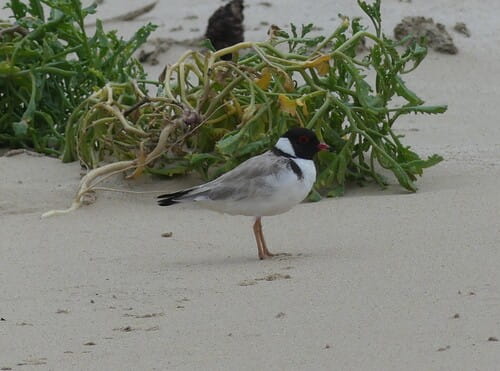
Caption: A hooded plover on the beach at Wilsons Promontory. Credit: John Newman, some rights reserved (CC BY-NC) via iNaturalist.
Sea Spurge (Euphorbia paralias) is a highly invasive coastal weed that forms dense populations which outcompete native vegetation, alter sand dune structure and reduce available habitat for fauna, including the threatened Hooded Plover. All efforts are critical in helping our new fledglings any way we can!
Current control methods have focussed on treating the species like any other weed – spraying and manual removal. However, through the CSIRO's national initiative, the fungus Venturia paralias was released at two locations along Cotters Beach in April.
Parks Victoria and Friends of the Prom volunteers worked together to release the fungus that damages the leaves and stems of sea spurge, reducing its reproductive capacity. Extensive research showed the fungus is highly specific to sea spurge and poses no risk to Australian flora.


