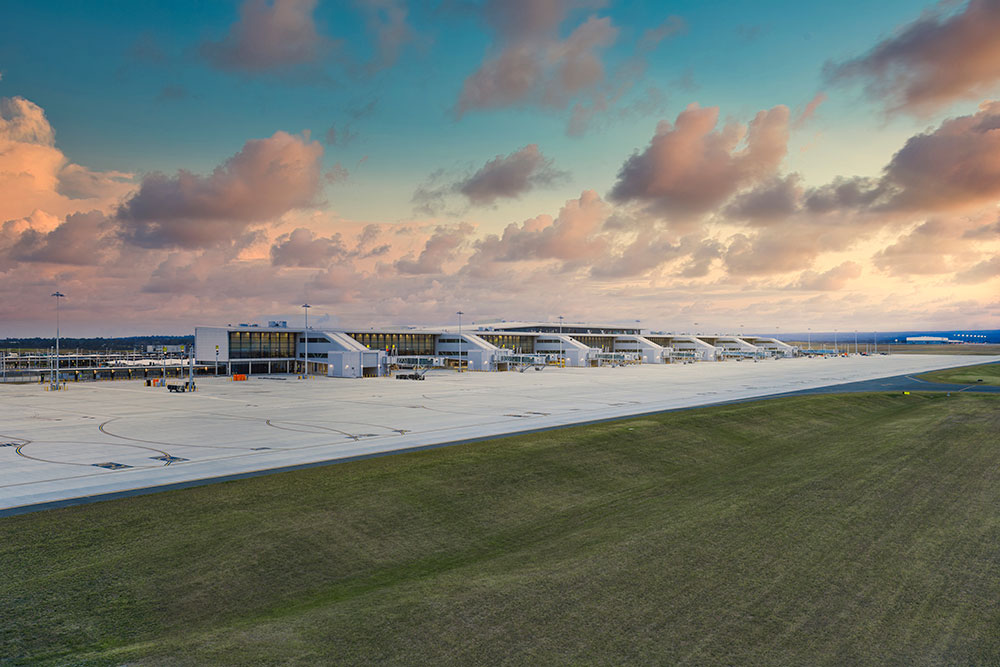
When the first international passenger arrives at Western Sydney International (Nancy-Bird Walton) Airport (WSI) on Monday 26 October, Australia's biosecurity system will be ready.
Teams from across the Department of Agriculture, Fisheries and Forestry (DAFF) have worked diligently in designing, preparing and testing the infrastructure, technology and operational capability needed to protect Australia at its newest international gateway.
Minister for Agriculture, Fisheries and Forestry, Julie Collins recently visited the airport to see our biosecurity capability ahead of the commencement of international passenger services. The visit highlighted the significant work undertaken to establish a modern, integrated biosecurity operating environment that supports safe travel and trade while maintaining Australia's strong biosecurity protections.
The opening of WSI represents a major milestone for Australia's border operations. Dedicated teams from across the department have established new biosecurity facilities, prepare a highly skilled workforce and deployed advanced screening technology that will support biosecurity operations from the airport's first international arrival.
Deputy Secretary, Biosecurity, Operations and Compliance Group, Justine Saunders, said the achievement reflected years of collaboration and preparation across the department and across government.
"WSI demonstrates what modern biosecurity looks like."
"Together, our teams have delivered a future-focused biosecurity capability that will support safe trade and travel while protecting Australia's agriculture, environment and way of life from day one."
"Biosecurity doesn't stop. I am incredibly proud of the teams whose diligence and dedicated work have made this milestone possible."
Among the new capabilities is a purpose-built whole-of-government canine facility, a shared Command Centre, incorporating a contemporary laboratory to undertake scientific diagnostic assessment of exotic pests and diseases, specialist examination facilities and next-generation 3D X-ray technology integrated into the airport's baggage handling system. Together, these capabilities strengthen Australia's ability to identify and manage biosecurity risks before they can impact Australia's agriculture, environment and economy.
Detector dogs ready for the new gateway
Six biosecurity detector dogs have also been trained and deployed in preparation for international flight operations. Working alongside their handlers, biosecurity officers, intelligence and advanced screening technology, detector dogs will provide another important layer of protection at Australia's newest international gateway.
The department's detector dogs already play a significant role in protecting Australia. In 2025 alone, our biosecurity detector dogs intercepted more than 45,500 biosecurity risk items at international airports and mail gateway facilities.
The new whole-of-government canine facility will support detector dog operations today while providing capacity for future growth. The facility includes a range of amenities for our staff and detector dogs and those from Australian Border Force and Australian Federal Police.
Designed around the health, training and operational needs of detector dog teams, the purpose-built facility includes dedicated areas for health management, hydrotherapy and conditioning, training and exercise.
Technology supporting the frontline
Detector dogs are only one part of the biosecurity capability being prepared for international passenger operations. Two state of the art 3D X-ray units have also been integrated into the airport's baggage handling system, adding another layer to our approach to identifying biosecurity risks.
The technology gives our biosecurity officers detailed images of passenger baggage, helping them focus on higher risk baggage and make more informed operational decisions.
When international passenger services begin, our highly skilled biosecurity officers, detector dog teams, advanced screening technology and scientific diagnostics will work together to manage biosecurity risks at Australia's newest international gateway.
It's another part of the work we do every day to help prevent harmful pests and diseases entering Australia and protect our agriculture, environment and way of life.