
UConn researchers help steer the field in new publication

Students perform an electromagnetic experiment at Dr. Joseph S. Renzulli Gifted and Talented Academy in Hartford. (Peter Morenus/UConn Photo)
While gifted and talented education programs can be found in most public schools in the country, there is no federal standard for how they are carried out - or how students are selected for them.
For educators and education researchers, this presents a problem. How can we be sure that gifted programs are fulfilling their purpose: helping ensure students are adequately challenged and supported in school? This mission is especially critical in today's era of widespread budget cuts to public education.
Scholars at the National Center for Research on Gifted Education (NCRGE), headquartered at UConn, recently completed a study exploring how gifted education is carried out in three US states. The findings, published in the journal Gifted Child Quarterly, provide insights into the impacts and efficacy of these programs - as well as ways they can be improved.
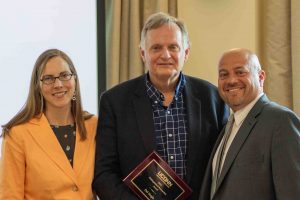
"We're seeing that there's a lot of very bright kids who are not achieving at the rates we would expect them to be achieving, and when we examine that data, it's really evident that we're leaving a lot of talent on the vine, so to speak," says Del Siegle, the study's first author (and the Lynn and Ray Neag Endowed Chair for Talent Development in UConn's Neag School of Education). "We need to do a better job of identifying kids for these services, and then we need to do a better job providing these services."
Fostering gifted education has been a lifelong mission for Siegle, who is the director of the NCRGE and of the Renzulli Center for Creativity, Gifted Education, and Talent Development. He hopes this new research can help steer the future of the field.
Challenges in Identification
The definition of giftedness has been evolving ever since it was coined in the early 20th century. At first, students were identified as gifted based solely on IQ scores. That's no longer the standard, as subsequent decades of research have shown the limitations of IQ evaluations - like cultural biases, and their focus on a single axis of intelligence (neglecting creative and emotional intelligence, for instance).
Siegle believes that in today's world, gifted identification should be pursued from the standpoint of a "talent scout, not a deficit detective."
"We need to be all about providing opportunities," he says. "That's much more important than saying, 'This kid's gifted, this kid's not gifted.' We should be less worried about stamping this label on kids, and more concerned with providing opportunities to develop kids' talents."
In this paper, the researchers note that most school districts now use multiple methods of analysis for identifying gifted students, such as achievement tests, creativity tests, and behavior rating scales. But these metrics are also not free from bias, and many gifted programs still rely on individual referrals from teachers rather than instituting a universal screening program, presenting another opportunity for potential bias. In other words, there are still plenty of cracks for students to fall through.
"We have confirmed that there is this issue of under-representation," Siegle says. "Some populations aren't being served by gifted programs to the extent they should be."
In this study, the researchers identified a few key takeaways to help combat bias in the identification of students for gifted programs. One common hurdle they identified was simply the year in which gifted identification takes place - typically in the second or third grade. By this point, significant achievement gaps have already emerged between underserved students and their peers.
"If gifted programs offer significant benefits, historically underserved groups face a double disadvantage - first by experiencing early achievement gaps, and then by having restricted access to advanced programs due to these initial disparities," the researchers write. So, they recommend, "Districts should consider initiating universal screening for giftedness in kindergarten or first grade rather than waiting until second or third grade."
Identifying gifted students in second or third grade poses another problem — if students are only assessed for gifted programs at this point, there is little opportunity for older students to enter these programs. Instead, the researchers recommend formal mandates for regular re-assessment of students. They also caution against relying on teacher or parent referrals alone, which they note may introduce subjectivity or delay access.
Finally, the researchers recommend another measure that could dramatically improve representation of ESOL (English as a second or foreign language) students in gifted programs: testing students in their native language.
"English learners are one of the fastest-growing populations of students we have in this country," notes Siegle. "We tend to put these kids' learning on hold [while they are learning English], which is such a travesty - we're ignoring the challenge and the opportunity here. If we can provide testing in their native language, then we can spot this talent earlier, and we can do something to develop it."
Programming and Curriculum
After students are identified for gifted education, what sort of educational programming do they actually receive? The answer varies greatly state by state. In fact, out of the 28 states that mandate gifted education programming, only half specify a mandatory minimum number of hours per week.
Many programs offer only 1-2 hours of instruction a week (even though, as Siegle says, "Gifted students are gifted all the time, not just for a couple hours"). And within this window, there is little standardization for what is taught - another area for improvement in the field.
The most common method for gifted programming is pull-out instruction, in which students are removed (pulled out) from their regular classrooms to receive specialized instruction.
Other methods include "push-in," in which a gifted specialist enters a regular classroom to work with students individually, and cluster grouping, in which gifted students are clustered together in a regular classroom to work with a teacher who has specialized training.
Siegle's research has found that schools/districts who implemented push-in instruction demonstrated higher academic achievement for gifted students. This suggests that the push-in model may be a beneficial technique for more schools to practice.
But the researchers also identified ways that the classic pull-out model could be improved to better support students' learning.
They were surprised to discover that the classes students were being pulled out of didn't necessarily correspond to the content of the pull-out instruction: for example, a child who is gifted in math may be pulled out of a language arts classroom to receive accelerated math instruction, potentially causing them to fall further behind in their weaker subject. The researchers strongly recommend that schools work to resolve this misalignment.
Every child deserves to learn something new every day.
They also recommend that districts regularly evaluate their own gifted programs to ensure alignment among student identification, curriculum, and service delivery. In the absence of federal or state standards for these metrics, it can be difficult to know where to start, but district self-evaluation can help with goal-setting and tracking performance over time.
Moving forward into the future of public education in America, Siegle would like to see a reinvestment in providing opportunities for all children, especially gifted children who are currently being under-identified or underserved.
"A lot of times what happens in schools is they try to figure out what a kid can't do, and then remediate it," says Siegle. "But that doesn't move us forward as a country, and that doesn't make school interesting for kids. Every child deserves to learn something new every day, and kids need an opportunity to develop their interests and strengths."
In this vein, Siegle is part of several research initiatives funded by the federal Jacob K. Javits Gifted and Talented Students Education Program. One, Project BUMP UP, is currently evaluating the efficacy of push-in math education for gifted students. Another, Project EAGLE, is offering no-cost workshops to help educators identify gifted students whose first language is not English.
In addition to Siegle, the research team for this paper included UConn educational psychology professor D. Betsy McCoach; E. Jean Gubbins, UConn gifted education professor emerita and associate director of the NCRGE; Rashea Hamilton, former UConn postdoctoral research associate; Gregory T. Boldt '24 Ph.D.; and Carolyn Callahan, commonwealth professor of education emeritus at the University of Virginia.


