
This story is part of an AI series looking at how WSU is driving innovation in research and teaching through artificial intelligence. View the entire series as it becomes available.
Designing robots to harvest fruit involves thorny challenges.
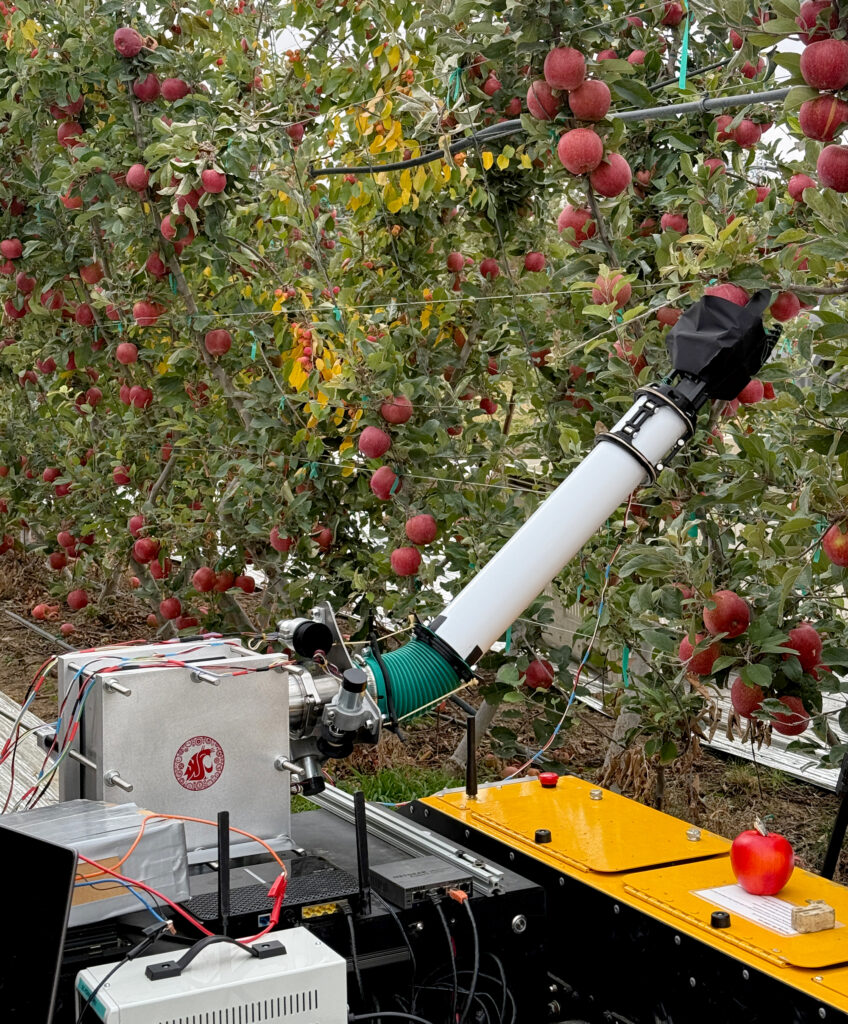
Robotic metal arms may damage tree limbs - so Washington State University researchers created a soft, inflatable robot arm to pick apples.
Strawberries are often tucked under leaves - so WSU scientists developed a system that uses AI-visioning to locate the fruit and guide a tiny blower that uses puffs of air to give the picker a clear path.
Such efforts to advance the automation of agricultural operations are moving forward at WSU, aimed at helping farmers confront growing labor shortages. While harvesting robots still have a ways to go before they are ready for routine use, the systems are being refined at WSU.
Automation is already in widespread use among field crops such as wheat and other grains, with GPS-guided tractors that can till and harvest with little human interaction. But there is further to go in orchards growing apples, cherries, grapes and other high-value perennial fruits, which have labor demands throughout the seasons.
"Basically, you're looking at a year-round need for labor," said Ananth Kalyanaraman, a WSU computer scientist who directs AgAID, an interdisciplinary institute of research, government and industry representatives from around the Pacific Northwest. "AI can help with infusion of robotics - some level of automation, some level of robotics, working hand-in-hand with humans."
Automation and robotics infused with AI are a key piece of the work WSU is doing to realize the farm of the future.
Automated irrigation systems are being tested that use machine learning to help drive decisions around water use for irrigation as well as cooling fruits and canopies in summer months. Drones are being deployed to gather data about crop stress, water use, and plant needs to feed machine learning tools. Fruit trees at demonstration orchards have been pruned to grow in the shape of "walls" to provide corridors allowing robotic systems to operate.
Lav Khot, a professor in the Department of Biological Systems Engineering with a focus on agricultural automation, said he envisions a day when many of the human challenges of agriculture are relieved by AI-assisted technology - systems that combine information about weather, soil, plant performance and growing conditions to feed automated decision-making from central control systems operated by growers.
"The stress we used to have to grow things, I think AI can help to mitigate that stress on humans," Khot said.
Recent projects at the WSU Smart Apple Orchard, anchored by Khot, Bernardita Sallato, associate professor of tree fruit extension and R. Troy Peters, professor and director of Center for Precision and Automated Agricultural Systems, have demonstrated the promise of automating irrigation systems. Using weather and water data, the systems adjusted irrigation levels and timing to meet the immediate conditions. Researchers were able to cut water usage significantly - up to about 50% in some cases - without hurting yields.
'Disappearing' workers
Agriculture is a $13 billion industry in Washington, but it has been beset by a shortage of workers. Some 3,700 farms went out of business between 2017 and 2022, according Census figures, with some citing labor shortages as a major factor. Over those same five years, the number of farmworkers declined by 23%, with the migrant labor force dropping 37%.
And when workers are available, the cost of labor can be daunting for growers.
"Hand harvesting costs a lot of money," Khot said. "We can help make a real difference."
Some 3,700 farms went out of business between 2017 and 2022, according Census figures, with some citing labor shortages as a major factor.
The problems addressed by the strawberry-picking robot exemplify the difficulties in replicating the range of human actions involved in picking fruit - spotting berries, evaluating ripeness, working around canopies, and picking the fruit without bruising it.
Previous robots had been tested in labs, where the fruit hung down from tabletop plant beds. But that's not what strawberries look like in the field, where they are often obscured by leaves.
The robot developed in WSU's Department of Biological Systems Engineering used an AI-vision system that combined multiple images of the plants to locate the fruit and direct a gentle puff of air, then apply soft silicone "fingers" to pluck the berry.
The soft, inflatable robotic apple-picking arm was designed by Ming Luo, Flaherty Assistant Professor in WSU's School of Mechanical and Materials Engineering, and colleagues. It offers a safe, inexpensive alternative to previous designs. Weighing less than 50 pounds and costing about $5,500, the arm can identify and pick an apple in about 25 seconds.
A remaining obstacle with these systems is speed: the robots perform the tasks effectively, but not quickly.
Still, progress is coming, as more and better data is gathered, feeding the ability of AI systems to help farmers bring in the crops that feed the world. Kalyanaraman - who is also a professor and director of the School of Electrical Engineering and Computer Science - said the focus of his work at WSU and AgAID is focused on bringing the advantages of new technology to the public.
"We always attach a purpose to the actual technology," he said. "The whole point of computing is to solve real-world problems. It's an art of problem-solving."
Tina Hilding, the director of communications in the Voiland School of Engineering and Architecture, contributed to this report.


