
Pancreatic cancer research is getting a boost at UC Davis Comprehensive Cancer Center, thanks to a $2 million funding infusion.
The Mark Foundation for Cancer Research announced the grant recently as part of the launch of a new coalition of leading organizations dedicated to solving early detection of some of the deadliest cancers. The focus includes pancreatic, ovarian and esophageal cancers — all of which have poor long-term survival rates.
Pancreatic cancer has been a research priority at UC Davis Health. Julie L. Sutcliffe, co-director for the UC Davis Center of Molecular and Genomic Imaging, and a professor of medicine and biomedical engineering, will lead one of six research teams for the coalition. Her team includes researchers Brian M. Wolpin and Andrew J. Aguirre at Dana-Farber Cancer Institute, and Laura D. Wood at Johns Hopkins University.
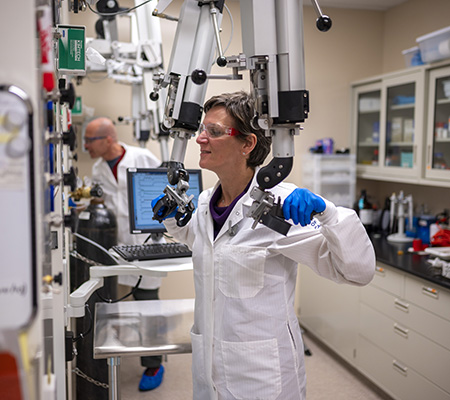
Sutcliffe's team is responsible for developing special imaging tools to help doctors find early changes in the pancreas — even before cancer fully forms. Using PET scans, they hope to detect tiny warning signs and early stages of pancreatic cancer so patients can get care sooner.
The research focuses on developing small, safe radioactive tags that light up cells to detect pre-cancerous cell changes called pancreatic intraepithelial neoplasia (PanIN). The research will look at microscopic changes in the cells that line the small tubes (ducts) of the pancreas. These cells can sometimes slowly develop into pancreatic ductal adenocarcinoma (PDAC), which starts in the cells that line the ducts of the pancreas. It is the most common type of pancreatic cancer.
"This grant gives us a powerful opportunity to move pancreatic cancer research forward," said Sutcliffe. "PanIN lesions have not been visible with conventional imaging and the ability to non-invasively detect and monitor PanIN allows us the opportunity to intercept PDAC at its earliest stages. Ultimately, our goal is to bring new options and real hope to patients who urgently need better outcomes."
Sutcliffe's team and five others from across the nation are sharing $12 million in funding from the Mark Foundation for Cancer Research and its coalition partners: American Association for Cancer Research, Lustgarten Foundation, Break Through Cancer and The Honorable Tina Brozman Foundation (Tina's Wish).
Each team is responsible for pursuing a research project aimed at overcoming the most pressing obstacles in early detection of cancer.
Sutcliffe is recognized internationally for her translational research efforts in the field of radiotheranostics. She leads several clinical trials at UC Davis using radiopharmaceuticals developed by her team to detect and treat cancer. She is a fellow of the Society of Nuclear Medicine and Molecular Imaging, a fellow and a past president of the World Molecular Imaging Society and a fellow of the American Institute of Medical and Biological Engineering.


