
A research team from the Kunming Institute of Zoology (KIZ) of the Chinese Academy of Sciences has demonstrated for the first time in non-human primates that auditory stimulation at 40-Hz significantly elevates β-amyloid levels in the cerebrospinal fluid (CSF) of aged rhesus monkeys, with this effect persisting for over five weeks.
The study, published in PNAS on January 5, provides the first non-human primate experimental evidence supporting the use of 40-Hz stimulation as a non-invasive physical therapy for Alzheimer's disease (AD), revealing significant differences between primate and rodent models.
Researchers led by Dr. HU Xintian at KIZ, together with collaborators, conducted the study using nine aged rhesus macaques (Macaca mulatta) aged 26-31 years. These aged individuals developed widespread spontaneous amyloid plaques in their brains, effectively mimicking the Aβ pathological feature of human AD and making them an ideal translational research model.
Using a randomized controlled design, the experimental group received one hour of 40-Hz auditory stimulation (using a 1-kHz pure tone) daily for seven consecutive days. After the stimulation period, levels of the key Aβ42 and Aβ40 proteins in the monkeys' CSF increased by 205.61% and 201.00%, respectively, with statistically significant differences. These results are consistent with previous findings in mouse models and support the hypothesis that 40-Hz stimulation facilitates the clearance of β-amyloid from the brain into the CSF.
Remarkably, CSF Aβ concentrations remained elevated when measured again 35 days (five weeks) after the stimulation ended, showing no significant decline from the levels measured immediately post-treatment. Such a sustained long-term effect has not been observed in any previous mouse model studies. This provides new important experimental evidence further supporting the use of 40-Hz stimulation as a non-invasive therapy for AD and underscores the unique value of aged rhesus monkeys for AD translational research.
Although currently approved anti-Aβ monoclonal antibody therapies can slow early-stage AD progression, they are associated with significant risks, including cerebral edema and hemorrhage. In contrast, 40-Hz auditory stimulation is a non-invasive, low-cost physical intervention that demonstrates therapeutic promise, supporting its use as a complementary or alternative therapeutic strategy for Alzheimer's disease.
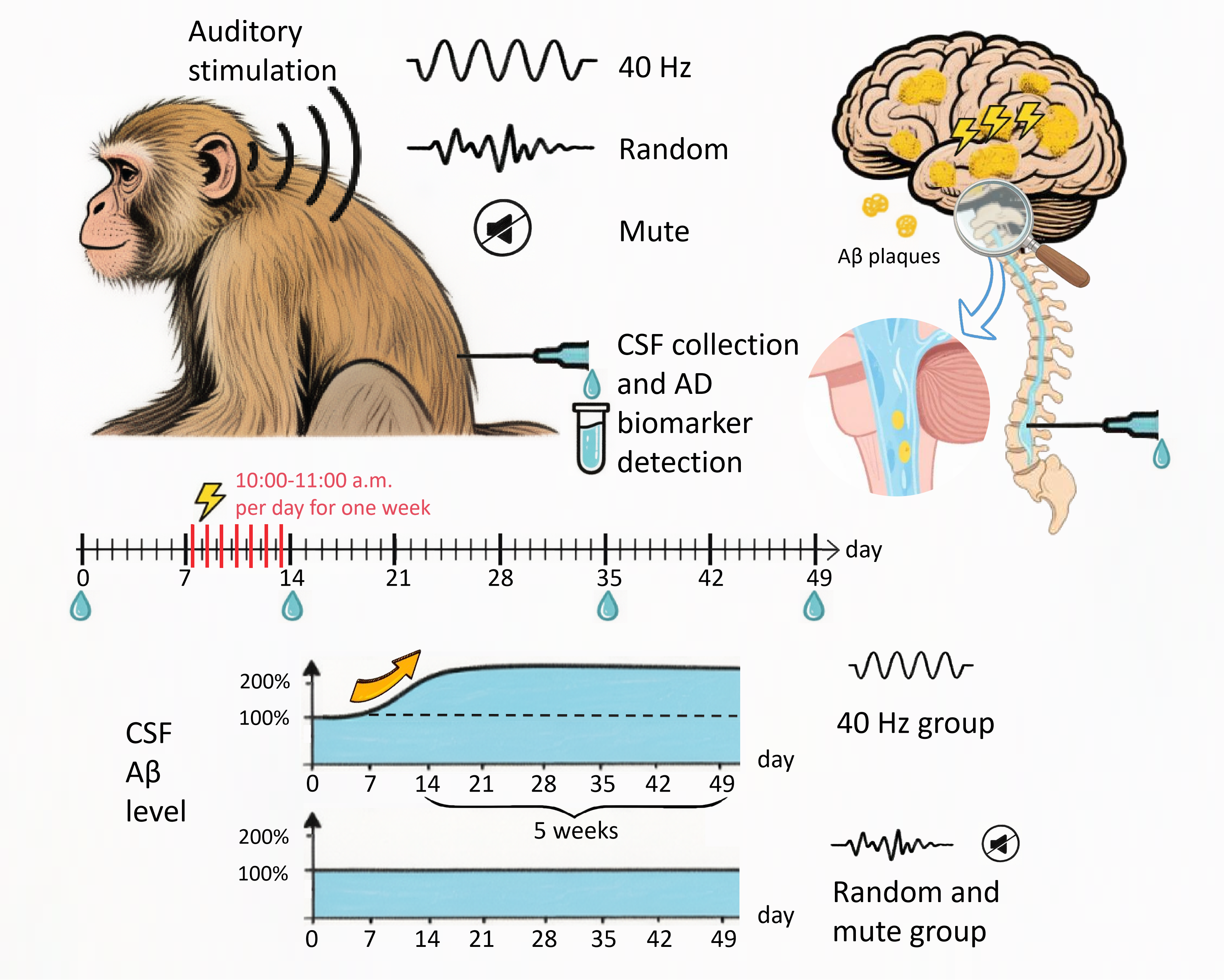
40Hz auditory stimulation specifically caused a significant increase of over 200% in Aβ42 and Aβ40 protein levels in the CSF of aged monkeys, which persisted for more than 5 weeks. (Image by KIZ)


