
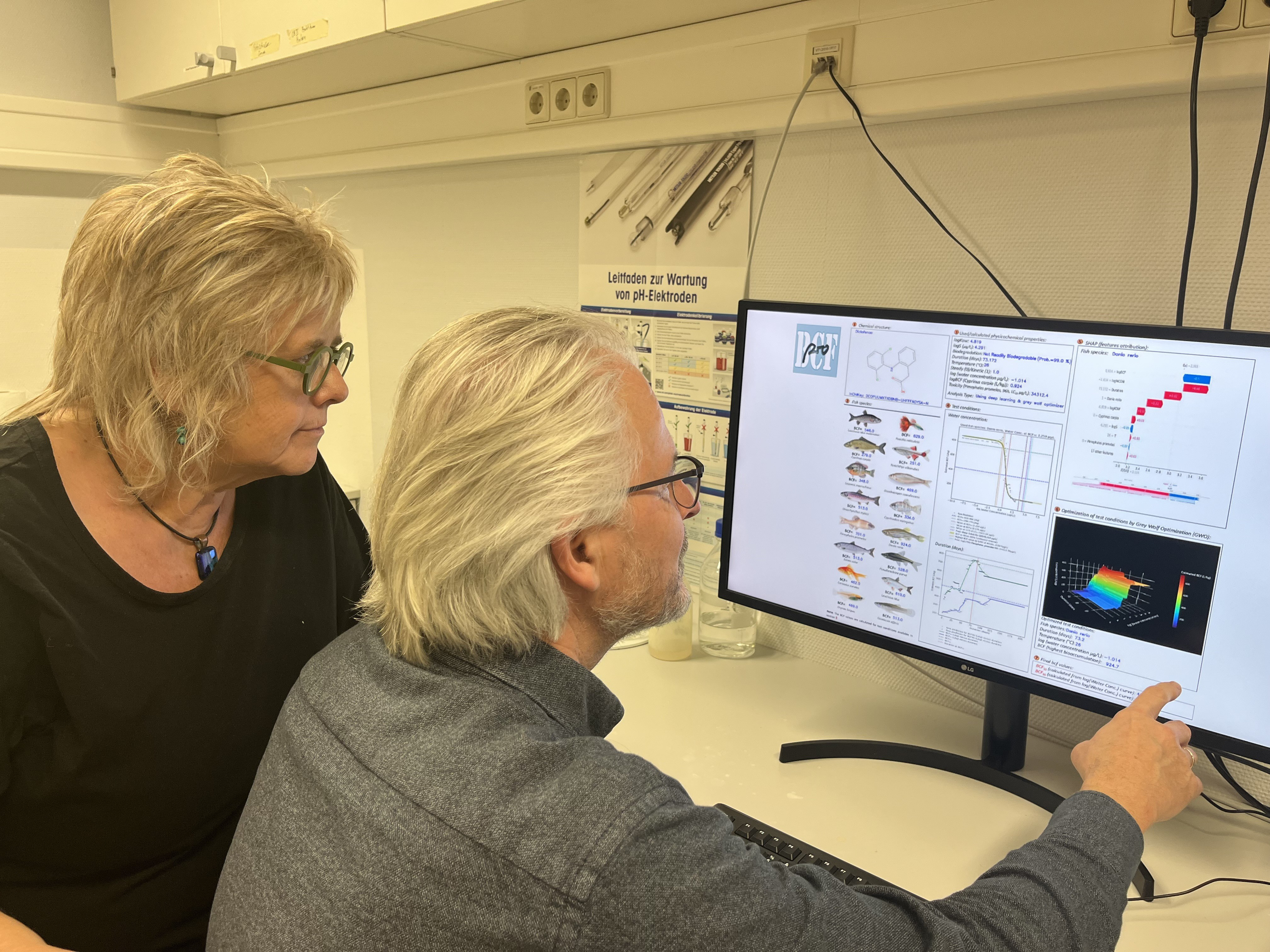
The bioconcentration factor shows the concentration of chemical substances in fish as compared to the surrounding water. It is the standard measure for determining the bioaccumulation of chemicals in the environment. Until now it was assumed that this factor, BCF for short, was a constant for each specific substance. Now, an interdisciplinary research team led by Professor Heinz Köhler from the Institute of Evolution and Ecology at the University of Tübingen has revealed that this is not the case and that the bioconcentration factor varies depending on the particular concentration used in the test. This discovery casts doubt on the bioaccumulation data used for the EU's licensing procedure for more than half of the chemicals that potentially accumulate in fish. Therefore, the research team has developed an artificial intelligence tool that enables researchers to assess the bioaccumulating properties of substances with a very high degree of certainty. This tool is being made available free of charge. The team has published their results in the Journal of Hazardous Materials.
The concentration of chemical substances in the food chain is problematic, especially as it also affects humans. "Concentrations can build up massively in the human body. And whether a substance is harmful often only becomes clear after a long time," says Heinz Köhler.
The bioconcentration factor in fish is used worldwide as a key benchmark for assessing the risk of chemicals, in order to standardize data on bioaccumulation in animals. "Contrary to what was previously thought - and practiced - the factor does not provide a criterion that is specific to each chemical," Köhler says. "If the test concentration for the surrounding water body is high, this in almost all cases delivers a lower BCF, and vice versa with a low test concentration. Our team has proven this mathematically and explained it physiologically." This effect had not previously been noted - or at least it had not previously been mentioned anywhere in the world in any chemical hazard classification regulations, according to Köhler. The team at the University of Tübingen headed by Heinz Köhler and Professor Rita Triebskorn, also co-author of the study, reached these findings together with their cooperation partners from the German Federal Environment Agency and the Universities of Yale and Athens by evaluating thousands of studies into chemical tests that assessed the bioconcentration factor.
Processing complex information efficiently
In its next step, the team used deep learning, an AI machine learning method, to develop a program that can predict experimental data on the bioconcentration factor with 90 percent certainty. Deep learning uses artificial networks - similar to the networked neurons in a brain - to process complex datasets and extract interesting patterns and features from the data. The method is used to process complex information efficiently. "We can also use our tool to describe especially critical values for the chemicals with worst-case scenarios, that is, instances when the chemicals would bioaccumulate particularly severely," says Köhler.
The team reached the same result as the old method for substances that are categorized as bioaccumulating in the EU in approx. 90 percent of cases. "However, when we used our tool to review the chemicals that have until now been categorized as not accumulating dangerously in animals, we reached an alarming result: more than 60 percent of the substances that should have been identified as bioaccumulating were not categorized as such with the established method." Those test conditions had been selected so that the result reflected a bioconcentration factor that was too low for worst-case conditions. "Our metastudy showed how important it is to conduct the chemical tests on the bioconcentration factor in fish under conditions that are relevant to the environment. This is the only way we can obtain realistic values for risk assessment," says the researcher. In order to ensure standardized and reliable categorization of chemicals, the research team is making the new AI tool, BCFpro, generally available free of charge.
Since BCFpro can also very reliably predict how future new chemical developments bioaccumulate, this computer-based method offers a massive potential for reducing animal testing. "Research must also focus on practice, challenge and examine it. That's what this study does. In this way, University of Tübingen researchers are helping to improve ecotoxicological methods and thus promote both environmental safety and animal welfare," says Professor Dr. Dr. h.c. (Dōshisha) Karla Pollmann, president of the University of Tübingen.


