Hydrogen can become a clever way to store renewable energy and power fuel cells - but this introduces the problem of what can store this hydrogen, in turn. Metal hydrides - solids that absorb hydrogen into their crystal structures - are promising candidates to safely hold large amounts of hydrogen and release it when needed. However, many materials that release hydrogen at convenient pressures do not store enough hydrogen by weight for it to be useful. Where do researchers begin searching for a solution with such a restrictive trade-off?
A Tohoku University-led research team has now created a clearer map for that search. By combining DigHyd, a curated database of hydrogen-storage measurements collected from the scientific literature, with GoodRegressor, a symbolic-regression tool that searches for human-readable equations, the team identified the main physical factors that control the performance of interstitial metal hydrides. This research turns a large body of scattered experimental data into an interpretable design map for hydrogen storage materials, which helps with the development of safe and efficient green energy storage.
The research was published in Chemical Science on May 25, 2026.
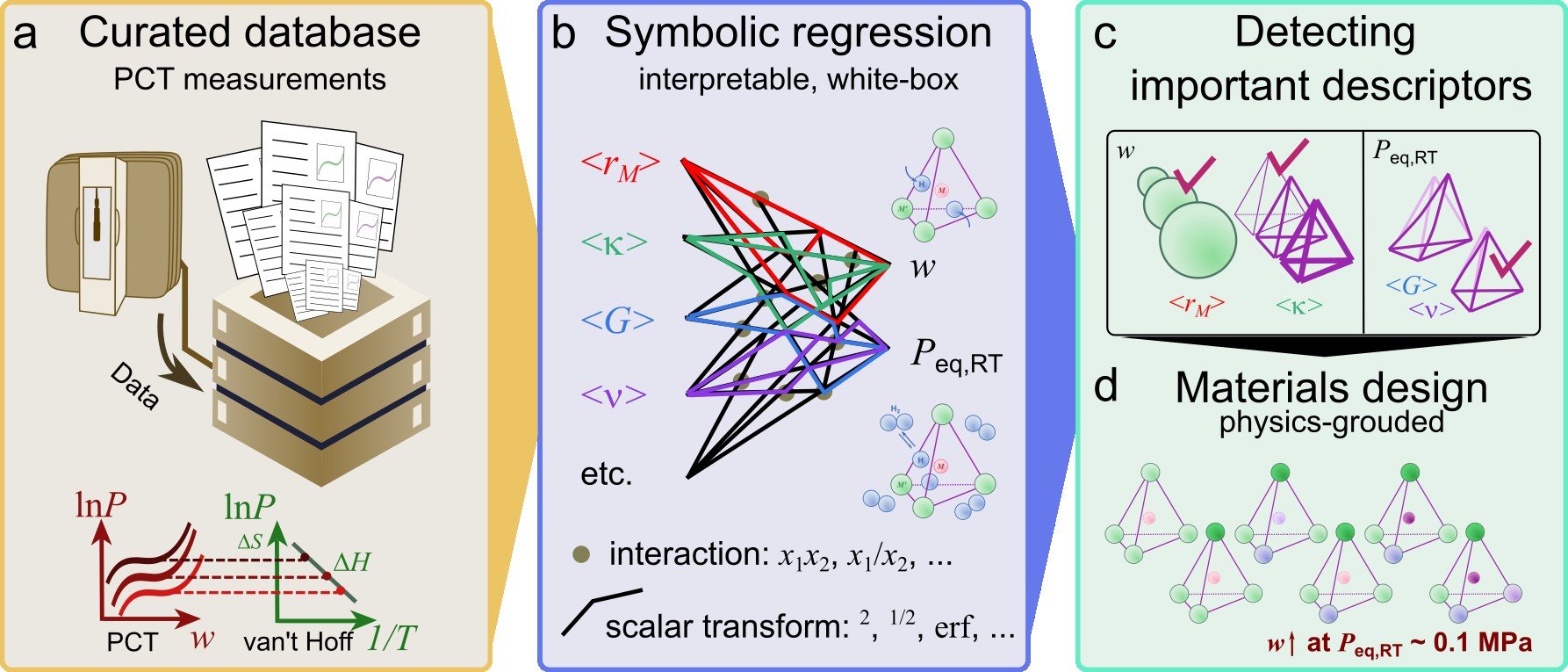
The study showed that hydrogen capacity and room-temperature equilibrium pressure are governed by different material features. Hydrogen capacity was mainly linked to the average size of the metal atoms and to thermal conductivity, a property related to how the metal lattice responds to hydrogen entering its empty spaces. The results suggest that materials are most favorable when the average metal-atom radius is tuned to about 1.47 Å and the lattice is relatively soft. In contrast, the pressure at which hydrogen is absorbed or released at room temperature was mainly controlled by elastic properties, especially shear modulus and Poisson's ratio, which describe how stiff or deformable the lattice is.
"The model doesn't spit out suggestions - it explains why certain physical properties matter, which we can then logically apply to produce the desired outcome" explains Distinguished Professor Hao Li (Advanced Institute for Materials Research (WPI-AIMR).
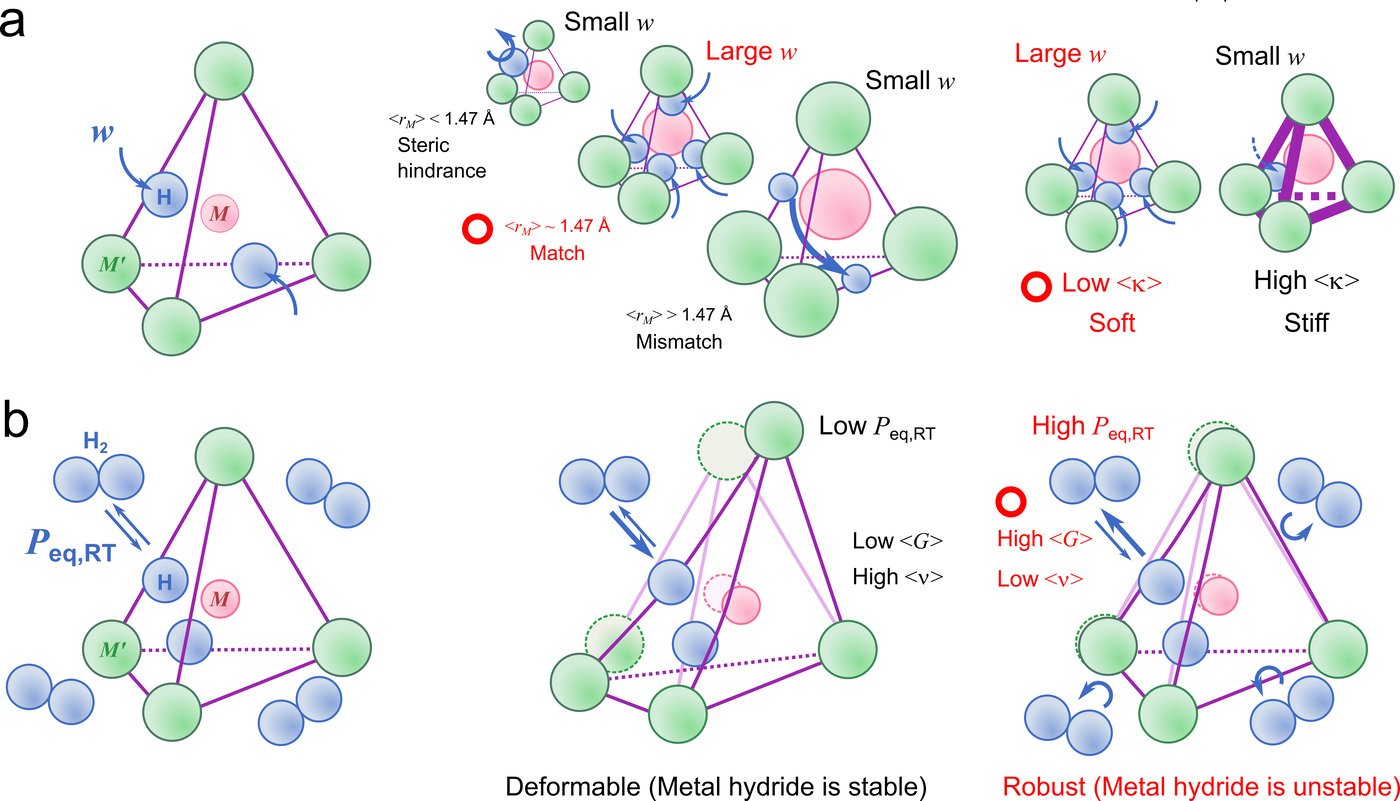
This separation of roles gives researchers a practical design blueprint: adjust geometry and lattice flexibility to raise capacity, while tuning stiffness to keep the equilibrium pressure near everyday conditions of around one atmosphere. Using this framework, the team proposed composition-changing routes for several major classes of interstitial hydrides, including BCC alloys, Laves phases, LaNi5-type materials, and TiFe-type materials.
"The proposed materials are design candidates that still require experimental validation, since they are so new," says Seong-Hoon Jang, an associate professor at the Unprecedented-scale Data Analytics Center. "Even so, the work provides an explainable way to narrow the search space and reduce trial-and-error in developing solid hydrogen-storage materials."
The research team suggests that this same strategy could also be extended to other energy materials, including ionic hydrides and hydride-based solid electrolytes.
- Publication Details:
Title: A unified descriptor framework for hydrogen storage capacity and equilibrium pressure in interstitial hydrides
Authors: Seong-Hoon Jang, Di Zhang, Xue Jia, Hung Ba Tran, Linda Zhang, Ryuhei Sato, Yusuke Hashimoto, Yusuke Ohashi, Toyoto Sato, Kiyoe Konno, Shin-ichi Orimo, Hao Li
Journal: Chemical Science
DOI: 10.1039/D6SC03089K