
Mingyu Qiao, UConn Assistant Professor of Innovation and Entrepreneurship in the College of Agriculture, Health, and Natural Resources, will lead a global team using a novel strain of microalgae grown on spent brewer waste to develop a lower cost version of an essential omega-3 fatty acid critical to fetal and infant brain and eye development
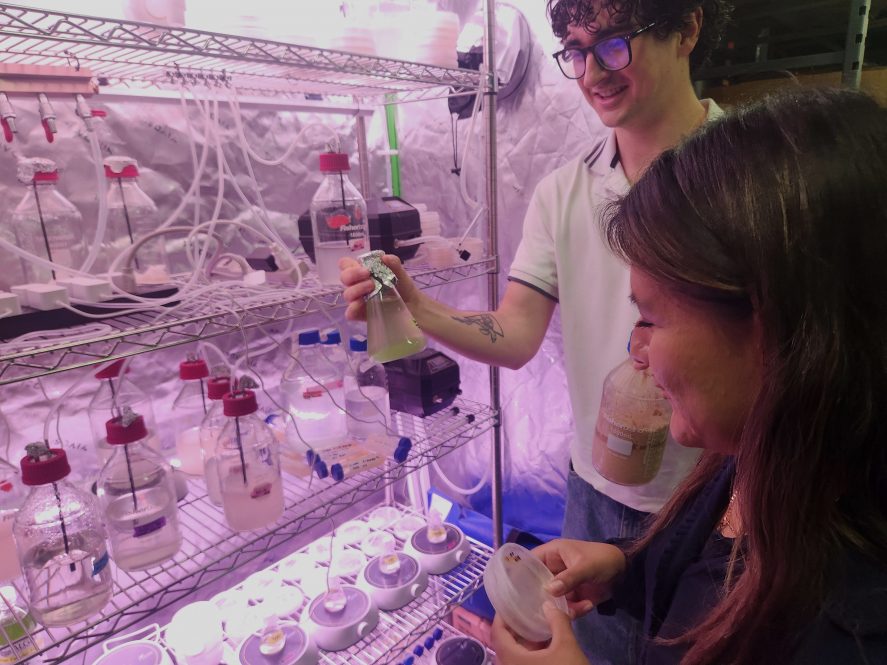
Graduate students Diana Pinta and Keegan Jalbert check on an array of flasks and plates being used to cultivate a novel strain of microalgae in the lab of Dr. Mingyu Qiao, assistant professor of innovation and entrepreneurship in the College of Agriculture, Health and Natural Resources (CAHNR), Department of Nutritional Sciences. Contributed photo.
A UConn researcher specializing in the development and commercialization of sustainable food products using algae and other natural materials has been awarded a $500,000 Grand Challenges grant from the Gates Foundation.
Mingyu Qiao, assistant professor of innovation and entrepreneurship in the College of Agriculture, Health and Natural Resources (CAHNR), Department of Nutritional Sciences, received word in June that his proposed project, Ultra Low-Cost DHA Powder from Algae Grown on Digested Grain Spent Wastes, had been selected for funding.
Qiao's lab at UConn specializes in using eco-friendly biomanufacturing and bioprocessing technologies to create scalable, cost-effective ways to produce nutritious, safe and affordable food and nutrients. Qiao has distinguished himself as an innovator in the eco-manufacturing of nutrients using microalgae. At UConn, he led a multidisciplinary team that won a $500,000 National Science Foundation Future Manufacturing Grant to develop a novel biomanufacturing technology using microalgae to produce essential amino acids for poultry feed.
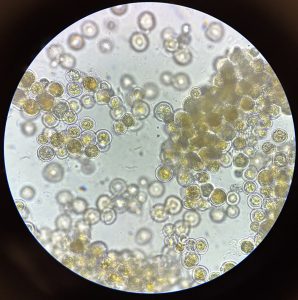
The latest project is a continuation of that research, though the end product is different. This one focuses on Docosahexaenoic Acid (DHA), an essential omega-3 fatty acid critical to fetal and infant brain and eye development. The DHA will be produced from a novel strain of microalgae recently isolated in Qiao's lab.
Using spent brewer waste to cultivate the microalgae offers a means of producing supplemental DHA for humans at a significantly lower cost than existing production methods. Moreover, this method can easily be deployed in low and middle-income countries (LMICs) in Africa and elsewhere to produce the nutrients locally and create jobs.
Qiao's proposal details the potentially game-changing impact of the project. While global health authorities recommend at least 200 mg of DHA for pregnant and lactating women, DHA deficiency remains widespread in low and middle-income countries around the world. Current pharmaceutical-grade algal DHA powders cost more than $52 per kilogram, due largely to the expense of producing DHA-rich microalgae using refined sugars, nutrients, and capital-intensive fermentation and downstream processing technologies.
That requirement alone accounts for up to 85% of total cost of production and limits the feasibility of manufacturing DHA in less wealthy countries without an established biomanufacturing infrastructure and workforce. Spent brewery waste is an abundant, underutilized resource in low to middle-income countries. Global production of the nutrient-rich byproduct of the brewing process exceeds 40 million tons annually, making it widely accessible.
Qiao's co-PIs on the project include Jeffrey McCutcheon, a UConn professor of chemical and biomolecular engineering; Qing Jin, an assistant professor of food science at the University of Maine; and Bo Wang, an assistance professor of bioproducts and system engineering at the University of Minnesota Twin Cities.
The award covers the initial 18-month development phase of the project, Qiao says. If successful, the project could be eligible for additional funding to establish manufacturing sites in Africa and beyond.


