
The first clear sign of exceptionally high solar activity came from Japanese cedar trees.
In 2012, Fusa Miyake was studying slices of ancient Japanese cedar, taken from a tree felled in the 1950s. It had grown on Yakushima Island, a protected site famed for its long-lived trees, some of which have stood for millennia, laying down one ring of wood after another.
These tree rings aren't just markers of age – they are also annual records of the Earth's atmosphere, and studying them could help us to predict, and prepare for, future disruptive solar storms.
- In most years, the level of carbon-14 in the atmosphere barely wobbles
- These small year-to-year shifts are the background rhythm of cosmic rays hitting Earth's atmosphere
- Then, in AD 774–775, there was a massive spike in carbon-14, far beyond normal variation
- This is the first discovered Miyake event: evidence of an extreme burst of high-energy particles striking Earth
While perusing these ancient tree records, Miyake stumbled upon something that gave her pause. The relative proportion of carbon-14 in each tree ring reveals how active the sun was each year. Between AD 774 and 775, the amount of this isotope in the cedar jumped by about 12 parts per thousand – roughly 20 times larger than the change expected from the ordinary variation in the sun. That was hard to explain.
A spike this sharp meant Earth's atmosphere had been hit by a sudden burst of unusually energetic particles. At first, there were reasons to be cautious: perhaps this was a laboratory artefact, or something peculiar to the Japanese cedars. Then other teams found the same signal in trees from North America and Europe. Whatever had happened in AD 774, it had marked the whole planet.
That made the list of possible culprits quite short. A nearby supernova explosion, or a gamma-ray burst, or a blast from a neutron star could each have been to blame – but all were ruled out, since possible sources of these were too distant. Eventually, researchers returned to the object we know best: the sun.
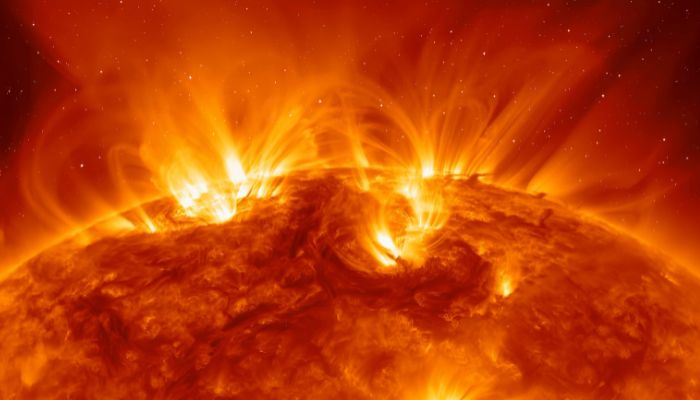
A solar flare is what happens when magnetic energy that has been building in the sun's atmosphere is suddenly released. In a matter of minutes, a patch of the sun can brighten violently, hurling out radiation across the electromagnetic spectrum, from radio waves to X-rays. Often, these eruptions are accompanied by streams of high-speed charged particles and vast bubbles of magnetised plasma known as coronal mass ejections. A solar storm can include both phenomena.
We know events like flares can be dramatic because they've happened before. In the summer of 1859, the sun produced the most famous solar storm in recorded history: the Carrington event. The eruption was so intense that telegraph lines across Europe and North America caught fire. Auroras, usually confined to polar skies, were seen deep into the tropics.
Ever since, Carrington has been the benchmark for solar violence. But the strange thing is that even Carrington wasn't powerful enough to leave a clear carbon-14 signature in tree rings. To do that, the sun would need to unleash a storm 10 times larger – a superflare. This ancient storm wouldn't be like anything that we've seen during the space age, when we've observed the sun up close with satellites.
Since Miyake's first discovery, researchers have discovered five more "Miyake events", occurring very roughly every 2000 years. Though they are rare, they still challenge our model of solar physics, which states that stars like our sun aren't supposed to produce events that energetic.
New evidence, however, suggests that lesser storms – still several times more powerful than Carrington – may happen far more often than we thought.
- Since 2012, researchers have been uncovering Miyake events one by one, reading the world's tree-ring archives for the sudden carbon-14 spikes left by extreme solar storms
- The first event was discovered by Fusa Miyake, who spots a jump in carbon-14 in Japanese cedar rings between AD 774 and 775. Measurements of beryllium-10, another radioisotope, in ice cores confirmed her discovery
- The next year, Miyake's team found a second spike in cedar and cypress, confirmed in European oak and Siberian larch
- Using both beryllium-10 Greenland ice core measurements and matching carbon-14 signals in Polish oak, researchers identified an AD 664 event in 2017
- In 2022, a landmark study led by Nicolas Brehm swept a global dataset spanning thousands of years of tree rings – and surfaceds two events at once, pushing Miyake events deep into prehistory
- In 2023, researchers discovered the largest confirmed Miyake event, detected as a massive radiocarbon spike in subfossil Scots pine from the French Alps, dating to 12,350 BC
Mind the gap
Ancient trees hold hints of such middle-range events, which could still be catastrophic for life on Earth. "There are intermediate events, which are smaller than Miyake events but perhaps bigger than Carrington," says Michael Dee at the University of Groningen in the Netherlands. "As we move to a more digitised society with extensive telecommunications networks, these events could pose a much bigger threat."
But researchers have a hard time estimating how frequently they occur.
Researchers are now stuck with a "missing middle" of solar violence. At one end, satellites and ground-based detectors give us a detailed picture of the relatively modest storms the sun produces today. At the other, tree rings have preserved the fingerprints of the most extreme Miyake events.
But that gap may now be starting to close. In a paper published this year, researchers, including Dee, combined eight high-resolution carbon-14 records from tree rings spanning almost the entire first millennium AD, from 1 to 970. Five of these series were newly measured from European oak, mainly from Germany and France, while three came from existing tree-ring datasets. They then modelled Earth's carbon cycle to search for abrupt increases in carbon-14 production, finding four candidate intermediate events, around AD 14, 553, 675 and 954. This would place such events at a frequency of around one every 200 years.
- Scientists can measure small solar bursts with satellites and rare events preserved in tree rings. Between them lies a gap
- Medium-sized storms may sit in an orderly array between the small, common ones and the rare, extreme ones
- Or the middle may fall away more sharply than expected. That would mean dangerous events are rarer than a straight extrapolation suggests
- But the curve could also bend the other way. If so, intermediate events may be more common than we think – a sign that large storms may be driven by different physics
Preparing for a storm
The exact nature of the danger posed by these intermediate events depends on what is actually causing them, says Benjamin Pope at Macquarie University in Australia. If the culprit is a coronal mass ejection, the main threat would come from the way the event distorts Earth's own magnetic field. It could trigger a geomagnetic storm, driving unwanted currents through power grids, pipelines and other long conductive systems. The damage would be uneven, shaped by geography, geology and the layout of infrastructure on the ground.

Dr Benjamin Pope. Photo: Hong Vu
Pope imagines a scenario in which an event may take out critical manufacturing capabilities, concentrated in the northern hemisphere. "If you, in a synchronised way, took out China, the US and European manufacturing, we're done," he says.
A solar flare causing an intermediate event would have different consequences. Rather than a cloud of plasma, the intense flashes of radiation would be absorbed high in the atmosphere, sparing most ground-based systems. But anything above that shield would be exposed. Satellites could be damaged, radio communications disrupted and GPS signals degraded or lost.
Establishing the cause of such middle-range events would require researchers to fill in more of the missing middle and, in turn, help us get a better sense of where larger Miyake events fit within what we know about solar physics.
That sounds simple enough. But interpreting solar events from carbon-14 can be complex. The carbon-14 spike is made high in the atmosphere, then has to mix down into air that trees can absorb. By then, a tree may already be growing new wood using carbon stored from previous years. Wood that is formed near the start of the annual growing season can be especially prone to this blurring; later-growing wood may offer a cleaner annual signal.
"Some tree rings start growing around spring, but the carbon they use to grow that ring could be from previous years. If you take a tree from Europe and a tree from Asia, they might behave differently," says Jian Wang, also at the University of Groningen, who was part of the 2026 study. "There's also the varying effect from the Earth's natural geomagnetic field that could reduce or amplify some signals."
That is why not every tree is equally useful. Researchers need species that lay down clear annual rings and preserve enough reliable carbon-bearing material to measure. Even then, the record can vary with species, latitude, season length, water, light and age. For the largest Miyake events, the signal is unmistakable. For smaller events, these subtleties can be the difference between a real solar storm and biological noise.
For now, researchers have pinpointed ancient New Zealand kauri trees. These giants are unusually useful archives: long-lived, well preserved and capable of yielding year-by-year records from the southern hemisphere, where Miyake event data is much thinner. "We're still dealing with a lot of unknowns," says Dee. "Any effort would have to be a global one, taking measurements from trees all over the globe."
The point of this work isn't only to work out how often civilisation might be jolted by a solar storm. Miyake events may also be telling us something profound about the sun itself. Until the first carbon-14 spike was found in Japanese cedar and linked to an eruption from the sun, few solar physicists had seriously entertained the idea that our star could produce particle storms on this scale. The discovery forced them to widen their sense of what was possible. Now the question remains: when will the next big storm come, and just how bad will it be?


