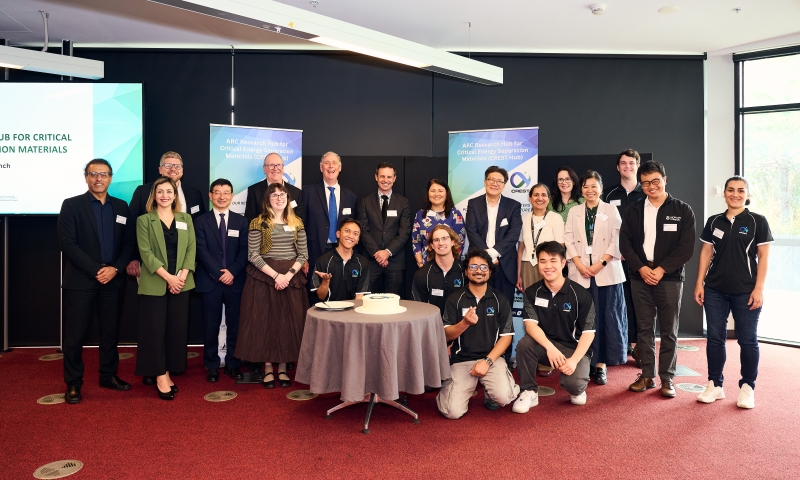
Australia's capacity to develop cleaner energy technologies and make better use of its critical minerals is set to benefit from the launch of the Australian Research Council (ARC) Research Hub for Critical Energy Separation Materials (CREST Hub), led by Monash University.
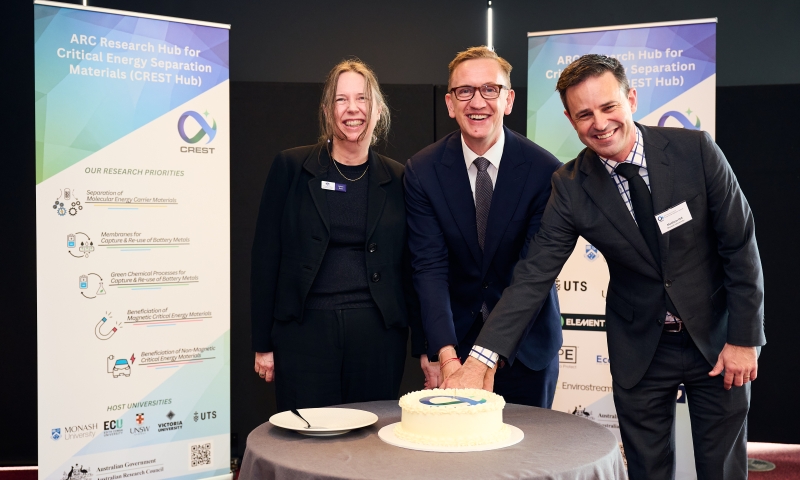
ARC Academic Director Professor Alison Ross, The Hon Julian Hill MP, Assistant Minister for International Education, and CREST Hub Director Professor Matthew Hill cut the cake at the launch event. Image credit: Supplied.
Supported by $4 million in ARC funding over 5 years, the CREST Hub brings together leading researchers and industry partners to develop more efficient and sustainable ways to extract, recover, process and recycle materials essential to Australia's clean energy future.
The Hon Julian Hill MP, Assistant Minister for International Education, officially launched the Hub at Monash University on 20 November 2026, alongside ARC Academic Director Professor Alison Ross, researchers, industry representatives and university partners.
Turning research into new technologies
Critical minerals and advanced materials are essential to technologies ranging from electric vehicle batteries and solar panels to renewable energy storage systems.
However, extracting and processing these materials can be costly, energy-intensive and environmentally challenging.
The CREST Hub aims to address these challenges by developing technologies that improve resource efficiency, reduce waste and support more sustainable industrial processes.
Its research includes:
- Improving the recovery of lithium for batteries and energy storage.
- Developing more energy-efficient methods of capturing carbon dioxide from industrial processes.
- Investigating lower-emissions approaches to producing silicon for solar panels and advanced technologies.
- Developing new ways to recover and recycle valuable materials that might otherwise be lost as waste.
These advances could help Australian industries reduce production costs and environmental impacts while creating opportunities for domestic processing, recycling and advanced manufacturing.
Connecting research and industry
Led by Professor Matthew Hill, the CREST Hub brings together 5 Australian universities and six industry partners, combining research expertise with practical industry experience.
Since commencing in June 2026, the Hub has established four research projects and welcomed four PhD students, with another nine expected to commence in 2027. The collaboration will help researchers develop technologies with the potential to move beyond the laboratory and be adopted at an industrial scale.
Professor Alison Ross said the Hub demonstrated the importance of sustained investment in research and collaboration.
'Australia's future prosperity will depend not only on the resources we have, but on the knowledge, expertise and technologies we develop to make better use of them,' Professor Ross said.
'Through initiatives such as CREST, the ARC supports researchers and industry partners to tackle complex challenges, develop new technologies and build the research capability Australia will need for the future.'
Supporting a more sustainable future
Beyond developing new technologies, the CREST Hub recognises the importance of considering how innovations affect communities and the environment.
Its research ambitions include engaging with communities and considering First Nations knowledge and perspectives in approaches to sustainable technology development.
By bringing together research excellence, industry expertise and community perspectives, the Hub aims to contribute to cleaner industrial processes, more secure supply chains and new opportunities for Australian manufacturing.
The CREST Hub is supported through the ARC's Industrial Transformation Research Program, which fosters collaboration between universities and industry to address challenges of national importance.
The ARC congratulates all participating research and industry partners on the Hub's official launch .