
New James Cook University research has shown that the venom produced by Irukandji jellyfish changes as temperatures rise – prompting the need for more detailed study of the impacts of climate heating on venom toxicity.
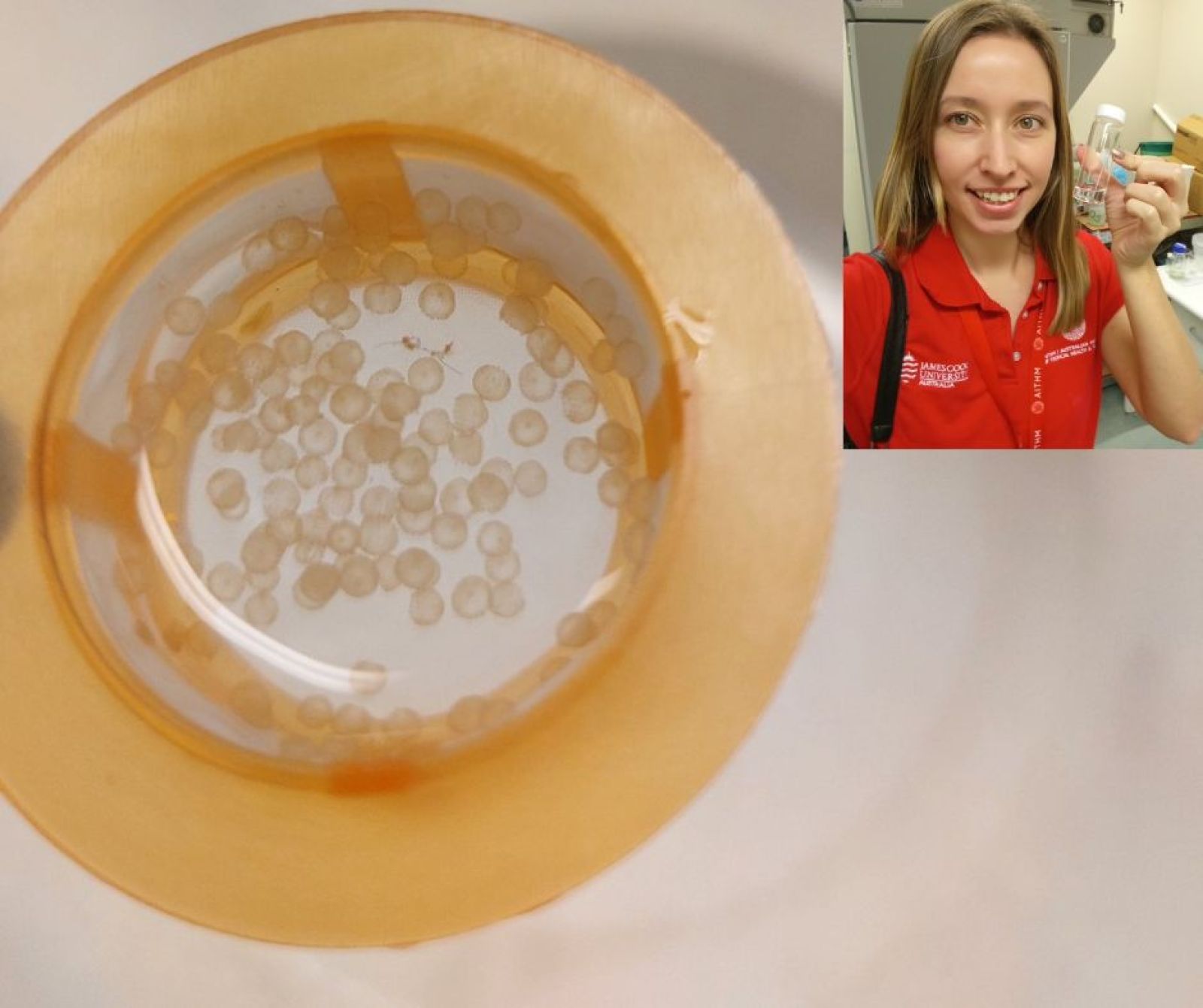
The tiny Irukandji jellyfish Carukia barnesi lives in the waters of northern Australia, predominately in Queensland with similar species in Western Australia.
Irukandji stings can be lethal. Its stings can cause a range of symptoms – nausea, muscle pain, vomiting and traumatic psychological effects.
Climate change is leading to increasing sea surface temperatures, extended marine heat waves and longer Irukandji stinger seasons. However, the influence of temperature on Irukandji venom toxicity remains poorly understood.
The research published in the journal Toxicon investigated the molecular composition of venom from tiny Irukandji jellyfish polyps, an early anemone-like life-stage, as well as juvenile jellyfish.
"If you think of venom as a cocktail – it's made up of a whole bunch of different molecular ingredients," Dr Emily O'Hara, the studies first author and JCU PhD graduate explained.
"For the two different jellyfish life stages, when you raise them at different temperatures, those cocktail ingredients change with temperature.
"The change in venom composition with temperature could be a reason for differences in sting intensity seen in human envenomations."
Dr O'Hara explained that very little is known about the early life stages of Irukandji jellyfish, principally because they are so small and difficult to find.
"Everything we currently know about them has been established on venom taken from jellyfish adults, because they're the only ones we've ever found in the wild," she said.
"If you look at younger jellyfish versus older ones … their diet changes. They go from eating mainly invertebrates – things without a spinal cord – to vertebrates – things with a spinal cord, like fish.
"We believe their venom changes because they are targeting different food."
The bell of an adult Irukandji jellyfish is the same size as a thumbnail, but the two life-stages the researchers looked at are even smaller. The polyps were about one millimetre and the juvenile medusa they studied were only one to two millimetres.
"They're both life stages that had never been looked at before … we had to make up an entirely new kind of venom extraction procedure to get the venom out," Dr O'Hara said.
"Jellyfish venom is contained in stinging organelles called nematocysts ... tiny little microscopic balloons, if you will, full of venom."
The researchers grew the polyps and juvenile medusa in temperature-controlled laboratory tanks and used Ultra High-Performance Liquid Chromatography/Mass Spectroscopy to assess venom composition changes between 27oC and 31oC.
Researchers found that one of the molecules in the polyp venom that was influenced by temperature had characteristics that were consistent with toxic venom compounds observed in both snakes and other types of jellyfish.
"There is every reason to assume the venom of adult Irukandji will also be subject to changes driven by environmental temperatures," Dr O'Hara said.


