
RMIT Galleries latest and one of its largest ever exhibitions, Creative Antarctica: Australian Artists and Writers in the Far South, brings audience on a journey to the Far South - offering new perspectives, encounters and understandings of one of the world's most remote and fragile landscapes.
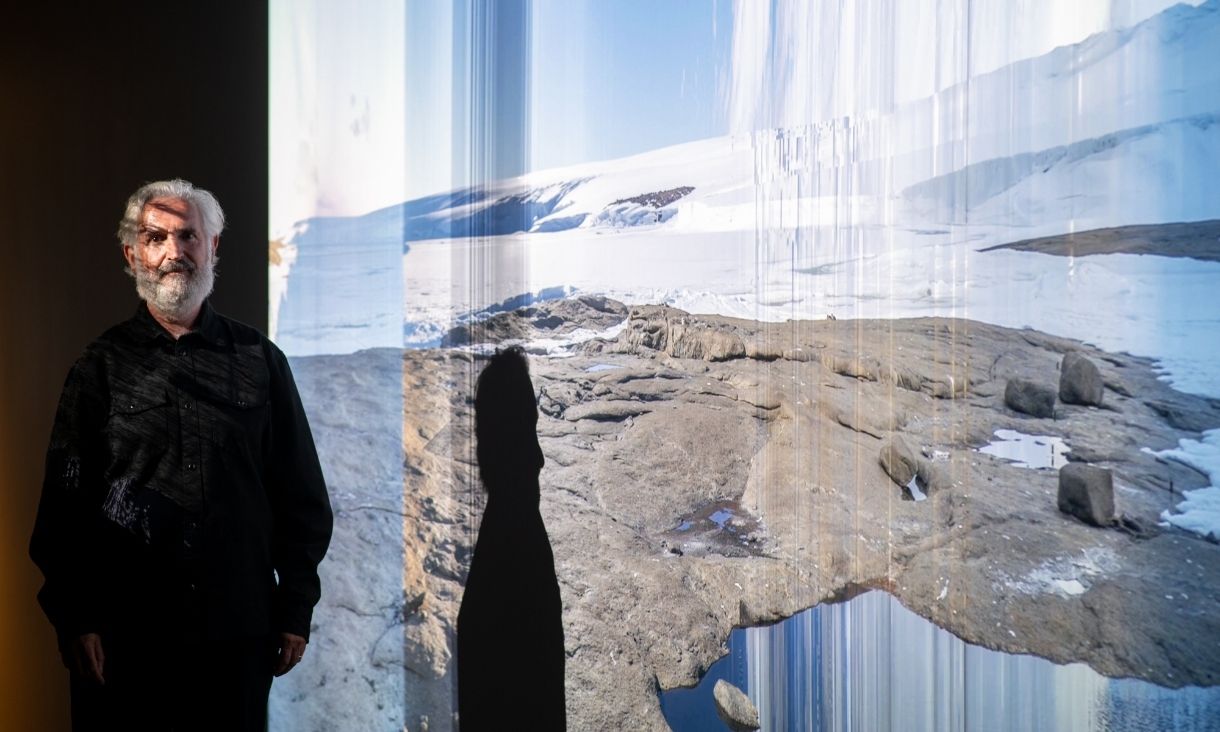
Philip Samartzis in front of Philip Samartzis, Martin Walch and Sean Williams, 'The Magnetic Quiet Zone', 2024, in 'Creative Antarctica: Australian Artists and Writers in the Far South, 2026, Design Hub Gallery. Photo by Keelan O'Hehir.
Creative Antarctica, is curated by sound artist and three-time Australian Antarctic Arts Fellowship recipient, RMIT Professor Philip Samartzis. It has been in development for five years and features the largest ever collection of Australian art and literature solely focused on Antarctica.
Exhibiting historically significant, contemporary and brand-new site-specific works through a variety of media, Creative Antarctica demonstrates how artists and writers play an increasingly vital role in observing and recording the tension between climate, landscape, technology and humans.
"Australia is one of the few countries that allows artists and writers to visit Antarctica, providing an alternative perspective to the scientific lens we've traditionally viewed the Far South through," said Professor Samartzis.
"Throughout the exhibition, the audience is immersed in the complexities and tensions of being on the ice, not just through the imagery of the alien landscape, but through the social, environmental and technological challenges faced by its inhabitants," he continued.
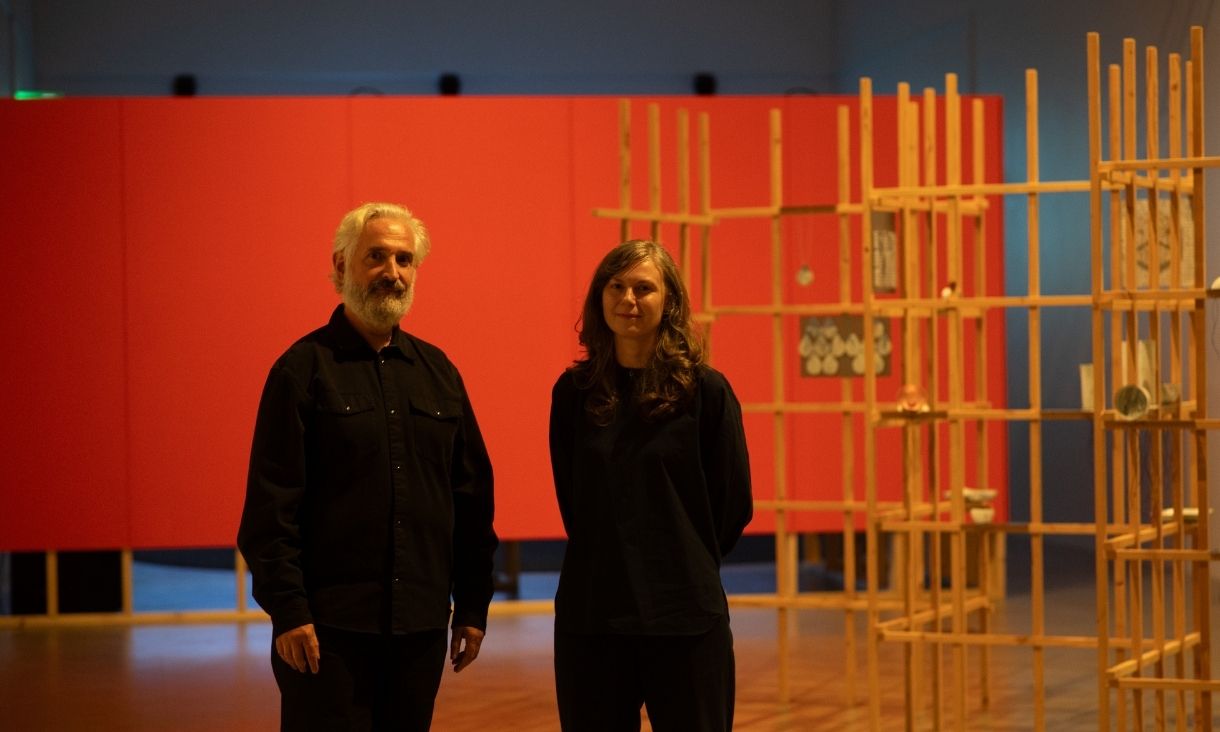
Philip Samartzis and Polly Stanton in front of Kirsten Haydon, 'Ice Scaffold Year', 2025, in 'Creative Antarctica: Australian Artists and Writers in the Far South, 2026, Design Hub Gallery. Photo by Keelan O'Hehir.
The exhibition also features work from artist, filmmaker and RMIT Media & Communications Senior Lecturer Dr Polly Stanton, who recently visited Antarctica as part of their 2025 Australian Antarctic Arts Fellowship.
Stanton spent three weeks on the ice, capturing sound and moving images at Casey Station, largely focusing on 'contested spaces' - capturing the tension and impact of humans intersecting with the natural world.
"I was fascinated by the fragile connection between the settled and unsettled aspects of Antarctica, and how the continent performs a sense of both absence and excess - the absence of permanent human settlement, and the excess of transnational governance and scientific oversight," said Stanton.
Stanton's experiences in Antarctica inspired her large-scale moving image work featured in the exhibition, Edgelands. It forms part of a larger, evolving creative research project currently in development called The Silence in These Empty Lands is Long which considers how patterns of human movement and occupation in Antarctica signal its significance in the growing climate crisis and shifting global environmental politics.
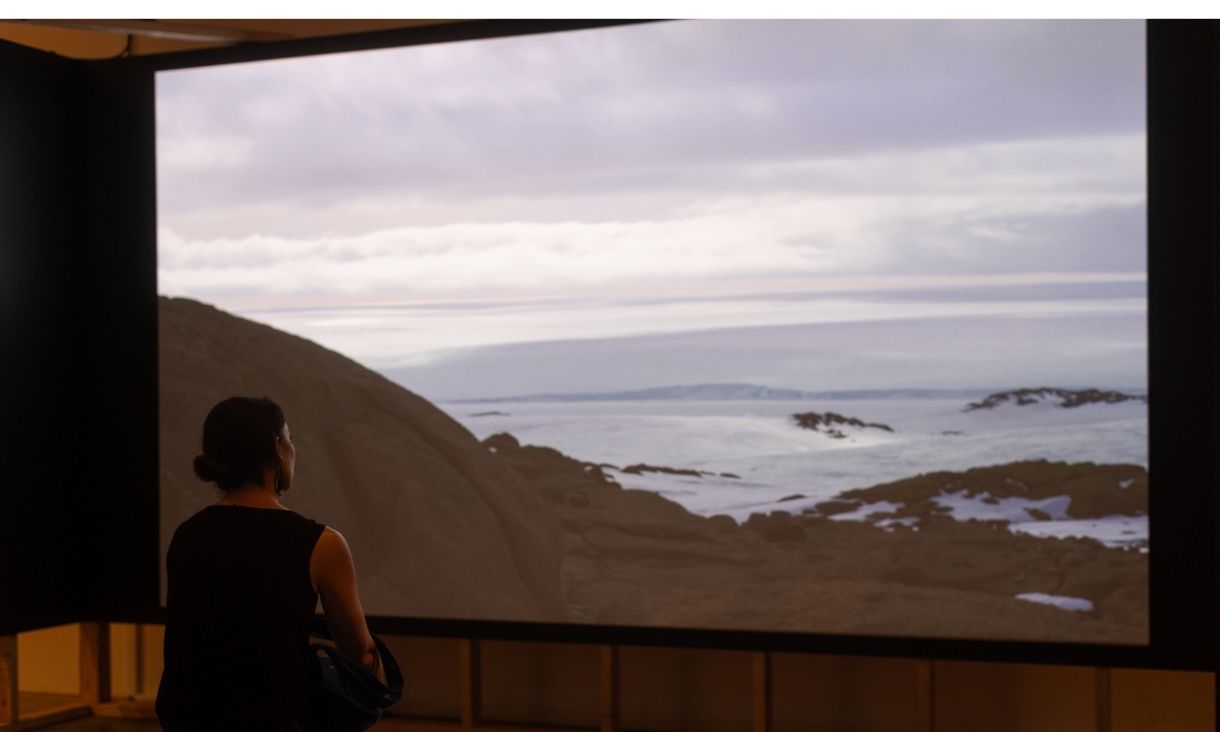
Installation view, Polly Stanton, 'Edgelands', 2026, in 'Creative Antarctica: Australian Artists and Writers in the Far South, 2026, Design Hub Gallery. Photo by Keelan O'Hehir.
"Edgelands grew out of my time in Antarctica, observing the everyday sites, sounds and movements in and around Casey Research Station and the wider Wilkes Land region of East Antarctica. By tracing these small human routines, I was able to document the rhythms of the station's operations and human-made environments, showing the implications of the human presence on a continent that is often considered absent of life."
"My drive with this work was to observe and capture the more mundane human spaces and gestures, and to consider how these everyday scenes feed into larger dynamics around Australia's national presence across Antarctic territories and its geopolitical position within the broader region of the circumpolar south," Stanton continued.
"Creative Antarctica represents not just artistic achievement, but the vital intersection of creative practice, scientific inquiry, and environmental consciousness that defines the most important work being done at RMIT through our signature initiatives: The Regenerative Futures Institute and Planetary Civics Inquiry," said Professor Tim Marshall, Deputy Vice-Chancellor and Deputy Vice-Chancellor of RMIT's College of Design and Social Context.
"This exhibition also highlights the essential role RMIT Galleries plays in our research mission. Not simply exhibition spaces, RMIT Galleries are vital research infrastructure that enables creative researchers to test ideas, present findings in inventive ways, and engage broad community audiences," he continued.
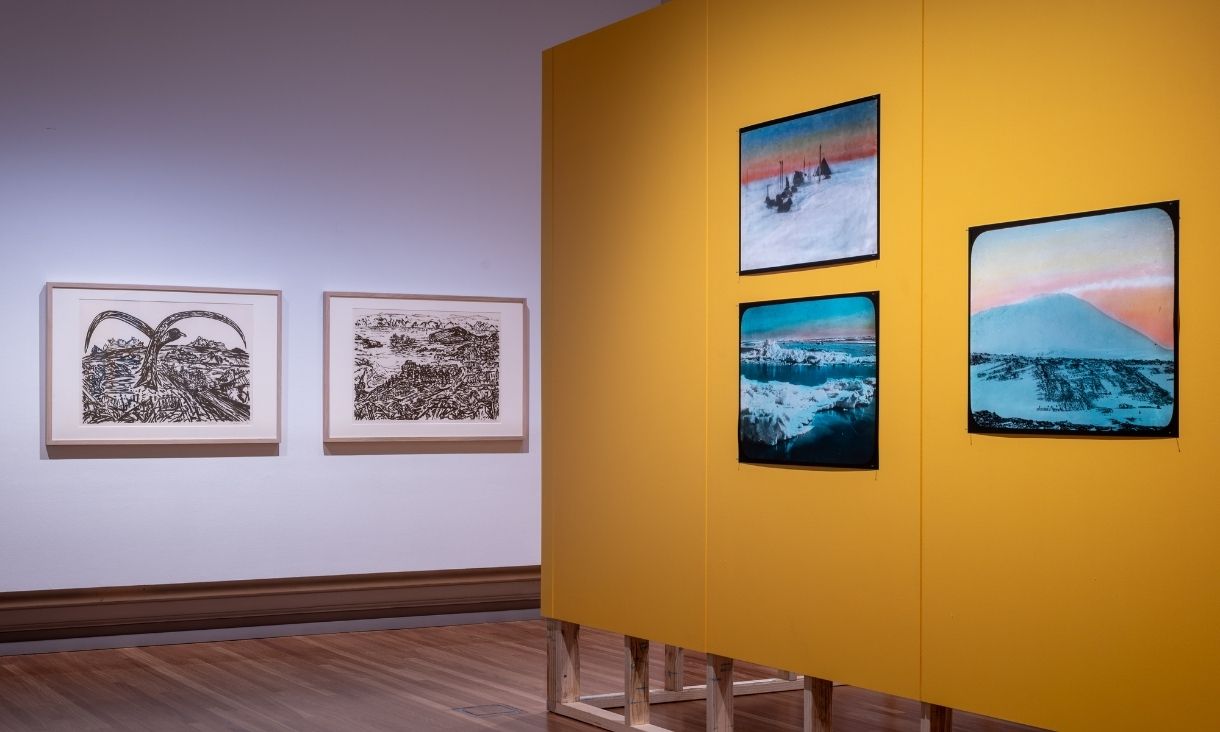
Installation view, Jan Senbergs (left) and Keith Jack (right), in 'Creative Antarctica: Australian Artists and Writers in the Far South, 2026, RMIT Gallery. Photo by Keelan O'Hehir.
Creative Antarctica: Australian Artists and Writers in the Far South is located across both RMIT Gallery and Design Hub and runs from Friday 20 February - Saturday 2 May 2026. Free entry, no registration required.
Artists include James Batchelor, David Bridie, Maria Buchner, David Burrows, Stephen Eastaugh, Lawrence English, Kirsten Haydon, William Hodges, Frank Hurley, Nicholas Hutcheson, Keith Jack, Leila Jeffreys, John Kelly, Janet Laurence, Nel Law, Phillip Law, Alison Lester, Sue Lovegrove, Bea Maddock, Douglas Mawson, John McCormick, Adam Nash, Miranda Nieboer, David Neilson, Sidney Nolan, Lin Onus, Charles Page, Judith Parrott, Christian Clare Robertson, Sally Robinson, Philip Samartzis, Jörg Schmeisser, Jan Senbergs, Polly Stanton, Charles Turnbull Harrisson, K. Verell, Martin Walch, and Sean Williams.
The exhibition is also accompanied by a wider public program, and features events, workshops and performances showcasing the vital role the arts play in documenting the Far South.
Eight Antarctic Anecdotes - Friday 20 February, 11:30am-5:00pm
FREE at RMIT Gallery | Design Hub Gallery
Join 8 Australian creative practitioners for a walkthrough of 'Creative Antarctica' and hear personal insights into how researchers, writers, sound and visual artists live and work on the ice.
Recording the Blizzard - Wednesday 25 February, 2:00-3:00pm
FREE at RMIT Black Box
'Recording the Blizzard' explores the challenges and creative possibilities of working with sound in Antarctica's most extreme conditions.
Air Pressure - Friday 27 February, 8:00pm
FREE at The Capitol
Encounter the continent through sonic field recordings and experimental performance by sound artist, researcher and three-time Australian Antarctic Arts Fellow, Professor Philip Samartzis, and Berlin-based experimental musician and artist, Michael Vorfeld. Supported by the City of Melbourne Arts Grants.
Into the White Abyss - Wednesday 18 March, 1:00-2:00pm
FREE at Design Hub Gallery
This presentation traces Philip Samartzis's long-term engagement with Antarctica through sound, listening, and fieldwork and reflects on the aesthetic, technical, and conceptual frameworks that underpin artistic practice in environments defined by scale, isolation, and sensory extremity.
The Thing (1982) - Thursday 19 March, 7:00- 9:00pm
$15 General Admission | $10 students
A screening of the iconic sci-fi thriller 'The Thing' (1982) on the big screen at Melbourne's most spectacular cinema.


