

Flinders University researchers and academics focused on improved aged care, curing deadly disease, expanding career horizons and saving whales have been acclaimed at this year's SA Science Excellence and Innovation Awards.
The State Government awards acknowledge leading academics and professionals working in STEMM (science, technology, engineering, mathematics and medicine), highlighting the importance of science, research and innovation to the development of industry and society as a whole.

Professor Maria Inacio, who leads the Registry of Senior Australians (ROSA) Research Centre at Flinders and SAHMRI, was named Mid-Career STEMM Professional of the Year.
 Professor Inacio and her large team are striving to improve the lives of older people by helping to shape how aged care is delivered across Australia. This involves using large‑scale data to understand how health and aged care systems work in real life, and how they can work better.
The ROSA national evidence platform can inform government reforms, including public star ratings for aged care services, safer use of medications, and greater support for older people to remain living at home.
The Flinders-based Motor Neurone Disease (MND) Clinical and Research Translation Team took out the prestigious Excellence in Collaborative Innovation Award.
 Associate Professor Mary-Louise Rogers, Associate Professor David Schultz, Dr Vinod Aiyappan, Professor Peter Catcheside and Ms Leanne Davis alongside a long line of other scientists, doctors and health professionals are working together to combine hospital care, research and patient advocacy to improve the lives of people and families affected by the disease.
The South Australian Motor Neurone Disease Clinical and Research Translational Team (SAMCARTT) has transformed how MND is managed in South Australia and informed international practice.
In the STEMM Educator of the Year - University/Registered Training Organisation category, three College of Science and Engineering academics were acknowledged.
Associate Professor David Hobbs, Dr Thomas Vincent and Dr Robert Trott, have helped deliver substantial benefits to students, industry, and the broader community through extended, credit-bearing industry placements across all STEMM disciplines.
The Flinders WIL program has helped more than 2,000 students complete immersive placements of up to five months, gaining real-world experience, professional skills and strong employment pathways.
The PhD Research Excellence award was presented to Dr Isabella Reeves, postdoctoral research associate in marine megafauna, from the College of Science and Engineering.
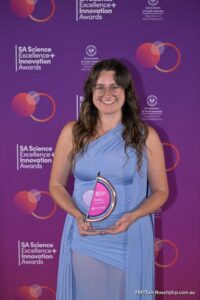 Dr Reeves' PhD advanced marine evolutionary ecology by clarifying how evolutionary history, population structure and foraging behaviour together shape predator ecology.
Through collaborative research incorporating First Nations knowledge alongside new genomic, forensic and nutritional approaches, the work moved beyond narrow case studies to deliver general insights into predator behaviour and ecosystem function.
Dr Samuel Tonkin, College of Science and Engineering research scientist, was also a PhD award finalist.
He is developing a low-cost, multi-use thermal imaging lens material at Flinders University. Its potential applications cover a range of uses including home fire detection, autonomous vehicles and consumer electronics.


