
Severe skeletal muscle injury, especially volumetric muscle loss, remains difficult to treat because effective regeneration requires safe, effective, and sustained intervention. Addressing this long-standing challenge, a research team led by Prof. BAI Shuo from the Institute of Process Engineering of the Chinese Academy of Sciences has pioneered a fully biodegradable, self-powered implantable electrical stimulation system designed to enhance muscle repair. The device operates independent of external power sources and does not compromise patient comfort.
The new muscle defect-electrical stimulation (MD-ES) system was reported in Cell Biomaterials on January 16.
MD-ES combines degradable materials and in situ electrical stimulation intervention to form a unified implantable strategy. It overcomes key limitations of conventional electrical stimulators-bulkiness, dependence on external power sources, and the need for a secondary surgical procedure to remove the device-which constrain long-term therapeutic outcomes and increase patient morbidity.
The system comprises two core components: a chitosan-polyvinyl alcohol (CS-PVA) composite piezoelectric film unit (PN) and a silk fibroin-based hydrogel scaffold that serves as both an electrical stimulator receiver and tissue engineering scaffold. This piezoelectric film can stably generate approximately 500 millivolts under mechanical stimulation. It maintains stable performance over 5,000 consecutive pressure cycles, ranking among the highest reported outputs for chitosan-based piezoelectric systems.
In the proposed design, the piezoelectric film unit is implanted subcutaneously near a joint where motion generates electrical signals, which are then transmitted to a conductive hydrogel scaffold at the site of muscle injury. This enables real-time in situ electrical stimulation of the defect area while simultaneously providing a supportive scaffold microenvironment. This design enhances myoblast proliferation and differentiation, thereby promoting muscle repair.
The researchers further optimized the device architecture to improve flexibility and output stability. At the same time, fully biodegradable encapsulation ensures that the entire system can be safely resorbed in vivo.
In a rat skeletal muscle injury model, the MD-ES system demonstrated potential for complete muscle recovery within two weeks and full degradation of the stimulator after approximately four weeks.
This work provides a new implantable strategy for muscle injury therapy by combining self-powered electrical stimulation with full biodegradability to reduce dependence on external power and avoid device removal surgery.
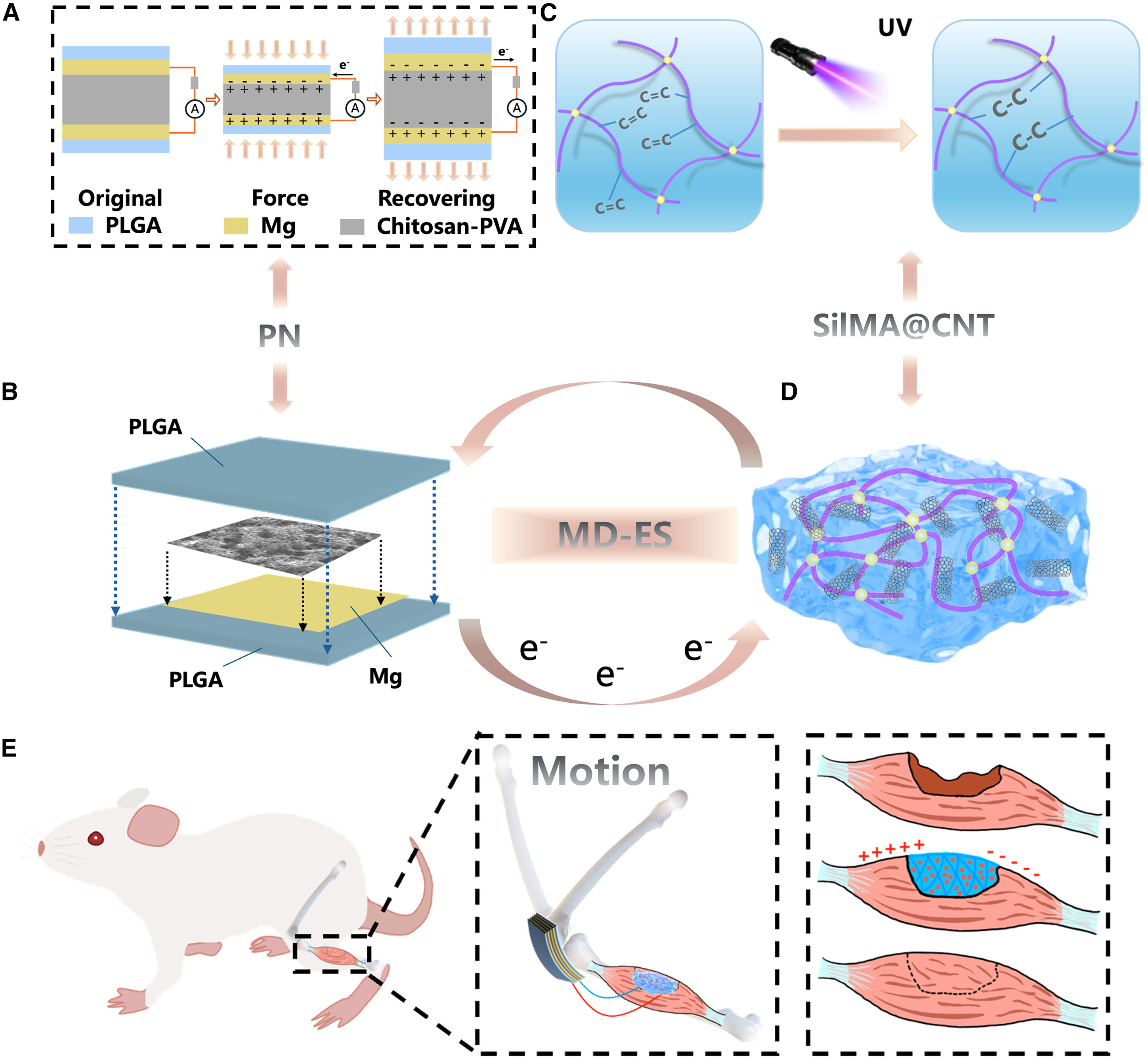
Schematic illustration of structural design and skeletal muscle repair application for MD-ES self-powered system (Image by LI Qi)


