
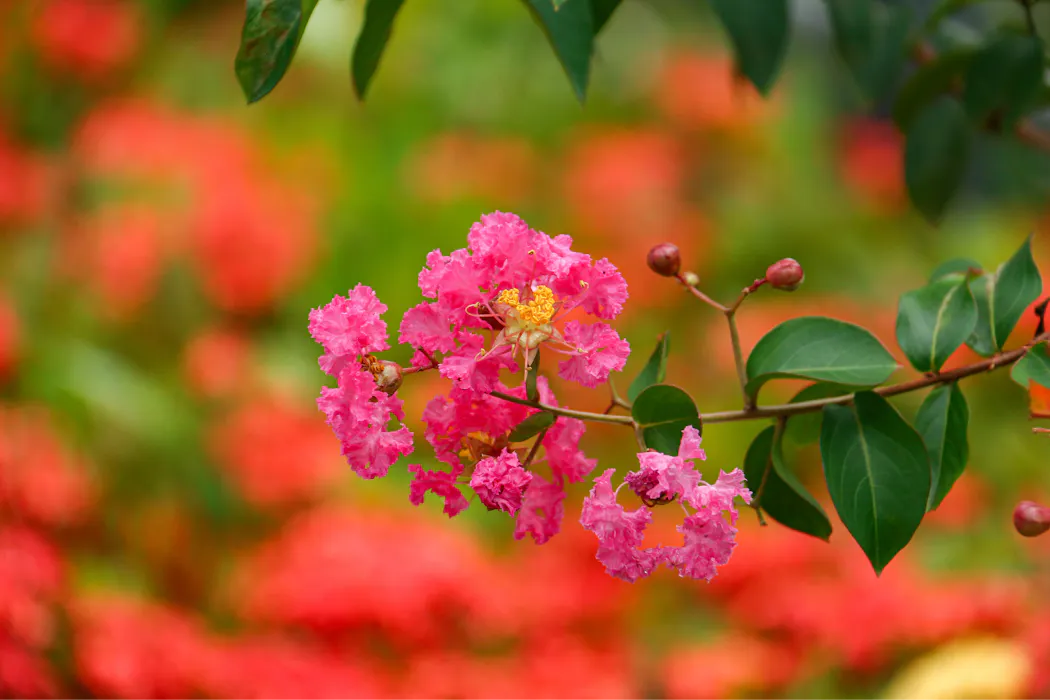
The crepe myrtle - a medium sized-tree often covered in an explosion of white, pink, purple or red flowers - lines many an Australian street. Lots of people love them but others think of them as an inadequate and over-planted species. Some even refer to them as " crap myrtle ", which is a little harsh.
Author
- Gregory Moore
Senior Research Associate, School of Agriculture, Food and Ecosystem Sciences, The University of Melbourne
In the right numbers, these small trees can be a good choice and do well in a small urban courtyard.
But perhaps large scale planting in urban streetscapes is not the best place for them - they can shed large volumes of flowers, which can get mushy and slippery as they decay.
Getting to know the crepe myrtle
Crepe myrtle is the common name for a number of Lagerstroemia species.
There are about 50 different species : one native to northern Australia .
That native, Lagerstroemia archeriana, is also known as the Queensland or native crepe myrtle; it's also just crepe myrtle to many.
It is a purple or pink flowering species found in Queensland and Western Australia, and occurs naturally in drier forests. It has been cultivated for a long time but tends to be better suited to northern Australia.
However, the specimen that most people are familiar with is Lagerstroemia indica , the common crepe myrtle - also known as crape myrtle or crapemyrtle.
The name crepe is thought to relate to the crinkled nature of the flower petals resembling a crêpe (a type of French pancake).
Lagerstroemia indica is a small tree up to about five metres in height, with lovely smooth, silver to coppery coloured bark. But it is best known for its impressive and abundant flowering in white, pink, purple or red.
In full flower and en masse, it's a stunner . It has been very widely planted in the streets of new urban developments where small blocks, large houses and narrow roads are de rigeuer.
However, Lagerstroemia indica can be prone to some fungal diseases like powdery mildew to which hybrid crepe myrtles are more resistant.
There are also hybrid crepe myrtles - usually a cross between Lagerstroemia indica and the Japanese crepe myrtle Lagerstroemia fauriei , which only produces white flowers.
These hybrids have the advantages of the more robust vigour, mottled bark and disease resistance of the Japanese species but retain the full colour range and magnificent flowering of Lagerstroemia indica. They also have great mottled bark - overall a magnificent combination .

A common street tree - but not always loved
Local governments love to plant crepe myrtle as a street tree - it's compact, boasts impressive flowers and reaches structural maturity in five to ten years. It tolerates a variety of soils and climates, lives for up to 100 years
However, these trees can look or feel a bit small in dense housing estates with big houses; they are just not large enough to give an appropriate sense of scale to this kind of streetscape.
Crepe myrtles also provide less shade and cooling than larger trees, and fewer habitats for organisms such as birds, insects and fungi. Apart from the native version, most crepe myrtle species provide little food source (for humans or animals).
Compared to elms, oaks or eucalypts, the crepe myrtle is a modestly-sized tree; there are no vaulted cathedral-like ceilings of branches with crepe myrtle.
In some places residents top or lop the trees to promote more prolific flowering. This treatment, which shortens the lifespan of trees, is known colloquiolly as crape murder and is not recommended in Australia.
And people often pile clippings high around the trunks, which can result in trunk damage from pest and diseases. It is better to mulch under trees (but don't let the clippings touch the trunk). You can prune young trees to shape their canopies for appearance.
Tree fashions come and go
Perhaps, to some people, the crepe myrtle just feels out of fashion.
Municipal horticulture has always had an element of fashion , even fads attached to it.
In the past there have been mass plantings of elms, palms, even southern conifers, and more recently of the ornamental pear (Pyrus calleryana) or Manchurian pear (Pyrus ussuriensis). There were doubts about the pears from the start given their history of weediness in the US . But now, despite some great spring flowering, they are going out of fashion and many people strongly dislike them .
Crepe myrtle seems to be on a similar trajectory to the pears. Despite some staunch support for this tree and its lovely flowers, they do not meet the long-term aspirations many people have for urban street trees. Some people fell out of love with them; others wanted them gone altogether.
They have their virtues
Despite the hate, crepe myrtles are likely to to be climate change hardy, as they tend to occur in hotter and drier regions of northern Australia and across Asia.
In the right place and in the right numbers, these small trees can be a good choice. They can look lovely in a garden or courtyard - but perhaps they are not the best pick for large scale planting in urban streetscapes.
In the longer term, only time will tell how successful crepe myrtle will be as street trees and in winning over the hearts and minds of residents.

Gregory Moore does not work for, consult, own shares in or receive funding from any company or organisation that would benefit from this article, and has disclosed no relevant affiliations beyond their academic appointment.


