
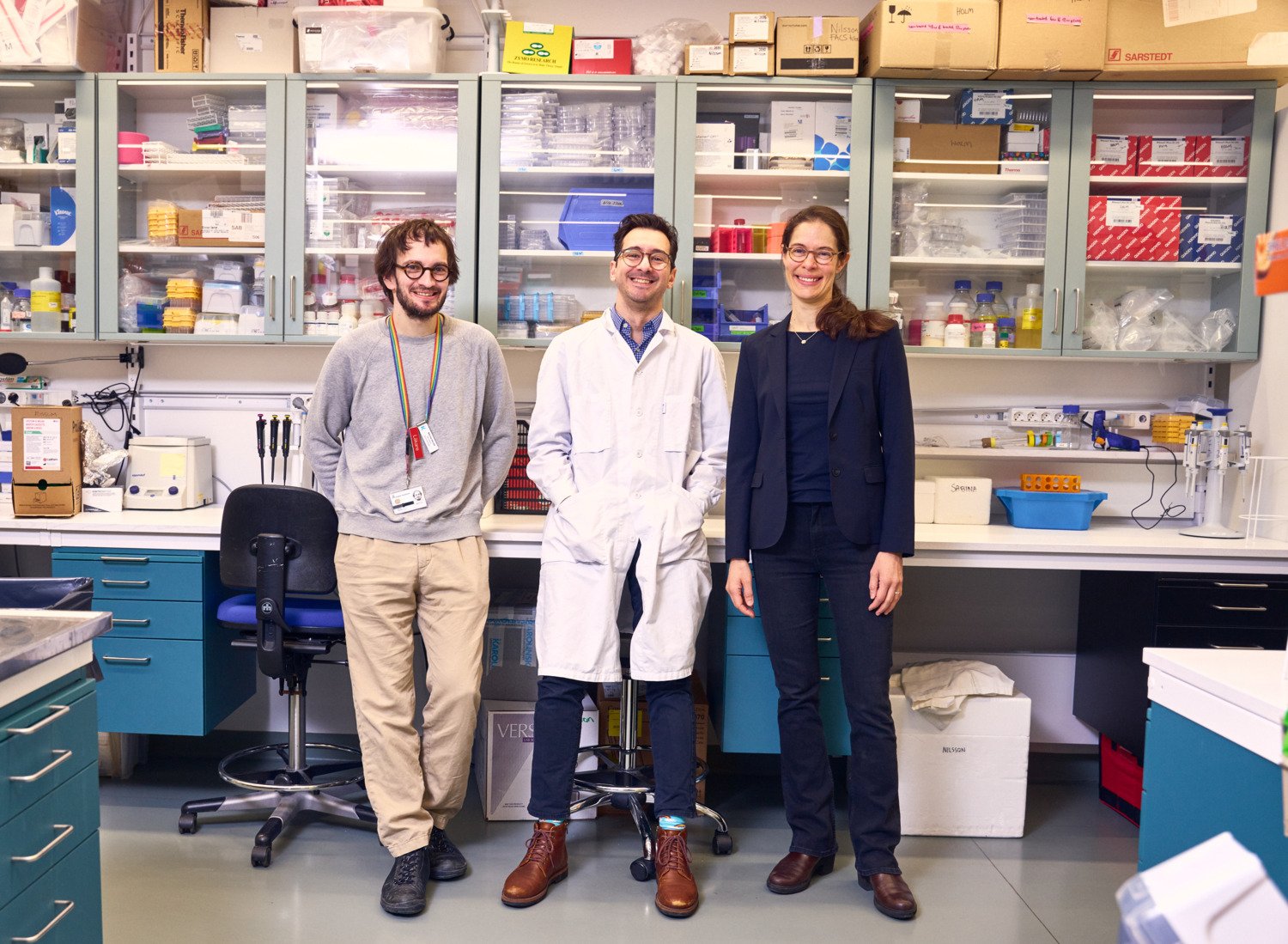
Clinical researchers Drs Hanna Brauner and Nikolas Herold appreciated collaborating as research leaders on equal terms, because it gives the best ideas the greatest room to flourish. Their project via Karolinska Institutet's research incubator has the potential to improve the treatment of skin (cutaneous) lymphoma.
Hanna Brauner is a dermatologist, Nikolas Herold a paediatrician, and both are interested in the biology of cancer. For both of them, it was a natural step to approach Karolinska Institutet's Research Incubator ( KIRI ).
"I was curious about this kind of complement to my normal everyday work - about not being so focused on my own question and being inspired and forging new connections outside the obvious fields," says Dr Hanna Brauner , docent at KI's Department of Medicine in Solna and dermatology at Karolinska University Hospital. "I wanted to be proactive in getting fresh impetus."
Nikolas Herold , docent at KI's Department of Women's and Children's Health and paediatric oncologist at Karolinska University Hospital, points out that most of his scientific achievements have only been possible through collaboration.
"Complex projects require a range of expertise, and besides, it's much more enjoyable working that way," he says. "So I was drawn to the idea of an incubator, of getting the opportunity to expose myself to different ideas and contacts without quite knowing where it will all lead."
"It didn't take long for us to realise that we could work well together," says Dr Brauner.
Experts who complement each other
Nikolas Herold believes that they complement each other well.
"My lab focuses on drugs and why they work for some patients but not others," he says. "We want to identify resistance factors that we can use as targets for future drug development. I have insight into immunological processes in tumours, but that's Hanna's speciality."
Hanna Brauner entered research immediately on obtaining her medical degree and earned her PhD on the kind of immune cells known as natural killer (NK) cells.
"I was interested in the part they play in inflammation of the skin. I've now broadened out to more clinical research and work with skin lymphoma, for which I'm patent manager here at Karolinska University Hospital."
Skin lymphoma onsets in cutaneous T cells and affects some 100 people in Sweden annually. The cancer in most of these patients is stable, but a quarter of them develop severe symptoms and are at a greater risk of dying.
"Little is still known about the disease, which is also hard to diagnose and which lacks effective treatments," says Dr Brauner.
The disease can be cured with stem-cell grafts but not all patients can take such a procedure.
"Palliative treatment helps only half of all patients," says Dr Brauner. "If I can use my professional expertise to make life easier for these patients, it would be worth a great deal."
In their project, they examined how the presence of an enzyme called SAMHD1 affects the immune cells in skin lymphoma. Dr Herold has been researching the enzyme for over a decade.
"The expression of the enzyme seems to change when the disease enters a more aggressive phase," he says.
Possible new therapies
The results are awaiting publication, but two principal findings offer new potential therapies. The immunological line concerns NK cells, which can usually "repel" lymphoma.
"The NK cells at the site turned out to be down-regulated, so a possible treatment would be to activate them locally," says Dr Brauner.
Cell cultures showed that combinations of existing drugs could circumvent the drug suppressive effect of SAMHD1.
"We found that, 'Wow, this drug makes SAMHD1 disappear!', which in turn makes the skin lymphoma more receptive to other medication," says Dr Herold.
The project gave results that they had neither predicted nor expected.
"Which is why they weren't in the project plan, but that's the exciting thing about research - getting findings you hadn't been counting on."
Dr Brauner agrees:
"Often, the results take you forward. You have to be prepared to re-evaluate what's most important and how everything's connected."
Lunchtime papers whirling
The pair have had to be creative in their meeting solutions, as they've been working at different places and as they're both researching clinicians. Dr Brauner mentions their productive lunchtime meetings.
"One of us was always in our doctor's gear and our postdoc would turn up with loads of printouts and diagrams...and we'd sit there discussing and taking notes while the papers whirled until one of us had to run back to their patients," she recalls.
Her advice is to make sure early on that entire research groups are able to meet up.
"We had lunch together and it was really great, with lots of discussions on the margins of the project," she continues. "We realised that there were synergies there and I wish that we'd brought the groups together sooner in the project."
Dr Herold says that the project has gone smoothly:
"Without KIRI, we'd never have been able to set up this collaboration, which has worked surprisingly well. We have slightly different ways of approaching things - Hanna's wise and thinks things through, whereas I can be very impulsive. It's a combination that has proved very productive."
"We bring different things to the table, both as people and as researchers," says Dr Brauner.
Both of them appreciated the equality of their shared leadership.
"Neither of us is in charge or is a junior partner, which better reflects how things are outside academia," says Dr Herold. "You have to argue your point, which means that the best ideas have the greatest chance of winning."
Dr Brauner agrees:
"We've had a frank and sincere discussion climate. We're super-experts in our respective fields and rather naïve about each other's, so we've questioned each other: 'What are you thinking? Why is that the obvious next step?' It's been highly instructive."
Valuable meetings at the faculty club
Dr Herold says that socialising within the KIRI network is also important.
"One shouldn't underestimate the value of meeting at the faculty club over a pizza and a glass of wine. It creates an environment that's conducive to conversation, be it on the difficulties of getting grants and private matters or about our research."
Dr Brauner is currently also sharing a doctoral student with KIRI Fellow Maria Kasper - "a nice little spin-off", as she puts it.
"KIRI isn't only about the postdoc project, even if it is a good initiative that makes people work a little harder on networking. It needs stating that there's other added value in coming together as different research fields and departments," she says.
Text: Lotta Fredholm
Translation: Neil Betteridge
KIRI in brief
• The Karolinska Institutet Research Incubator ( KIRI ) is a platform for young researchers to meet and forge interdisciplinary partnerships.
• KIRI was conceived in KI's Strategi 2030 steering document and was launched in 2022.
• Young researchers who are assistant professors (BUL) can apply to be a KIRI Fellow. In 2025, 20 international BUL positions were advertised, compared to the previous 8 to 10 a year.
• Two KIRI Fellows may apply for grants for a joint project, gaining access to a postdoc who works in both their laboratories.
• On 23 March 2026, the first cohort of KIRI Fellows celebrated concluding their four years on the programme.
• Since inception in 2022 and its intake of just over 30 Fellows, KIRI has grown to over 80 Fellows, 20 active postdocs and 28 different interdisciplinary research projects - some in the process of starting up, others concluded.


