
Having grown up in Ciudad Juárez, Chihuahua, just across the border from El Paso, Texas, Luisana Duarte Armendáriz '26 Ph.D. straddled the line between languages, cultures, and national borders
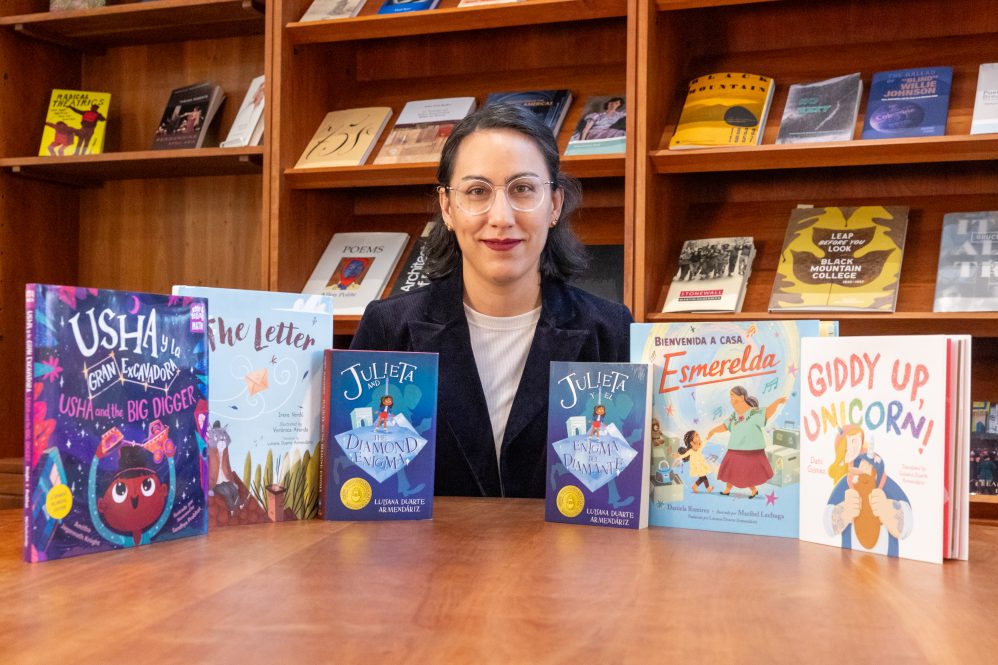
Luisana Duarte Armendariz '26 Ph.D. poses for a photo with her book, "Julieta and the Diamond Enigma" in both English and Spanish, as well as other children's books she has translated from Spanish to English in the Dodd Center for Human Rights on Tuesday, March 17, 2026. (Sydney Herdle/UConn Photo)
Like the main character of a good book, Luisana Duarte Armendáriz has a deep backstory, each turn casually worked into conversation when, and only when, it becomes pertinent to drop mention of things like dean of discipline at a boarding school.
 She doesn't open with graphic designer or multimedia journalist and won't even talk about the time she held in her hand an acceptance letter to medical school. Sure, her stint as a high school art teacher might come up, along with that year-long missionary trip to the Philippines.
But unless she's prodded, the doctoral candidate who's set to graduate in May, only mentions her past in relation to the present and to the future, as she reconciles the possibility, even opportunity, of yet another reinvention after defending her research this summer.

Duarte Armendáriz '26 Ph.D. takes to heart her grandfather's wisdom doled out whenever she and her 23 cousins - that's just on her mother's side – switched majors or pivoted professions: Take the lessons gained from each experience and transfer them to the next, never were they useless.
It's why this semester as the graduate assistant for the UConn English department's Creative Writing Program she delighted in using her graphic design skills to help create posters for Poetic Journeys.
And it's why her dissertation looking at the intersection of children's literature and translation studies is a natural fit.
Having grown up in Ciudad Juárez, Chihuahua, just across the border from El Paso, Texas, Duarte Armendáriz straddled the line between languages, cultures, and national borders, just as the young characters in her picture books and young adult novels stride their own stories.
Author, translator, and dog mom, that's what she is today, the order of which is situationally dependent.
Writing - Not Exclusive to Geniuses
"I cannot write creatively in Spanish, and that goes back to growing up on the border and having more access to entertainment in English. My creative language is in English," Duarte Armendáriz says. "I have compartments for different activities in the language that I do them in - like my love language is in English, but my cutesy language is in Spanish."
When she watched a colleague's young child last spring, she admits needing a few days to find a natural play language to communicate with the 6-year-old. With her nieces and nephews, play happens in Spanish not English, the same as her childhood, and she had to adjust.
Duarte Armendáriz says her own childhood was filled with books, her mother a frequent visitor of the library in El Paso with daughter in tow, her grandfather forever inquiring what book she had a nose in, her extended family as subjects of news reports in a paper she started at 8 years old.
Her "first crush," she says, was the detective Sherlock Holmes, it's why she learned to play the violin.
Yet, she says she didn't recognize writing as a potential career until she was nearly done with college. It was a profession for only geniuses she thought, until taking a creative writing class that focused on children's literature.
One might say she had an ah-ha moment, so when applying for master's programs she looked for one that would give her opportunity to bring to life the character that had been living in her head for some time.
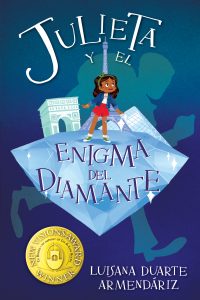
Simmons University in Boston paired her with an editor from Lee and Low Books to - in a single semester - write the first draft of "Julieta and The Diamond Enigma." Its sequel, "Julieta and The Cryptic Rose," will be released Sept. 15.
Both chapter books, they tell the story of young Julieta, "who's sort of a combination of Amelia Bedelia, Ramona Quimby, and Flavia de Luce," she says, as the girl solves mysteries that involve her art handler father and art restorer mother.
"I didn't know I was writing a mystery until my editor told me to put in more red herrings," Duarte Armendáriz says. "I had this idea that it was just going to be an adventure story of a girl who would travel to a lot of places. That was the original nugget of the story, and it was more like a fantasy adjacent story in my head. But then it started evolving."
Two deep revisions and four years later, "The Diamond Enigma" was published in June 2020. "The Cryptic Rose" has taken six years to produce, but in between a couple of pictures books have been in development, although not yet sold, and a Ph.D. program has been in progress.
"I've definitely incorporated stories from my own life and things that have happened to me," Duarte Armendáriz says, giving as an example, "My first name is a hard one, people have always mispronounced it, so I knew that English readers would see 'Julieta' as 'Juliette.' In the first pages of the first book, she says that her name sounds like the hooting of an owl. That was a piece of my life that I was able to incorporate."
Making a Story Accessible
Duarte Armendáriz once interned at the Massachusetts-based Charlesbridge Publishing, a stint during which she says she read through the "slush pile," or unsolicited submissions that were sent to the publisher without an agent as a go-between.
A mound capped with too many my-grandkids-and-me stories and sing-song rhymes that didn't quite hit the mark, she noted what worked and what didn't – because most submissions don't get a hardcover, let alone a soft one.
"Those stories, it's not that they didn't have value because they're the experience of someone, but there's still something in them that might not appeal to everyone," Duarte Armendáriz says. "The key is trying to make a story accessible and find a new angle that hasn't been done before, which is a hard thing."
Almost equally as hard for an author is letting go of their story, the characters and the world they invested time into building.
Upon completion of a story, Duarte Armendáriz explains, the next person to see it outside of the editors is the illustrator, a person deliberately kept out of the process until that point, a stranger to the author to allow for them to conceive the visual elements from the text the author provided.
"It's their interpretation of the world that I created," she says. "And even though it might be scary for writers, I really appreciate it because, for example, the cover illustrator of 'Julieta,' Olivia Aserr, put a bandage on her knee. That says so much about who she is and her personality. I would never have thought about adding it if I had drawn Julieta."
That one little detail made an impression, she notes, and could have changed the tone, meaning, and clarity of the story - something she, as a translator of children's literature, also keeps foremost in mind with the copy before her.
Translations Give Ideas for Ideas
Translating text from Spanish to English, or any language into any language, is not a word-for-word practice. Duarte Armendáriz describes it as "sense for sense. You want to give the idea for the idea."
A translator must answer many questions as they move through the process including whether to maintain the cultural references of a story or synthesize the ideas into something a foreign audience would understand. After all, an English-speaking audience may not understand the cultural nuances of a story originally written in Swedish for Swedes, she says as an example.
"When translating children's literature, you also have to think about changes in time, because what was allowed 20 years ago might not be as palatable today," Duarte Armendáriz says. "I created a ruckus in one of my translation classes, because in the beginning of a book I'm trying to translate, the mom is smoking a cigarette inside the house.
"It's not crucial to the story, and I can change it to something else that will keep the essence of what the cigarette was doing, so it will be a little easier on contemporary American audiences," she continues. "My professor was aghast, 'How could you take away the cigarette?' But I'm thinking about this as an industry. Who are the gatekeepers? The editors, the parents? Translation can be sense for sense, but you can also keep it foreign or make it domestic, depending on what the goal is."
She also needs to know who the intended reader is because, she notes, Mexican Spanish is different than Castilian Spanish and Cuban Spanish and even Mexican American Spanish in the U.S. Indeed, "pelota," "bola," and "balón" all mean "ball" in Spanish, just not to everyone who speaks Spanish.
Only a small percentage of foreign texts are translated into English for U.S. audiences each year, whereas other countries are more inclined to adapt English texts to their tongue, Duarte Armendáriz explains. That's not surprising, as translations are one way for a country without a literary culture to build one or enhance what's produced domestically.
"It's a way to get to know the world and have access to other experiences that otherwise you wouldn't have," she says of translated works, comparing them to Greek, Roman, or Asian art on display in a museum. "Books are just another representation of that art. It's another way of understanding the people around us."
Children Devour Every Word
Duarte Armendáriz has been learning origami lately and passes along a fluorescent pink frog. Her practice of the Japanese art of paper folding is in preparation for school visits this fall when "The Cryptic Rose" debuts.
Just how the frog fits in though, is about as cryptic as the meaning of the rose.
Usually, Duarte Armendáriz visits fourth and fifth grade classrooms, students who've built up to chapter books and have read all about Julieta. One Massachusetts school has designed a curriculum around the book.
Teachers there take the upper elementary school students to the Museum of Fine Arts in Boston where they hunt for treasures, in search of their favorite piece. Later, back in the classroom, Duarte Armendáriz visits to help them sort through what they found and gives them a writing prompt: How would they smuggle that piece out of the museum?
Create a distraction. Tuck it in an updo. Dip it in … oh, Duarte Armendáriz says she might incorporate that one into a future book. It's pretty clever.
"It's reinvigorating to go into classrooms and see that people actually read what I wrote because it's a few years from when I sat down to write until it's in the hands of the audience," she says. "And children pay attention to all the details. I have to reread very quickly before I go into a classroom, so I'm not saying, 'I wrote that? I don't remember writing that. It was just a plot point. I have no idea.' They want a reason for everything."
That's much the same as what she as a young girl would have expected from writer and illustrator Leo Lionni, a childhood favorite, or from the Hardy Boys, maybe her second and third girl crushes.
"Letting yourself be silly is something that I always appreciated and still appreciate in children's books," she says. "With Julieta, I try to imbue that in her. I laugh sometimes when I'm writing because I think, 'I would do that' or 'I wouldn't do that, but I would want to do that,' so I live vicariously through her. I really allow myself to play through writing, and that's something that's a through-line even in my own reading."


