

Gulam Manji, MD, PhD is leading clinical trials for daraxonrasib, the new therapy with unprecedented results, including nearly doubling pancreatic cancer survival rates.
A new targeted therapy for pancreatic cancer that was supported by research from Columbia is generating unprecedented excitement across the oncology community after results presented in the plenary session of the 2026 American Society of Clinical Oncology (ASCO) Annual Meeting showed the drug nearly doubled overall survival in patients with previously treated metastatic pancreatic cancer. The findings, which were simultaneously published in the New England Journal of Medicine, received a standing ovation from thousands of oncologists attending the meeting.
In the phase 3 RASolute 302 trial, patients who received the oral RAS(ON) inhibitor daraxonrasib had a median overall survival of 13.2 months, compared with 6.7 months for those receiving chemotherapy. The treatment also significantly improved progression-free survival and reduced the risk of death by 60%.
These results validate years of research and bring us closer to a future where more patients with pancreatic cancer have effective treatment options.
For a disease where treatment advances have historically been measured in weeks rather than months, the results represent one of the most significant breakthroughs in pancreatic cancer in decades.
The achievement builds on years of work by researchers, including Herbert Irving Comprehensive Cancer Center (HICCC) members Kenneth Olive, PhD, and Gulam Manji, MD, PhD.
From Columbia's mouse hospital to a global clinical trial

Kenneth Olive, PhD, led early research into KRAS inhibitors, including preclinical work for daraxonrasib.
Pancreatic cancer has long been considered one of the most difficult cancers to treat. More than 90% of pancreatic tumors are driven by mutations in the KRAS gene, yet for decades researchers were unable to effectively target the protein, leading many to label it "undruggable."
Daraxonrasib belongs to a new class of therapies known as RAS(ON) multi-selective inhibitors. Rather than targeting a single KRAS mutation, these drugs act like a molecular glue, enveloping RAS proteins and blocking the signals that drive many pancreatic cancers.
When Revolution Medicines developed the compound, the company partnered with Olive's lab to evaluate the drug in advanced mouse models of pancreatic cancer through their renowned "mouse hospital." The effort expanded across multiple institutions and culminated in a landmark 2024 Nature study.
The study demonstrated that daraxonrasib could selectively target pancreatic tumor cells while largely sparing normal tissues, helping address longstanding concerns that broadly targeting RAS proteins would prove too toxic for patients. The findings provided some of the strongest evidence to date that a broad RAS inhibitor could be both effective and tolerable, a critical step toward advancing the drug into later-stage clinical testing.
"By unleashing a consortium of scientists on this problem, we were able to examine active RAS inhibition in every major class of model for pancreatic cancer, and this inhibitor performed really well in all," Olive said when the collaboration began.
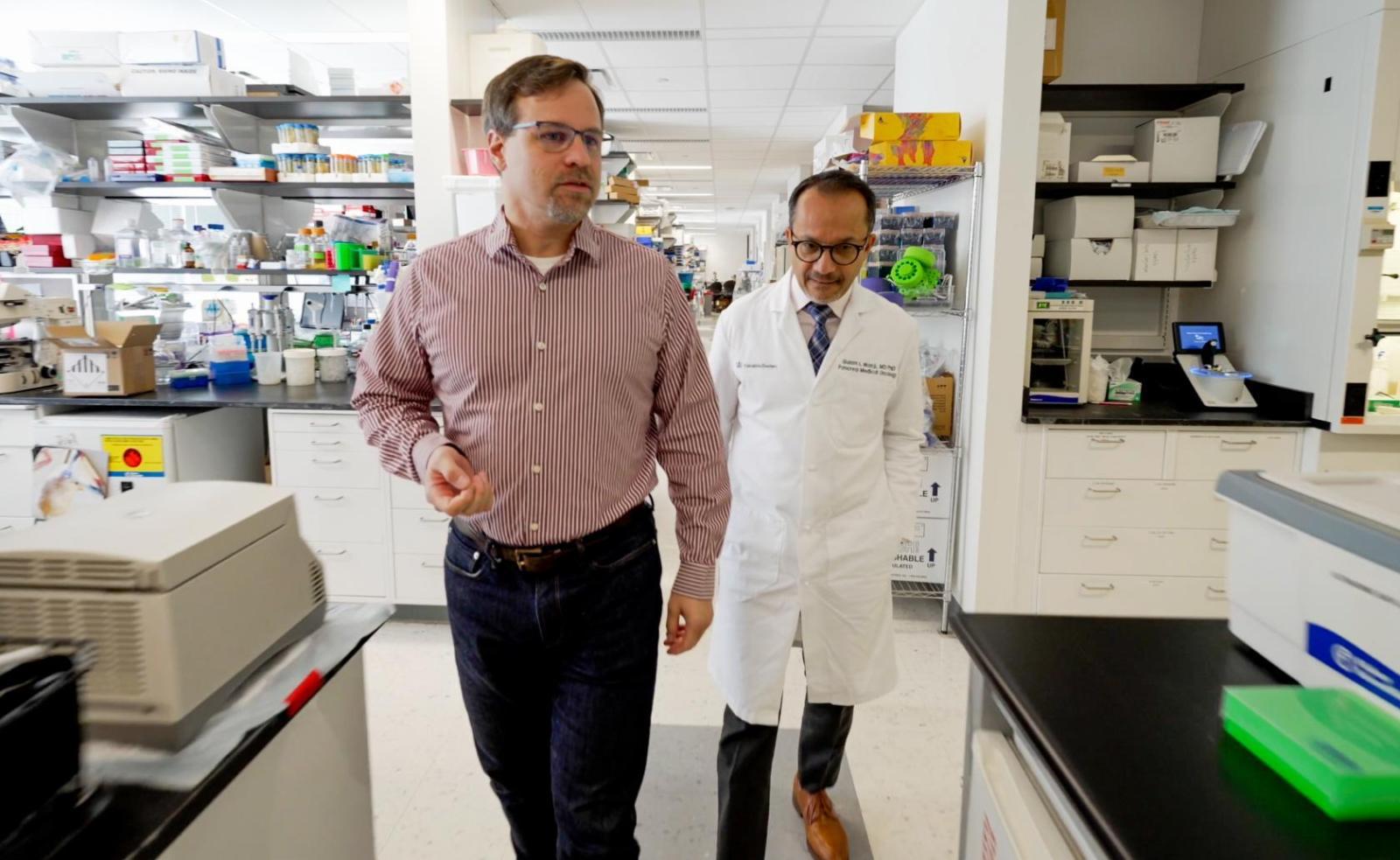
Based on Olive's findings, Gulam Manji (right) led the Phase 3 clinical trial for daraxonrasib at Columbia with unprecedented results.
From laboratory discovery to patient impact
A gastrointestinal medical oncologist and pancreatic cancer specialist at Columbia, Manji served as Columbia's principal investigator for the daraxonrasib trials and is a co-author of both the ASCO plenary presentation and the New England Journal of Medicine paper reporting the findings.
The latest findings suggest daraxonrasib may soon become a new standard of care for patients whose disease has progressed after first-line treatment. The therapy has already received both Fast Track and Breakthrough Therapy designations from the U.S. Food and Drug Administration, reflecting the urgent need for more effective treatments and the drug's potential demonstrated in earlier clinical studies. With positive phase 3 data now reported, the drug appears poised to move toward regulatory review and approval.
Researchers are already exploring how to build on the success of daraxonrasib. Columbia will participate in future studies evaluating daraxonrasib in combination with other targeted therapies. Manji sees the potential that these next-generation approaches to further improve outcomes and help overcome resistance that can emerge over time.
For patients with pancreatic cancer, the results represent the culmination of decades of effort to target one of cancer's most elusive drivers.
"Pancreatic cancer has long been one of the most difficult cancers to treat, and for many years we have seen only incremental progress," says Manji. "To see a therapy nearly double overall survival in a phase 3 study is remarkable. These results validate years of research and bring us closer to a future where more patients with pancreatic cancer have effective treatment options."


