Complex life began to develop earlier, and over a longer span of time, than previously believed, a groundbreaking new study has revealed. The research sheds new light on the conditions needed for early organisms to evolve and challenges several long-standing scientific theories in this area.
Published in the journal Nature, the research indicates that complex organisms evolved long before there were substantial levels of oxygen in the atmosphere, something which had previously been considered a prerequisite to the evolution of complex life. The study was led by the University of Bristol (UK), and features researchers from the Royal Netherlands Institute for Sea Research (NIOZ), the University of Bath (UK), and the Okinawa Institute of Science and Technology (Japan; OIST).
"The earth is approximately 4.5 billion years old, with the first microbial life forms appearing over 4 billion years ago. These organisms consisted of two groups - bacteria and the distinct but related archaea, collectively known as prokaryotes," said co-author Professor Anja Spang, from the Department of Microbiology & Biogeochemistry at NIOZ.
Prokaryotes were the only form of life on earth for hundreds of millions of years, until more complex eukaryotic cells including organisms such as algae, fungi, plants and animals evolved.
Professor Davide Pisani from School of Biological Sciences at the University of Bristol and co-author, said: "Previous ideas on how and when early prokaryotes transformed into complex eukaryotes has largely been in the realm of speculation. Estimates have spanned a billion years, as no intermediate forms exist and definitive fossil evidence has been lacking."
However, the collaborative research team has developed a new way of probing these questions, by extending on the 'molecular clocks' method which is used to estimate how long ago two species shared a common ancestor.
"The approach was two-fold: by collecting sequence data from hundreds of species and combining this with known fossil evidence, we were able to create a time-resolved tree of life. We could then apply this framework to better resolve the timing of historical events within individual gene families," said co-lead author Professor Tom Williams in the Department of Life Sciences at the University of Bath.
By collecting evidence from multiple gene families (more than a hundred in total) in multiple biological systems and focusing on the features which distinguish eukaryotes from prokaryotes, the team were able to begin to piece together the developmental pathway for complex life.
Surprisingly the researchers found evidence that the transition began almost 2.9 billion years ago - almost a billion years earlier than by some other estimates - suggesting that the nucleus and other internal structures appear to have evolved significantly before mitochondria. "The process of cumulative complexification took place over a much longer time period than previously thought," said co-author Professor Gergely Szöllősi, head of the Model-Based Evolutionary Genomics Unit at OIST. "This research builds on our collaboration with Profs. Williams and Spang aimed at developing novel ways to calibrate and use molecular clock methods. The results have again provided compelling evidence that has updated our understanding of early evolution."
The data meant the scientists have been able to reject some scenarios put forward for eukaryogenesis (the evolution of complex life), and their data did not neatly fit with any existing theory. Consequently, the team has proposed a new evidence-based scenario for the emergence of complex life they have called 'CALM' - Complex Archaeon, Late Mitochondrion.
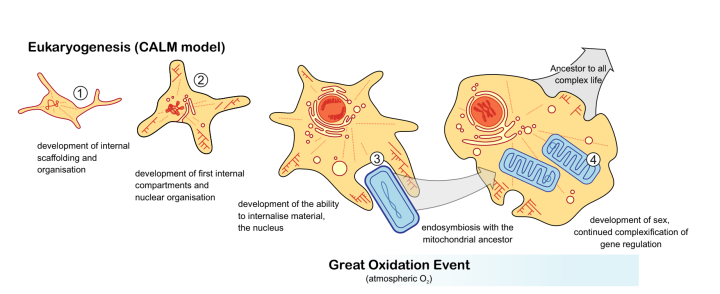
Lead author Dr. Christopher Kay, Research Associate in the School of Biological Sciences, said: "What sets this study apart is looking into detail about what these gene families actually do - and which proteins interact with which - all in absolute time. It has required the combination of a number of disciplines to do this: paleontology to inform the timeline, phylogenetics to create faithful and useful trees, and molecular biology to give these gene families a context. It was a big job."
"One of our most significant findings was that the mitochondria arose significantly later than expected. The timing coincides with the first substantial rise in atmospheric oxygen," said author Professor Philip Donoghue, School of Earth Sciences.
"This insight ties evolutionary biology directly to Earth's geochemical history. The archaeal ancestor of eukaryotes began evolving complex features roughly a billion years before oxygen became abundant, in oceans that were entirely anoxic."
Original press release issued by the University of Bristol, available here.